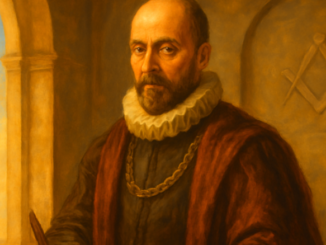
Square and compass symbolizing truth and integrity in Freemasonry
Content & Summary

Montaigne on Liars: Truth as the Foundation of Character

Have you ever considered what really happens when someone lies? Not just to the truth itself, but to the bond between people? In his ninth essay from the first book of his famous Essais, Michel de Montaigne tackles precisely this question. ‘On Liars’ is a compact yet powerful meditation on the nature of falsehood, the role of memory, and why sincerity forms the bedrock of every meaningful human relationship. Let’s explore the core of this timeless essay — and why it still matters, especially for those who value integrity and brotherhood. The Starting Point: A Poor Memory Montaigne opens his essay with a striking confession: he has an extraordinarily poor memory. This personal trait becomes the launching pad for his entire reflection on lying. He observes that people with weak memories are often suspected of being liars because they struggle to tell their stories consistently. Yet Montaigne turns this assumption on its head. Precisely because he knows his memory fails him, he has learned to always speak the truth. A liar, after all, needs an excellent memory to keep track of all his fabrications. This insight feels remarkably modern. Montaigne demonstrates that honesty is not merely a moral choice — […]

Masonic symbols representing the agnostic search for truth and meaning
Philosophy & Ethics

Agnosticism and Freemasonry: The Art of Not Knowing

What if the answer to life’s greatest questions isn’t a definitive yes or no, but an honest “I don’t know”? Agnosticism makes room for exactly that kind of intellectual humility. Far from being a position of weakness, it takes genuine courage to acknowledge that some truths may lie beyond our reach. In Freemasonry, we find a remarkable kinship with this philosophical stance — not as doctrine, but as a living practice of seeking without the pretense of final answers. What Does Agnosticism Actually Mean? The word “agnostic” has its roots in Greek: “a” means without, and “gnosis” means knowledge. An agnostic is, quite literally, someone who acknowledges that certain knowledge — particularly about the existence of a higher power or the ultimate purpose of the universe — may be fundamentally unattainable. This is not intellectual laziness. It is a deeply considered epistemological position. The agnostic doesn’t claim that truth doesn’t exist, but rather that we as human beings may lack the tools to fully grasp it. The term was first coined in the nineteenth century by the British biologist Thomas Henry Huxley, who grappled with the question of how we can truly know what we think we know. Since then, […]

Skull and hourglass as Masonic memento mori symbols on a dark background
Content & Summary

Montaigne on Feelings That Reach Beyond Ourselves

In the sixteenth century, a French nobleman wrote an essay that still challenges the way we think about death, fame, and the memory we leave behind. Michel de Montaigne explored, in the third essay of his first book, how human emotions stretch toward times and places we will never experience. Centuries later, his questions still resonate — perhaps nowhere more deeply than in the symbolic world of Freemasonry, where mortality and eternity stand as central themes of reflection and ritual. The Core Idea of the Essay Montaigne opens with a deceptively simple observation: we concern ourselves with matters that lie far beyond our own existence. We worry about our reputation after death, about what will happen to our bodies, about the memory we leave behind. But can we truly feel anything about events that take place when we no longer exist? This is the central paradox Montaigne investigates. He argues that our emotions extend into domains our consciousness can never reach — and he wonders whether this makes any sense at all. Historical Examples as Mirrors As is typical of his essays, Montaigne draws liberally from classical antiquity. He cites Roman generals and Greek philosophers who were intensely preoccupied with […]

A veiled figure in silent grief, symbolizing Montaigne's essay on sadness
Content & Summary

Montaigne on Grief: When Words Fall Short

There comes a moment when grief cuts so deep that it turns to silence. Tears refuse to fall, words catch in the throat, and what remains is a stillness that weighs more than any gesture. Michel de Montaigne explored this phenomenon in his brief but penetrating essay ‘On Sadness,’ the second chapter of his monumental Essays. He poses a question that resonates as powerfully today as it did in the sixteenth century: what happens when emotion exceeds the limits of expression? The Core Idea: Emotion Beyond Expression Montaigne opens his essay with a striking claim: he professes to be hardly susceptible to sadness himself. This is not an attempt at Stoic indifference but rather a runway toward his real subject. What fascinates him are those moments when grief becomes so overwhelming that the body simply cannot express it. Instead of releasing us, the sheer intensity of the emotion paralyzes us. This central insight illuminates a paradox most of us recognize: the most intense feelings sometimes manifest as total silence. A mother who loses her child may appear calm while others weep around her. Only later, when the initial shock begins to subside, do the tears come. Montaigne sees in this […]