A national team coach openly admits he hopes his greatest rival catches a cold before a crucial match. It sounds like a moment of weakness, but in truth it reveals something far deeper: the recognition of greatness in another person. This candid sporting confession raises an ancient question that has occupied humanity for centuries. How do we relate to those who surpass us? And what does history teach us about the art of acknowledging excellence without diminishing ourselves?
Chivalric Recognition in the Middle Ages
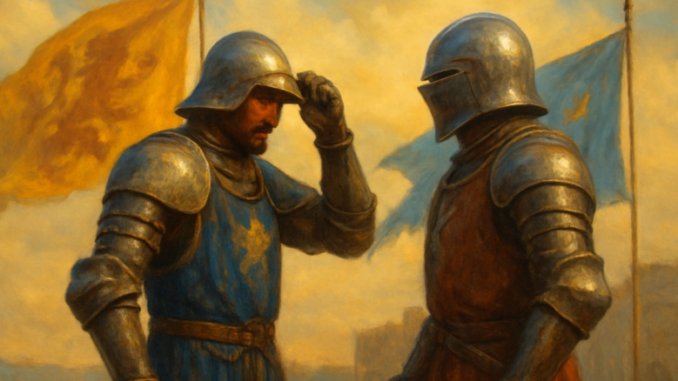
In the twelfth century, a remarkable tradition emerged at the courts of Europe. Knights who were about to face each other in tournaments would often speak words of praise about their opponent before the fight began. This was no empty courtesy — it was an essential part of the code of chivalry. The belief was simple yet profound: only a worthy enemy could make a worthy victory possible. A knight who belittled his opponent also diminished the value of his own potential triumph.
This attitude appears throughout medieval chronicles. Opponents were described with respect, their skills celebrated, their courage acknowledged. It was an era in which honor mattered more than merely winning. The paradox was clear: the greater the foe, the greater the glory in victory — and the more bearable the shame in defeat.
The Operative Lodges and Their Competitors
A strikingly similar dynamic played out in the medieval stonemasons’ lodges — the forerunners of today’s Masonic lodges. Different guilds of stonecutters often worked on the same cathedral, each responsible for a different section of the building. Although rivalry existed over craftsmanship and techniques, there was also a deep awareness of mutual dependence.
A master stonecutter who recognized the skill of a competitor did not do so out of weakness. It was a sign of wisdom. Only those who could see the excellence of others were truly capable of improving their own work. The operative lodges cultivated a culture in which admiration and ambition went hand in hand. Craftsmen learned from one another, even as they competed with each other.
The true master acknowledges the greatness of his rival, for in that acknowledgment he reveals the sharpness of his own eye.
Brotherhood Beyond Your Own Circle
What these historical examples share is an understanding of brotherhood that extends beyond one’s own group. In Freemasonry, brotherhood is often described as a bond between like-minded individuals, but the oldest traditions point to something broader. Brotherhood also means recognizing human worth in those who stand opposite us — including our rivals and adversaries.
The eighteenth-century lodges, born in an era of religious and political division, offered a space where men from vastly different backgrounds could meet as equals. This principle extended beyond the lodge walls. A true Freemason, it was taught, treated even his opponents with dignity. Not because he knew no struggle, but because he understood that conflict without respect leads to degradation.
The Fear That Connects
When a coach today openly expresses his apprehension about an extraordinary opponent, he stands in a long and honored tradition. It is a gesture of intellectual honesty. What he is really saying is: I see what this player is capable of, and I know we must give absolutely everything we have. That recognition is not surrender — it is a form of respect that elevates the contest itself.
In the lodge, we recognize this moment. When a Brother acknowledges the merits of another, even when that other person overshadows him, he demonstrates character. It takes courage to name greatness without being diminished by it. This ability — seeing light in others — is one of the subtler lessons that the Masonic ideal of brotherhood offers us.
Lessons for Today
What can we draw from all this for the present day? First, that rivalry and brotherhood are not mutually exclusive. On the contrary, the most fruitful rivalries arise where mutual respect forms the foundation. Second, that recognizing another person’s qualities is not a sign of weakness but a mark of self-knowledge. Those who can see the strength of their opponent also understand their own limitations.
Consider the key principles at work here: recognizing greatness in others enlarges your own field of vision. Rivalry without respect leads to bitterness. Brotherhood reaches further than your own circle. And fear of the other can, in its truest form, be an act of tribute.
The medieval knights, the stonecutters in their operative lodges, and the early Freemasons all understood that true strength reveals itself in the willingness to truly see the other. Not as an obstacle, but as a mirror. Not as an enemy, but as a fellow human being whose excellence challenges us to bring out the best in ourselves.
A coach’s confession about his fear of a brilliant opponent may bring a smile to our faces, but it touches on something essential. Brotherhood, in its deepest sense, is the capacity to recognize greatness wherever we encounter it. History teaches us that this attitude is not weakness but a form of strength that has united practitioners across disciplines for centuries. Whether on the tournament field, in the stonemason’s lodge, or on the sports pitch — whoever truly sees the other ultimately comes to see himself.
Copyright text & image: devrijmetselaar.nl
Texts are based on the ideas and content of the author of devrijmetselaar.nl, reviewed, corrected, and supplemented with the assistance of OpenAI. Images are created based on the ideas of the author of devrijmetselaar.nl using OpenAI/DALL-E.
Frequently Asked Questions
What does Freemasonry teach about dealing with rivals and competitors?
Freemasonry teaches that recognizing excellence in our rivals and adversaries is a sign of wisdom and strength, not weakness. This tradition traces back to medieval knights and stonemasons who understood that acknowledging a competitor's greatness actually elevates one's own achievements. True Masonic brotherhood extends beyond our own circle to include treating even our opponents with dignity and respect.
How did medieval stonemasons practice brotherhood while competing with each other?
Medieval operative lodges—the forerunners of modern Masonic lodges—cultivated a culture where craftsmen admired each other's skills while competing for recognition. Stonecutters understood that only by recognizing the excellence of their competitors could they improve their own work, creating a dynamic where admiration and ambition coexisted naturally.
Is Freemasonry only about brotherhood within the lodge?
No—Freemasonry's oldest traditions teach that brotherhood extends far beyond one's own group. The fraternity emphasizes recognizing human worth in all people, including those who oppose us, reflecting an understanding that true brotherhood means treating even adversaries with dignity and respect.
What can modern people learn from the chivalric code about handling competition?
The medieval chivalric code teaches us that acknowledging an opponent's greatness doesn't diminish our own victory—it enhances it. By recognizing the worth of those who surpass us or stand against us, we demonstrate the sharpness of our own judgment and reveal true character, a principle central to Masonic philosophy.

Be the first to comment