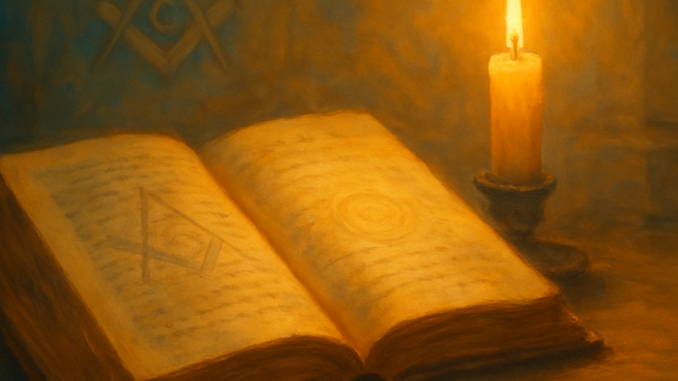
When the first speculative lodges opened their doors in the eighteenth century, the brethren developed a remarkable way of communicating. They did not speak directly about the things that moved them most deeply. Instead, they chose allusive language — a style in which meaning lies hidden behind images, references, and symbols. The allusive meaning of their words opened doors that direct speech would have left firmly shut. This article explores how this subtle art of allusion still forms the backbone of philosophical transmission within Freemasonry.
What Is Allusive Language?
To speak allusively means to hint, to reference without making something fully explicit. The word comes from the Latin alludere, meaning “to play upon” or “to touch lightly.” When someone speaks allusively, they approach a subject without spelling it out entirely. The listener must make the connection, fill in the missing piece, and complete the meaning. This is not a sign of vagueness — it is an act of trust in the intelligence and sensitivity of the person listening.
In the philosophical tradition, this kind of indirect speech has deep roots. Socrates asked questions rather than providing answers. The mystical poets of the Middle Ages wrapped their insights in allegory. Zen masters spoke in riddles designed to bypass the rational mind and reach the heart. All of these traditions understood that certain truths cannot be handed over directly — they can only be awakened within the receiver.
Allusive Meaning in Historical Lodge Rituals
When the first Grand Lodge was established in London in 1717, speculative Freemasons inherited a treasure trove of symbolic language from the operative stonemason guilds. The tools of the stonecutter became metaphors for spiritual labor. The square taught justice, the compasses taught temperance, and the rough ashlar represented the unrefined self. This was allusive language at its finest: meaning was never stated directly but always conveyed through an intermediary image.
This indirect way of teaching had practical advantages in times of religious and political persecution. But its true power ran deeper. By speaking allusively, the lodges compelled their members to participate actively in the learning process. Those who simply receive direct instruction absorb knowledge passively. Those who must forge the connection between image and meaning for themselves transform knowledge into genuine insight.
The truth you discover for yourself burns brighter than the truth you are merely told.
Allusion as a Philosophical Method
The choice to speak allusively is more than a stylistic preference. It is a philosophical stance on the nature of knowledge and its transmission. Freemasonry operates on the principle that life’s most important lessons cannot be captured in words alone. How do you explain love to someone who has never loved? How do you describe the taste of honey to someone who has only ever known salt? Some truths can only be experienced, not explained.
This is where the power of allusion reveals itself. By hinting at what is meant rather than stating it outright, the speaker creates a space in which the listener can bring their own experience to the table. The symbol becomes a mirror. The figurative language becomes an invitation to self-examination. What emerges is not a one-way transfer from teacher to student, but a dialogue between equals searching for meaning together.
The Three Levels of Allusive Transmission
Masonic allusion operates on three distinct levels. The first is the literal level: the concrete image, story, or narrative that is presented. A rough stone is simply a rough stone. A builder’s tool is simply a tool. At this level, everything is tangible and accessible.
The second is the allegorical level: the moral or philosophical lesson concealed behind the image. The rough stone becomes a representation of the human being who has not yet begun the work of self-improvement. The builder’s tool becomes a guide for ethical conduct.
The third, and perhaps most profound, is the personal level: the unique meaning that each individual discovers for themselves. No two Masons will find exactly the same lesson in the same symbol, because no two people carry the same life experience into the lodge. This is not a flaw in the system — it is its greatest strength.
From Past to Present: Allusive Speech in Our Time
In an era of instant communication, rapid-fire news cycles, and social media that demands explicit positions, allusive language can seem old-fashioned. Yet the opposite is true. In a world full of noise and snap judgments, the art of allusion offers a powerful counterbalance. It invites us to slow down, to reflect, to tolerate ambiguity rather than rushing toward certainty.
The modern lodge preserves this tradition not out of nostalgic conservatism but out of philosophical conviction. Learning to speak allusively teaches you to listen allusively as well. And those who can listen for allusion develop a sensitivity to the unspoken meanings that flow through every human interaction. This is not an academic skill — it is a life art that deepens relationships and enlarges self-knowledge.
The Lesson for Today
What can we take from this centuries-old practice? Perhaps this: that the most valuable knowledge cannot always be transferred directly. That there is wisdom in not saying everything. That we honor others more by inviting them toward their own discovery than by overwhelming them with ready-made answers. The allusive speech of Freemasonry reminds us that meaning is not a product to be delivered — it is a process to be lived through together.
The significance of allusive language reaches far beyond linguistic curiosity. It touches the very core of how we learn, grow, and meet one another in the mystery of existence. The brethren who developed this art understood that the greatest truths cannot be spoken outright — they can only be touched upon, gestured toward, alluded to. Allusive speech invites us to build the bridge ourselves, to make the connection, to complete the meaning. And therein lies perhaps the deepest lesson of all: that we are not mere recipients of wisdom, but participants in its unfolding.
Copyright text & image: devrijmetselaar.nl
Texts are based on the ideas and content of the author of devrijmetselaar.nl, reviewed, corrected, and supplemented with the assistance of OpenAI. Images are created based on the ideas of the author of devrijmetselaar.nl using OpenAI/DALL-E.
Frequently Asked Questions
Why do Freemasons use symbolic and allusive language instead of speaking directly?
Allusive language invites members to actively participate in their own learning journey, transforming passive knowledge into genuine personal insight. By hinting at meaning rather than stating it directly, Freemasonry honors the intelligence of its members and allows deeper truths to be awakened from within. This method also has historical roots in protecting the craft during times of persecution, while serving the timeless principle that life's most important lessons cannot be fully captured in words alone.
What is the difference between allusive speech and being unclear or vague?
Allusive speech is a deliberate and respectful art form that trusts the listener's intelligence and sensitivity to make meaningful connections, whereas vagueness simply lacks clarity. In Freemasonry, allusion uses carefully chosen symbols, images, and references—like the square representing justice or the compass representing temperance—that have profound and intentional meanings. Allusion is precise in its indirectness; it guides the seeker toward truth rather than obscuring it.
How does allusive language help preserve Masonic teachings?
By encoding wisdom in symbols and allegories rather than explicit statements, allusive language allows Masonic truths to transcend time, culture, and language barriers. Members must engage deeply with the material to understand it, which strengthens retention and personal transformation. This method has successfully preserved the philosophical traditions of Freemasonry for over three centuries while remaining relevant to each new generation of seekers.
Is allusive language used in Masonic rituals and if so, why?
Yes, allusive language is fundamental to Masonic rituals, where the tools of the stonemason are transformed into metaphors for spiritual development and self-improvement. This approach allows candidates to experience the lessons experientially rather than merely hearing them, creating a more profound and lasting impact on their understanding. The ritualistic use of allusion compels active participation, making each member a co-creator of their own enlightenment within the lodge.
Can someone understand Freemasonry without understanding allusive speech?
While it's possible to learn about Freemasonry on a surface level without fully grasping allusive language, true understanding of the craft's deeper philosophical teachings requires engaging with its symbolic and allusive traditions. Fortunately, Masonic education and mentorship within the lodge help members gradually develop the ability to interpret and appreciate this subtle art of communication. This journey of learning to think allusively is itself part of the transformative experience that Freemasonry offers.


Be the first to comment