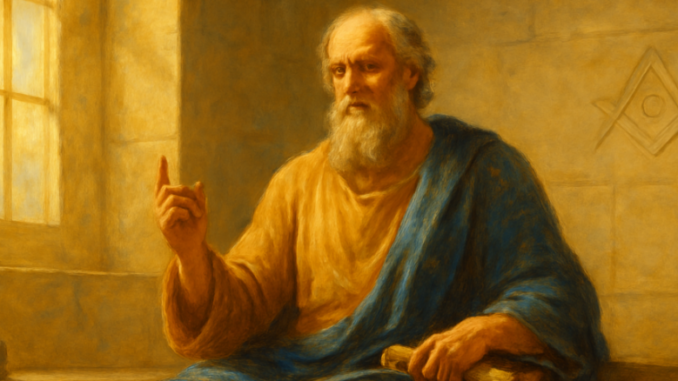
In fifth-century Athens, a young aristocrat named Meno posed a question that philosophers have grappled with ever since: can virtue be taught, or is it an innate quality? Plato recorded this exchange in a dialogue that not only explores the foundations of ethics but also introduces a revolutionary theory of knowledge. The Meno remains one of the most accessible yet profoundly deep works in Western philosophy — a text that compels us to reflect on what we truly know and how we can become better people. For those on the Masonic path, where self-improvement and the pursuit of wisdom stand at the very heart of the Craft, this ancient dialogue holds remarkable resonance.
The Central Question of the Dialogue
The Meno opens with a direct and seemingly simple question from its title character to Socrates: is virtue something that can be taught, does it come through practice, or is it naturally present in human beings? True to his method, Socrates refuses to answer the question before first establishing what virtue actually is. This leads to an inquiry characteristic of Plato’s early dialogues — the dismantling of false certainties to create space for genuine understanding.
Meno makes several attempts at a definition. He offers examples: the virtue of a man lies in governing the state, that of a woman in managing the household, that of a child in obedience. Socrates points out that this is not a definition but merely a catalogue. What is the common quality that makes all these different activities expressions of the same virtue? The conversation reveals just how difficult it is to truly grasp universal concepts — a challenge that anyone who has worked through Masonic degrees will recognize intimately.
The Paradox of Learning
When the inquiry reaches an impasse, Meno articulates what has become known as the paradox of learning. How can we search for something we do not know? If we already know it, there is no need to search. If we do not know it, how will we recognize what to look for, or know when we have found it? This is not a rhetorical trick but a fundamental challenge to the very possibility of acquiring knowledge.
Socrates responds with his famous theory of recollection. The soul, he argues, is immortal and has already beheld all things in previous existences. What we call learning is actually remembering. The soul already carries truth within it; inquiry simply awakens this dormant knowledge. This idea — that wisdom lies hidden within and must be drawn out rather than poured in — mirrors one of the most enduring principles in Freemasonry: that the rough ashlar already contains the perfect stone, waiting to be revealed through careful work.
The Conversation with the Slave
To demonstrate this theory, Socrates calls over an uneducated slave boy and presents him with a geometric problem: how do you double the area of a square? By asking questions alone — without giving any direct instruction — Socrates guides the boy step by step toward the correct answer. The young man discovers that the diagonal of the original square forms the side of the doubled square.
True knowledge lies hidden within the soul and can be awakened through the right questions — it cannot be poured in from outside.
This famous passage demonstrates that the slave did not receive the solution from Socrates but drew it from within himself. The knowledge was already there; it simply needed to be liberated. This demonstration has inspired philosophers and educators for centuries. It suggests that education is not the filling of an empty vessel but the lighting of a flame — a metaphor that speaks powerfully to the Masonic experience of initiation and gradual illumination.
Virtue, Knowledge, and Right Opinion
After this interlude, the conversation returns to the original question. If virtue is knowledge, then it can be taught. But are there teachers of virtue? Socrates and Meno examine the great statesmen of Athens — Themistocles, Aristides, Pericles. All were virtuous men, yet none of them succeeded in imparting the same virtue to their sons. This suggests that virtue is not transmitted through conventional teaching.
Plato introduces here a subtle but crucial distinction between knowledge and right opinion. Both can lead to correct action, but only knowledge is permanently anchored. A right opinion, Socrates explains, is like the statues of Daedalus: beautiful but inclined to run away unless they are tied down. Knowledge is right opinion secured by reasoning and an understanding of causes. For the Freemason, this distinction carries deep significance. Ritual and symbol may point us toward truth, but only through reflection and understanding do those truths become genuinely our own.
A Provisional Conclusion
The dialogue ends without a definitive answer — a hallmark of Plato’s early works. Socrates tentatively concludes that if virtue does not come through teaching, it may be a divine gift, bestowed upon certain individuals without their understanding why. This might seem a modest conclusion after such extensive inquiry, but therein lies the very wisdom of the Meno.
The most important lesson is not the answer but the process. Through the conversation, we become aware of our own ignorance — the essential first step toward genuine insight. Meno began with the certainty that he knew what virtue was; he ends with the realization that he must investigate further. That transformation is itself a form of moral progress, and it echoes the Masonic journey from darkness to light.
The Core Themes Brought Together
The Meno weaves several major themes into a coherent whole. It addresses the teachability of virtue and the broader question of moral education. It confronts the paradox of learning and offers the theory of recollection as a solution. It establishes the epistemological distinction between knowledge and right opinion. And it demonstrates the Socratic method as a path toward self-knowledge and wisdom.
The work stands at the crossroads of ethics and epistemology. Plato shows that we cannot determine how virtue is acquired without first understanding what virtue is — and we cannot understand what knowledge is without reflecting on how we obtain it. This interweaving makes the Meno a pivotal text in Plato’s intellectual development, foreshadowing the mature dialogues in which his Theory of Forms is fully articulated.
More than two thousand years after it was written, the Meno remains a compelling invitation to self-examination. Plato’s message is timeless: true knowledge cannot be imposed from the outside but must be awakened from within. The conversation between Socrates and the young Meno reminds us that the search for wisdom begins with acknowledging our own limitations. Those who dare to question what they think they know open the door to deeper understanding and a more virtuous life — a principle that lies at the very foundation of the Masonic journey toward light.
Copyright text & image: devrijmetselaar.nl
Texts are based on the ideas and content of the author of devrijmetselaar.nl, reviewed, corrected, and supplemented with the assistance of OpenAI. Images are created based on the ideas of the author of devrijmetselaar.nl using OpenAI/DALL-E.
Frequently Asked Questions
What is the main question Plato explores in the Meno dialogue?
The central question of the Meno is whether virtue can be taught, comes through practice, or is an innate quality naturally present in human beings. Socrates uses this inquiry to help Meno understand that true knowledge requires first establishing what virtue actually is, rather than simply listing examples.
What is the paradox of learning that Meno presents?
The paradox of learning questions how we can search for something we do not know. If we already know it, there is no need to search; if we don't know it, how will we recognize it or know when we've found it? This fundamental challenge addresses the very possibility of acquiring knowledge.
How does Socrates resolve the paradox of learning with his theory of recollection?
Socrates responds that the soul is immortal and has already beheld all things in previous existences. What we call learning is actually remembering—the soul already carries truth within it, and inquiry simply awakens this dormant knowledge that lies hidden within us.

Be the first to comment