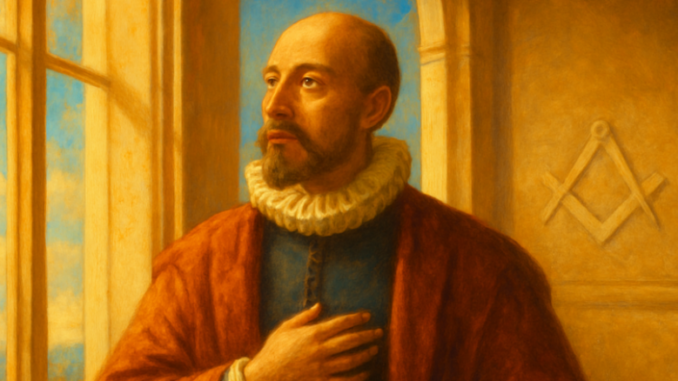
Imagine you are about to have a difficult conversation. Perhaps it involves a conflict, a business deal, or a personal matter that has been simmering for too long. You feel the tension, the uncertainty about the outcome, and somewhere beneath it all, the vulnerability of the moment. Michel de Montaigne, the sixteenth-century philosopher celebrated for his deeply personal essays, wrote about precisely these kinds of moments. In his essay ‘That the Hour of Negotiation Is Dangerous,’ he examines why the period of deliberation can be so perilous — and what it demands of our integrity. His insights connect in surprising ways to values that lie at the very heart of Freemasonry.
The Vulnerable In-Between
In this essay, Montaigne describes how the period of negotiation represents a uniquely dangerous phase. Not because conversations themselves are harmful, but because during this interim the usual rules seem temporarily suspended. Opposing parties come together under a flag of provisional peace. There is no agreement yet, but open hostility has ceased. Within that apparent calm lies the real danger: trust can be exploited, words can be twisted, and anyone who lets down their guard may pay a heavy price.
Montaigne draws on historical examples of leaders who were ambushed or deceived during negotiations. The lesson he extracts is not cynical but realistic: be aware of the vulnerability that arises when you open yourself to the other side. That awareness is not a sign of distrust — it is a sign of wisdom.
Trust as a Foundation
What does any of this have to do with Freemasonry? More than you might expect. Trust is central to life in the Lodge. Brethren gather in a space where openness is encouraged and where members are allowed to show vulnerability. This is only possible when a shared foundation of honesty and mutual respect exists. Masonic rituals and symbols serve to affirm and strengthen that trust, time and again.
Montaigne‘s warning about the dangers of negotiation serves as a powerful reminder of how precious and fragile trust truly is. It must be earned, maintained, and protected. Anyone who enters a Lodge understands that the promises of discretion and brotherly fidelity are not empty words — they are the prerequisites for genuine connection.
Honesty in Dialogue
Another thread running through Montaigne’s essay is the question of honesty. Negotiation can easily devolve into a game of cunning, where the most skillful deceiver wins. Montaigne rejects this outright. He advocates for an attitude of sincerity, even when it appears tactically disadvantageous. A man of honour, he suggests, holds to his word — especially during uncertain hours.
The true measure of a person reveals itself not in times of ease, but in moments of uncertainty and trial.
This resonates deeply with Masonic ethics. The search for truth — one of the brotherhood’s core values — is not limited to philosophical or spiritual knowledge. It extends to personal integrity in everyday life. Are you the same person behind closed doors as you are in public? Do you keep your word, even when no one is watching?
The Art of Listening
Negotiation demands not only the ability to speak, but above all the ability to listen. Montaigne was a masterful observer of human behaviour, and his essays reveal a profound curiosity about the motivations of others. In any negotiation, this skill is indispensable: someone who only speaks but never listens will miss signals, nuances, and opportunities for genuine understanding.
In Freemasonry, silence is cherished as a form of wisdom. The Entered Apprentice first learns to be silent and to observe before being permitted to speak. This is not suppression — it is an exercise in receptivity. Only those who truly listen can understand the other and arrive at a deeper connection.
Brotherhood in Times of Tension
At its core, Montaigne’s essay is about how people relate to one another in moments of tension and uncertainty. That is precisely where brotherhood proves its worth. It is easy to be cordial when everything is going well. The real test comes when interests collide, when misunderstandings loom, and when the temptation to distrust the other is strongest.
Brotherhood asks us to give the benefit of the doubt. It asks us to search for common ground, even amid disagreement. It asks for the courage to remain vulnerable, even when that carries risk.
Freemasonry provides a training ground for these very skills. In the Lodge, people meet who might otherwise find themselves on opposite sides in daily life. The shared rituals and symbols create a framework in which practising brotherhood becomes possible — even when it is difficult.
Inner Growth Through Reflection
What Montaigne ultimately teaches us is that negotiation is not merely an external activity — it is also an inner process. How do you deal with your own fears, your desire for control, your instinct toward distrust? The ‘dangerous hours’ are not dangerous solely because of the other party, but also because of what they expose within ourselves.
Freemasons will recognise in this the path of self-reflection and inner growth. The rough ashlar that must be shaped into a perfect cube is a powerful symbol for this process. We are all imperfect, but through honest self-examination and sustained effort, we can move ever closer to our better nature.
Montaigne’s essay on the dangers of negotiation is far more than a historical caution. It is an invitation to reflect on how we relate to others in moments of vulnerability. Freemasonry offers a path that poses the same essential questions: Are you honest, even when honesty is hard? Can you both give and receive trust? Are you willing to listen before you speak? These are not questions with easy answers — but they are the questions that shape us into better men.
Copyright text & image: devrijmetselaar.nl
Texts are based on the ideas and content of the author of devrijmetselaar.nl, reviewed, corrected, and supplemented with the assistance of OpenAI. Images are created based on the ideas of the author of devrijmetselaar.nl using OpenAI/DALL-E.
Frequently Asked Questions
How does Montaigne's philosophy on negotiation relate to Freemasonry?
Montaigne's emphasis on maintaining honesty and integrity during vulnerable moments of negotiation directly mirrors core Masonic values of trust, truthfulness, and brotherly fidelity. Both emphasize that genuine connection and respect can only flourish when members commit to sincerity and discretion, even when it might seem disadvantageous. This shared philosophy strengthens the bonds between Brethren within the Lodge.
Why is trust so important in Freemasonry?
Trust forms the essential foundation that allows Masons to gather in openness and show vulnerability within the Lodge. Masonic rituals, symbols, and oaths continuously affirm and strengthen this mutual trust among Brethren. Without this carefully maintained trust, the authentic brotherhood and genuine connection that Freemasonry promotes would not be possible.
What does Montaigne teach us about honesty during difficult conversations?
Montaigne advocates that a person of honor maintains sincerity and integrity even during uncertain negotiations, rather than resorting to cunning or deception. He teaches that true character is revealed not in times of ease but during moments of trial and uncertainty. This principle of unwavering honesty is central to how Freemasons conduct themselves in the Lodge and beyond.
How do Masonic values help members navigate vulnerable moments?
Freemasonry cultivates an environment where members understand that honesty, discretion, and mutual respect are not merely ideals but sacred commitments. By grounding themselves in these Masonic principles—similar to Montaigne's wisdom—Brethren are better equipped to approach difficult conversations and negotiations with integrity and awareness. The Lodge provides both the ethical framework and supportive community needed to maintain these values during uncertain hours.


Be the first to comment