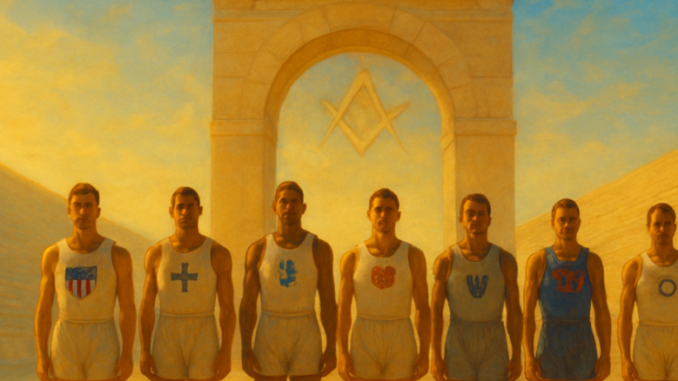
In 1896, athletes from thirteen different nations gathered in Athens for the first modern Olympic Games. Among them were men whose homelands had regarded each other as enemies just fifty years earlier. Yet there they stood, shoulder to shoulder on the field of play, united by a competition that transcended borders. Today, as international football matches once again bring political tensions to the surface, it is worth looking back at how sport has both united and divided throughout history — and what this teaches us about the deeply human yearning for brotherhood.
The Olympic Ideal and Its Masonic Roots
Few people realize that the revival of the Olympic Games was closely linked to ideals that were also cherished in Masonic lodges. The nineteenth-century movement that gave rise to the modern Games was steeped in universalist principles: the conviction that all people, regardless of origin or nationality, are capable of nobility and fair competition. This philosophy mirrors the Masonic ideal of the chain of brotherhood, in which men from vastly different backgrounds meet as equals.
The first international sporting competitions emerged in the eighteenth century — a period when lodges were expanding rapidly across Europe. It is no coincidence that both movements flourished during the same era. Organized sport and Freemasonry alike offered a space in which social divisions were temporarily suspended. On the playing field, what mattered was not your title or country of origin, but your skill and your character.
Historic Encounters That Crossed Enemy Lines
History is filled with examples of sporting encounters that cut through political tensions. During World War I, the famous Christmas Truce of 1914 saw soldiers from opposing armies playing football together in no man’s land. This spontaneous moment of humanity revealed that beneath the uniforms were ordinary men who shared the same longing for peace and connection.
A century before that, in 1717, the first four lodges in London united to form the Grand Lodge. Here, too, the overcoming of division played a central role. After decades of religious conflict and civil war, the lodge offered a neutral space where men of different faiths could meet without the weapons of debate. The rules were elegantly simple: no discussion of religion or politics within the temple walls.
The Challenge of Separating the Game from the State
Yet the separation between sport and politics has always been an ideal that proves difficult to uphold in practice. The 1936 Berlin Olympics, the boycotts of 1980 and 1984, and countless other moments have shown that international competitions inevitably carry a political charge. When nations meet on the field, they bring their histories with them.
“Where people come together, their pasts come together as well. The art lies in creating something new in that moment.” This observation, attributed to a nineteenth-century thinker, captures the challenge perfectly. Freemasonry has developed an answer to this dilemma over the centuries — not by pretending that differences do not exist, but by creating a ritual space in which those differences are temporarily set aside. The lodge is not a place where conflicts are resolved, but where they are put into perspective through the shared experience of ritual.
Rituals of Encounter in Sport and Lodge
Both sport and Freemasonry employ rituals that lift participants above their everyday identities. The athlete entering the stadium undergoes a transformation. He is no longer merely the citizen of a country — he is a participant in a game with its own rules and values. The pre-match handshake, the shared anthem, the deference to the referee: these are all ritual acts that define a sacred space.
In Freemasonry, we find strikingly similar elements. The brother entering the lodge leaves his social position at the door. Within the temple walls, he is neither director nor laborer, neither supporter of this political movement nor that one — he is simply a seeker of light. This leveling is not intended to deny differences but to create a space in which deeper connection becomes possible.
The Symbols of Fair Play
Both traditions share a rich symbolic vocabulary around fairness and justice. In sport, we speak of fair play. In Freemasonry, we speak of the level — the tool that reminds us all people are equal. The referee with his whistle is comparable to the Worshipful Master who maintains order in the lodge. Both are guardians of rules that make it possible for opponents to meet with mutual respect.
Consider the parallels in Masonic symbolism: the level as a symbol of equality among all brethren; the square as a reminder of upright conduct in all dealings; the handshake as a sign of trust that reaches across borders; and light as a shared aspiration toward enlightenment and understanding. Each of these symbols finds its echo on the playing field, where sportsmanship demands the same virtues of honesty, respect, and integrity.
What History Teaches Us Today
When we see international sporting events making tensions between nations visible today, history reminds us of an important truth. The separation between sport and politics is not a given — it is an ongoing effort. It requires all involved to be willing, even if only for ninety minutes, to let go of enemy images and see each other as fellow players in a greater game.
Freemasonry offers a valuable model here. Not because it has all the answers, but because for three centuries it has been experimenting with creating spaces in which divisions are transcended. The lodge is a laboratory of brotherhood, where men learn that genuine connection is possible without papering over disagreements. It is a space where the handshake means more than courtesy — it is a commitment to see the humanity in the other.
The athletes who entered the stadium together in 1896 understood something that we sometimes risk forgetting: that the truest competition is not against one another, but against the barriers we build between ourselves. Whether on the playing field or on the checkered floor of a Masonic lodge, the ritual of meeting as equals remains one of the most powerful tools humanity has ever devised. In a world that seems increasingly divided, the ancient wisdom of both sport and Freemasonry whispers the same enduring message — that brotherhood is not the absence of difference, but the courage to reach across it.
Copyright text & image: devrijmetselaar.nl
Texts are based on the ideas and content of the author of devrijmetselaar.nl, reviewed, corrected, and supplemented with the assistance of OpenAI. Images are created based on the ideas of the author of devrijmetselaar.nl using OpenAI/DALL-E.
Frequently Asked Questions
What is the connection between Freemasonry and the modern Olympic Games?
The revival of the Olympic Games in the nineteenth century was closely linked to Masonic ideals of universalism and brotherhood. Both movements flourished during the same era and shared the conviction that all people, regardless of origin or nationality, are capable of nobility and fair competition. This philosophy mirrors the Masonic ideal of the chain of brotherhood, where men from vastly different backgrounds meet as equals.
How does Freemasonry promote unity across different backgrounds?
Freemasonry creates a neutral space where men of different faiths, nationalities, and social standings can meet as equals, much like sport does on the playing field. By suspending social divisions within the lodge and maintaining elegant rules against discussing religion or politics within temple walls, Freemasonry fosters genuine brotherhood and mutual respect among its members.
Did Masonic principles influence how sport was organized internationally?
Yes, the rise of organized international sport in the eighteenth century coincided with the rapid expansion of Masonic lodges across Europe, and both movements were rooted in universalist principles. Freemasonry offered a model for how diverse groups could come together in fellowship, transcending national boundaries and social divisions—ideals that became central to modern international sporting competitions.
Can Freemasonry help bridge political tensions between nations?
Freemasonry demonstrates that it is possible to create spaces where political and national divisions are temporarily suspended in favor of shared human values and brotherhood. While perfect separation of politics from international gatherings remains challenging, Masonic lodges have historically shown that men from different nations and beliefs can find common ground and mutual respect when united by shared principles.

Be the first to comment