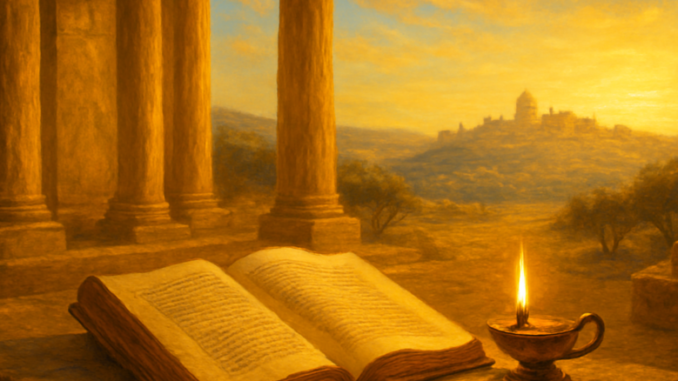
Most of us have lived through seasons when everything we carefully built seemed to crumble. A time when certainties wavered and we wondered whether the light would ever return. This is precisely the experience at the heart of the Book of Joel — one of the shortest yet most penetrating prophetic texts in the Old Testament. For Freemasons, this small but mighty book contains surprising layers of meaning that speak directly to the heart of the initiatory journey.
A Plague That Strips Everything Bare
The Book of Joel opens with a harrowing image: a locust plague that devours the land completely. Wave after wave of locusts descend, sparing nothing. The vines wither, the grain harvest fails, even the trees die. It is a picture of total devastation — one you may recognize from your own life, when setback followed setback in relentless succession.
What stands out is that the prophet does not look away from the suffering. He invites the people to truly face the destruction, to mourn and to grieve. In Freemasonry, we know a similar moment: the confrontation with our own imperfection before we can begin to build. You can only rebuild once you have honestly looked at what has been broken down. The rough ashlar cannot be shaped until we acknowledge its roughness.
The Darkness Before the Dawn
Joel then describes a day of darkness and gloom, a day of clouds and thick fog. The sun and moon are darkened; the stars withdraw their light. This cosmic imagery carries a profound symbolic charge. In many traditions — including Freemasonry — darkness is not viewed as the end, but as a necessary phase of reflection and transformation.
Think of the moment when a candidate first enters the lodge: blindfolded, unaware of what lies ahead, surrendered to the trust that light will follow. The darkness in Joel is not nihilistic. It is pregnant with possibility. It asks you to pause, to release the illusion of control, and to make yourself receptive to something new. Every Mason who has experienced the darkness of initiation knows that it is not a punishment but a preparation.
Inner Transformation as the Condition for Renewal
At the very center of the prophecy rings a call that forms the core of the entire book:
“Rend your heart, and not your garments, and turn to the Eternal.”
This is not a call for outward display, but for genuine inner transformation. It is not about ritual for the sake of form, but about sincere self-reflection. Does this sound familiar? In Freemasonry, we speak of chipping away at the rough ashlar — the ongoing work on ourselves that goes far beyond following rules or memorizing ritual. It demands honesty about our own shadow sides and the courage to truly open our hearts.
Joel suggests that when this inner turning takes place, restoration becomes possible. The locusts are driven away, the rain returns, the harvest is restored. This is not magical thinking but a deep insight into how renewal actually works: from the inside out. The external world begins to change when we change within — a principle that every working Mason understands intuitively.
The Outpouring of the Spirit
Perhaps the most famous passage in Joel is the promise that the spirit will be poured out upon all people — young and old, men and women, servants and handmaids. Visions will be seen, dreams will be dreamed. It is a radical democratization of wisdom and insight.
For Freemasons, this resonates powerfully with the ideal of brotherhood. Knowledge and light are not reserved for an elite few but are shared with all who sincerely seek them. The lodge is a space where origin, status, and background fade into irrelevance. What matters is the willingness to learn, to grow, and to contribute to the greater whole. Joel’s vision of a spirit poured out on all flesh mirrors the Masonic conviction that every human being carries within them the potential for enlightenment.
Symbols That Continue to Speak
The imagery of Joel is timeless in its power:
The locusts serve as a symbol for destructive forces, both external and internal — the habits, fears, and vices that strip our inner landscape bare. The darkened sun represents the phase of uncertainty and not-knowing that precedes every genuine breakthrough. The rent heart is an image of sincere self-reflection, the willingness to look beneath appearances. The outpoured spirit stands as a promise of shared wisdom and collective illumination. And the restored land represents the fruit of inner work — the harvest that follows honest labor.
These symbols invite you to look beyond the literal text. They speak of universal human experiences: loss, hope, transformation, and community. In this sense, Joel is not merely an ancient document but a mirror for your own life’s journey — and for the Masonic path in particular.
What Joel Still Teaches Us Today
The Book of Joel is short — just three chapters — but its message is clear. Destruction is not the end. Darkness is not final. When you are willing to look honestly inward and open your heart to change, restoration becomes possible. This is not passive waiting but active participation in your own growth.
In Freemasonry, we call this the work on the temple — not a building of stone, but the temple of your own character and consciousness. Joel reminds us that this work sometimes begins in darkness, but it is always directed toward the light. The working tools are in our hands; the blueprint is written in our hearts.
Perhaps you stand at a crossroads right now, or perhaps you are looking back on a season of loss. The Book of Joel offers no easy answers, but it does offer a perspective: the locust plague does not have the last word, dawn waits beyond the darkness, and the spirit is shared with all who are willing to receive it. It is an invitation to open your heart and continue building — stone by stone, day by day.
Copyright text & image: devrijmetselaar.nl
Texts are based on the ideas and content of the author of devrijmetselaar.nl, reviewed, corrected, and supplemented with the assistance of OpenAI. Images are created based on the ideas of the author of devrijmetselaar.nl using OpenAI/DALL-E.
Frequently Asked Questions
What does the Book of Joel teach Freemasons about dealing with difficult times?
The Book of Joel teaches that destruction and hardship are not punishments but necessary phases of transformation and renewal. Like the locust plague in Joel, Freemasons learn to honestly face their imperfections and challenges, understanding that true rebuilding—like shaping the rough ashlar—can only begin after acknowledging what needs to be changed. This mirrors the Masonic journey of inner work that leads to genuine personal growth.
How does the darkness described in Joel relate to Freemasonry initiation?
The cosmic darkness in Joel represents a necessary phase of reflection and spiritual preparation, much like the blindfold worn by candidates entering the lodge for the first time. In both traditions, darkness is not an ending but a transformative space where initiates learn to release the illusion of control and become receptive to light and new understanding. This darkness is a profound gift, not a punishment.
What is the central message of Joel that Freemasons should understand?
At the heart of Joel is the call to "rend your heart, and not your garments"—a call for genuine inner transformation rather than empty outward display. For Freemasons, this speaks directly to the real work of self-improvement: chipping away at the rough ashlar through honest self-reflection and courage to face one's shadow sides. When this sincere inner turning takes place, true renewal becomes possible, as the external world begins to change from within.
Why is the Book of Joel significant for understanding the Masonic journey?
The Book of Joel encapsulates the complete cycle of the Masonic initiatory experience: confronting imperfection, moving through darkness and uncertainty, undergoing inner transformation, and emerging renewed. Its message that restoration comes from genuine inner work rather than superficial ritual aligns perfectly with Freemasonry's core principle of building oneself as a better person through sincere dedication to self-improvement.


Be the first to comment