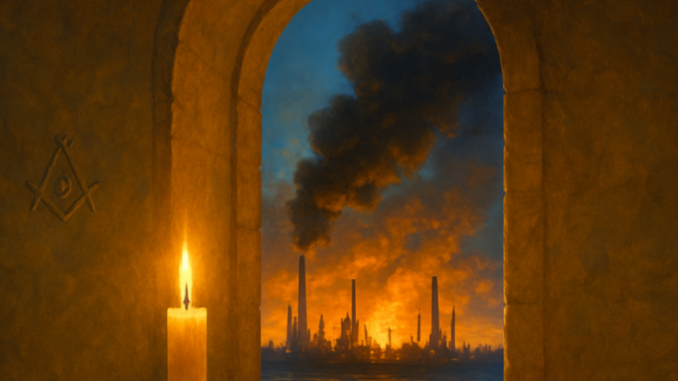
The old Master gazed at the candle on the altar. The flame danced restlessly, as though it had something to say. That morning, he had read the news — burning storage tanks, columns of smoke rising miles into the sky, a refinery consumed by fire. He reflected on the strange paradox of fire: the very element that illuminates the temple can also devour everything in its path.
When Fire Destroys Instead of Illuminates
This week, images emerged of a large-scale attack on an oil refinery near Moscow — reportedly the largest in the region. Massive walls of flame, thick black smoke, and the unmistakable sense of destruction that seems to seep through the screen itself. For many, this is simply another piece of war news to scroll past. But for those who look with a contemplative eye, there is more to see than strategic targets and economic damage.
Fire has always carried a dual meaning in human history. It is the symbol of civilization — of warmth and community gathered around the hearth. But it is equally the instrument of devastation, of cities reduced to ash. In Freemasonry, fire stands as one of the most powerful symbols we know: the light that drives out darkness, but also the purifying element that must harden the rough stone before it becomes fit for use.
The Rough Stone in Times of Conflict
In the Masonic tradition, every person is a rough stone. The lifelong work of a Mason consists of chiseling, polishing, and shaping that stone into something worthy of its place in the greater edifice of humanity. But what happens when it is not the chisel that is wielded, but the sledgehammer? When the purpose is no longer to build, but to destroy?
The answer may lie not in denying the destruction, but in acknowledging what comes after. Every fire leaves ash, and from ash, new growth can emerge. This is not cheap optimism or an attempt to diminish suffering. It is the sober observation that the human spirit possesses a remarkable capacity to rebuild, to restore, and sometimes to create something finer than what stood before.
The Ritual of Rebuilding
Freemasonry tells the story of a temple that was destroyed and rebuilt. This narrative has resonated through the centuries — not because temples themselves are so important, but because the story mirrors the human condition. We build, we lose, we grieve, and we build again. It is a cycle that is both painful and hopeful.
The true builder is not defined by what he creates, but by his ability to begin again after the storm.
This saying, shared in various forms across lodges around the world, touches on something essential. Destruction is not the end of the story. It is a dark chapter, certainly, but never the final page. The question a Freemason asks himself is not “why did this happen?” but rather “what can I contribute to the restoration?”
Oil as Lifeblood, Fire as Transformation
A refinery is, in a sense, the beating heart of a modern economy. Crude oil flows in, and out come the fuels that keep our world turning. It is a process of transformation not unlike the alchemical dreams of old. When such a center is attacked, the impact extends beyond economics — it strikes at the collective sense of security and predictability.
Yet it is precisely this vulnerability that has something to teach us. We are all dependent on systems far larger than ourselves. That interconnectedness — so central to Masonic thought — also means we share one another’s fate. The smoke rising from a burning installation knows no borders, just as the consequences of conflict are never confined to the immediate combatants.
The Quiet Question Behind the Headlines
Behind every report from the front lines lies a question that is rarely asked aloud: how do we break the cycle? Freemasonry offers no political answers and takes no position on the legitimacy of military actions. That is not its role. But it does offer a framework for thinking about what it means to be human in a world of conflict.
Do we recognize the humanity in the other, even when that other is presented as an enemy? Can we hold fast to the ideal of brotherhood, even when the world is on fire? What do we personally contribute to healing and reconciliation, however small that contribution may be?
These are not easy questions, and honest answers are harder still. But the very act of asking them is itself a gesture of hope. It is the acknowledgment that we are not powerless — that we can choose how we respond to the chaos around us.
Building What Endures
The Freemason does not build refineries or strategic installations. He builds something far harder to destroy: character, connection, and the quiet hope that people can ultimately find their way to one another. This edifice is invisible to satellites and invulnerable to missiles. It exists in the space between people — in the hand that is extended, in the conversation that takes place despite every difference.
When the flames have died and the smoke has cleared, there will be rebuilding. That is what human beings do. The only question is: do we rebuild the same thing, or do we dare to dream of something better? In that question lies the very heart of both the tragedy and the promise of our human existence.
The old Master extinguished the candle as evening fell. Tomorrow, a new flame would be lit — as it is every day. Not because darkness has been defeated once and for all, but because lighting the flame is a choice we can make again and again. In a world where fire both destroys and illuminates, our task lies in choosing which fire we feed.
Copyright text & image: devrijmetselaar.nl
Texts are based on the ideas and content of the author of devrijmetselaar.nl, reviewed, corrected, and supplemented with the assistance of OpenAI. Images are created based on the ideas of the author of devrijmetselaar.nl using OpenAI/DALL-E.
Frequently Asked Questions
What does Freemasonry teach about dealing with destruction and loss?
Freemasonry teaches that destruction, while painful, is not the end of the story. The tradition holds that humans possess a remarkable capacity to rebuild and restore after loss, and that a true Mason is defined not by what he creates, but by his ability to begin again after hardship. This mirrors the Masonic narrative of a temple that was destroyed and rebuilt, reminding us that renewal is always possible.
What do Masons mean by calling a person a 'rough stone'?
In Masonic tradition, every person begins as a rough stone that must be carefully chiseled, polished, and shaped throughout life to become worthy of its place in the greater structure of humanity. This metaphor emphasizes that personal development is a lifelong journey of self-improvement and refinement, guided by the principles of Freemasonry.
How does Freemasonry view fire as a symbol?
Fire holds a dual meaning in Freemasonry: it is the light that drives out darkness and symbolizes civilization and community, but it is also a purifying and transformative element. Like the fire that hardens rough stone to make it fit for use, life's trials can refine and strengthen a person's character.
What is the Masonic perspective on rebuilding after crisis?
Freemasonry emphasizes that a Mason's true purpose is not simply to create, but to have the courage and resilience to rebuild. Rather than asking 'why did this happen,' Masons ask 'what can I contribute to restoration?' This forward-looking approach transforms grief and loss into purposeful action and renewal.

Be the first to comment