Picture this: two Freemasons sit together after a lodge meeting. One is an engineer specializing in circular economy. The other is a classicist, steeped in ancient philosophy. The conversation turns to sustainability. What follows is not a debate but a shared exploration — a dialogue that touches on what it truly means to bear responsibility for what comes after us. This conversation, reconstructed in essence, forms the foundation of this article.
The Question That Opens Everything
“What is sustainability, really?” the classicist asks, stirring his coffee with a pensive look. “We use the word as if everyone knows what it means. But is it a goal? A method? A moral duty?”
The engineer smiles. “In my field, we talk about systems that can sustain themselves without exhausting their resources. But you’re right — that’s merely the technical definition. The philosophical question runs deeper: why should we care about what happens a hundred years from now?”
This is precisely the question Freemasons have grappled with for centuries, albeit in different terms. The construction of the symbolic temple is not a project for a single lifetime. It is a work that transcends generations.
The Stone You Leave Behind
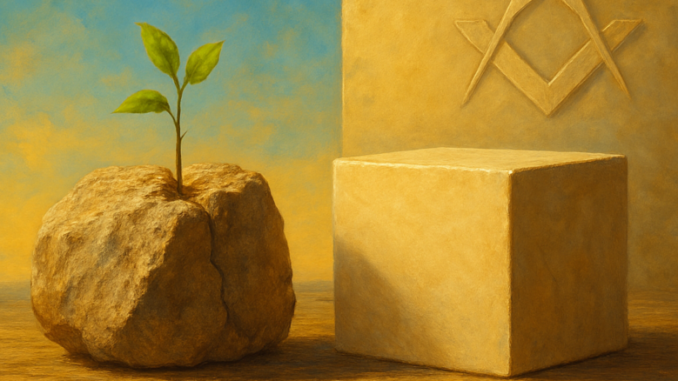
“Are you familiar with the concept of the rough and the smooth ashlar?” the classicist asks. The engineer nods. Every Freemason knows this symbol. The rough ashlar represents the person at the beginning of their journey — unworked and full of sharp edges. The smooth ashlar is the ideal: the person who has labored upon themselves.
“But what happens to that stone when we are no longer here? Does it fit into the structure that others will continue to build? That is the question that connects sustainability to our work.”
The engineer leans forward. “So you’re saying that sustainability isn’t just about what we consume, but about what we leave behind? About the quality of our contribution to the whole?” The classicist nods slowly. “The Stoics spoke of living in accordance with nature. Not as romantic idealism, but as an acknowledgment that we are part of something greater. Marcus Aurelius wrote that we are but a moment in an infinite stream.”
Three Philosophical Perspectives on Sustainable Action
The conversation deepens. The two brothers explore different philosophical traditions that resonate with sustainability thinking.
Stewardship
The first approach is that of stewardship. We are not owners of the earth, but its caretakers. This idea appears across many religious and philosophical traditions. For Freemasons, it translates into the responsibility to pass on the lodge, the community, and the world in better condition than we found them.
The Categorical Imperative
Kant would say: act only according to that maxim by which you can at the same time will that it should become a universal law. Applied to sustainability, this means we must ask ourselves whether our way of living would be viable if everyone lived the same way. It is a confronting thought — one that calls for humility.
Virtue Ethics
Aristotle emphasized the importance of character virtues. Temperance, justice, and practical wisdom are precisely the qualities that make sustainable action possible. It is not about rules or prohibitions, but about cultivating a character that naturally chooses what is right.
Temperance: taking no more than what is needed.
Justice: sharing fairly with present and future generations.
Practical wisdom: recognizing the good in complex situations.
The Temple That Is Never Finished
“Do you know what has always resonated with me about Freemasonry?” the engineer says after a pause. “That we are building something we ourselves will never see completed. The symbolic temple is, by definition, unfinished. And yet we work on it, day after day.”
The classicist recognizes in this a deep truth about sustainability. It asks us to invest in outcomes we may never witness. To plant trees in whose shade others will rest. This requires a form of trust and hope that extends far beyond self-interest.
In the lodge, Freemasons practice this very attitude. They tend traditions that have existed for centuries and that, they hope, will endure for centuries more. Each generation adds something, adapts something, and passes the whole along. This is sustainability in its most fundamental sense: the capacity to endure through continual renewal within continuity.
From Thinking to Doing
The conversation nears its end. The coffee cups are empty, but the thoughts linger. “Philosophy is beautiful,” the engineer says, “but what does this mean in practice? How do we translate these insights into action?”
The classicist considers this. “Perhaps it begins with awareness. With every decision, large or small, we can ask ourselves: what am I leaving behind with this choice? What stone am I adding to the structure? Is it a stone that fits, that bears weight, that adds beauty?”
This is not a ready-made answer. It is an invitation to reflect. And that is exactly what Freemasonry has always sought to offer: not dogma, but a method. Not solutions, but better questions.
The dialogue between the engineer and the classicist illustrates that sustainability is far more than an environmental term. It is a philosophical stance that calls for responsibility beyond our own lifetime. For Freemasons, this is hardly a new concept. The symbolic labor on the temple of humanity has always operated on this time horizon. Perhaps Freemasonry’s contribution to the sustainability conversation lies precisely here: in the reminder that we are part of a story larger than ourselves, and that the quality of our contribution matters — even if we will never see the final result.
Copyright text & image: devrijmetselaar.nl
Texts are based on the ideas and content of the author of devrijmetselaar.nl, reviewed, corrected, and supplemented with the assistance of OpenAI. Images are created based on the ideas of the author of devrijmetselaar.nl using OpenAI/DALL-E.
Frequently Asked Questions
How does Freemasonry connect to sustainability and environmental responsibility?
Freemasonry views sustainability as a philosophical foundation rooted in stewardship — the idea that we are caretakers rather than owners of what we inherit. The tradition emphasizes passing on our lodges, communities, and world in better condition than we found them, recognizing that our work transcends generations and contributes to something greater than ourselves.
What do the rough and smooth ashlars teach us about sustainability?
The rough ashlar represents the unfinished person, while the smooth ashlar symbolizes one who has labored upon themselves. This teaches Freemasons that sustainability is not just about resource consumption, but about the quality and integrity of what we contribute to the collective structure that future generations will build upon.
Is Freemasonry concerned with future generations?
Yes, deeply. Freemasonry teaches that the symbolic temple is a work that transcends individual lifetimes and requires ongoing contribution from successive generations. This perspective aligns with sustainable thinking, as it acknowledges our moral duty to ensure that what we leave behind serves and benefits those who come after us.
How does Kant's philosophy apply to Masonic sustainability principles?
Freemasonry embraces Kant's categorical imperative in its approach to sustainability: we should only act according to principles we would will as universal laws. This means Freemasons are called to examine whether their way of living would be viable if everyone lived the same way, promoting responsible and ethical action.

Be the first to comment