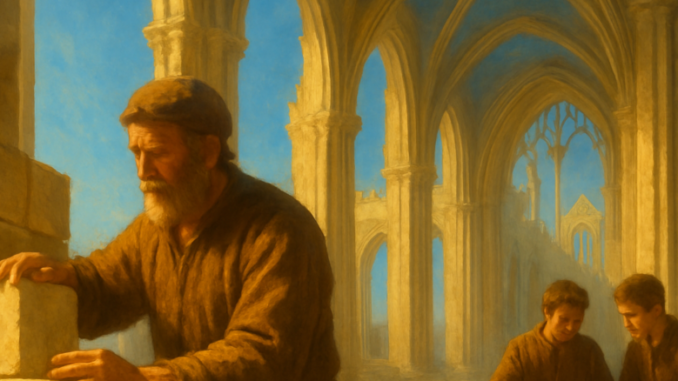
Imagine this: a cathedral whose first stone was laid by someone who knew they would never live to see it finished. Medieval master builders didn’t work for themselves — they worked for generations yet to come. In an age where sustainability is largely defined by carbon targets and climate goals, Freemasonry invites us to ask a deeper question: what does it truly mean to build for eternity?
The Operative Roots of Sustainable Thinking
Freemasonry traces its origins to the guilds of stonemasons and master builders. These craftsmen didn’t build disposable architecture. Every stone was carefully selected, every joint crafted to endure for centuries. This wasn’t romantic idealism — it was necessity. A cathedral that collapsed meant the end of a reputation, and often the end of a life.
When Freemasonry evolved from operative to speculative in the eighteenth century, it carried this mentality with it. The physical building blocks became symbols, but the philosophy remained intact: what you create must stand the test of time. Not because someone forces you, but because you understand that your work is part of something far greater than yourself.
Stewardship: A Forgotten Philosophical Concept
In modern sustainability discussions, you rarely hear the word stewardship. Yet this concept touches the very heart of what sustainability should be. A steward is not an owner but a caretaker. He receives something valuable from previous generations and bears the responsibility of passing it on — in equal or better condition — to those who follow.
“We do not inherit the earth from our ancestors; we borrow it from our children.”
This insight, often attributed to indigenous wisdom traditions, resonates deeply with Masonic philosophy. The lodge itself functions as a training ground for stewardship. Each generation of brethren receives traditions, rituals, and symbols they did not invent, but are entrusted to enrich and pass on. This creates a unique relationship with time: you are merely a link in a chain that began long before you and will continue long after you are gone.
The Temple as a Metaphor for the Planet
Freemasons speak of building an inner temple and, by extension, a temple of humanity. This metaphor takes on new urgency when we apply it to our relationship with the earth. The planet is the ultimate temple — the structure within which all human endeavor takes place. Without a foundation, there is no building. Without a healthy earth, there is no civilization.
The Freemason learns to work with care and precision. A rough stone is not shaped through brute force, but through patience and respect for the material. The same approach could define our relationship with natural resources. Not to deplete, but to cultivate. Not to dominate, but to collaborate.
Four Pillars of Sustainable Masonic Thinking
Masonic philosophy offers four principles that align remarkably well with genuine sustainability:
Long-term vision: Acting with future generations in mind, not quarterly results. The medieval builder who laid foundations for towers his grandchildren would complete embodied this principle perfectly.
Interconnectedness: Recognizing that everything is connected within the great edifice of existence. No stone stands alone, and no action exists in isolation.
Temperance: The classical virtue that tempers the urge to consume. In a world driven by excess, moderation is a radical act.
Craftsmanship: Choosing quality over quantity, durability over disposability. The mason’s approach to stone is a philosophy of life.
From Individual Growth to Collective Responsibility
A common criticism of sustainability initiatives is that individual action is meaningless against the scale of global problems. Masonic philosophy offers a powerful counterpoint. The improvement of the world begins with the improvement of the self — not as an excuse for passivity, but as the foundation for meaningful action.
In the lodge, a Freemason experiences firsthand how individual transformation can grow into collective strength. Every brother who lives more consciously contributes to a culture of awareness. This principle translates directly to sustainability: personal choices form patterns, patterns form cultures, and cultures form systems. The question is not whether your individual action is enough, but whether you are willing to contribute your stone to an edifice that is greater than yourself.
The Wisdom of the Unfinished Cathedral
Perhaps the deepest lesson lies in accepting that we will never see the final result. The medieval master builder laid foundations for towers that only his grandchildren would complete. This attitude requires a special kind of trust and humility.
Today’s sustainability targets for 2050 or 2100 demand exactly this same mentality. We plant trees whose shade we will never sit in. We reform systems whose fruits we will never harvest. This is not sacrifice — it is an act of connection with the future. It is building in the truest sense of the word.
Sustainability is more than a checklist of environmentally friendly choices. It is a philosophical stance that calls for humility about our place in time and a deep sense of connection to those who will come after us. Freemasonry, with its centuries-old tradition of symbolic building, reminds us that true sustainability begins with the realization that we are stewards. We do not build for ourselves — we build for a temple that will never be finished. And it is precisely in that incompleteness that its beauty lies.
Copyright text & image: devrijmetselaar.nl
Texts are based on the ideas and content of the author of devrijmetselaar.nl, reviewed, corrected, and supplemented with the assistance of OpenAI. Images are created based on the ideas of the author of devrijmetselaar.nl using OpenAI/DALL-E.
Frequently Asked Questions
What does Freemasonry teach about our responsibility to future generations?
Freemasonry teaches that we are stewards, not owners, of what we inherit from previous generations. Like medieval master builders who laid cathedral stones they would never see completed, Freemasons understand that our work must endure beyond our lifetime and should be passed on in equal or better condition to those who follow.
How does the concept of stewardship differ from modern sustainability practices?
While modern sustainability often focuses on metrics like carbon targets, Masonic stewardship emphasizes a philosophical relationship with time and responsibility. A steward acts as a caretaker motivated by duty and understanding that they are part of a chain extending from ancestors to descendants, creating a deeper commitment than external requirements alone.
Why do Freemasons use the temple as a metaphor for the planet?
Freemasons view the temple as the ultimate structure representing civilization and human potential. The earth serves as the foundation for all human endeavor, and just as a mason carefully shapes stone with patience and respect, we should approach natural resources with care and precision—cultivating and collaborating rather than depleting and dominating.
How did medieval stonemasons influence Freemasonry's approach to sustainability?
Medieval master builders created lasting architecture by carefully selecting materials and crafting joints to endure for centuries, not out of idealism but practical necessity. When Freemasonry evolved from operative to speculative practice, it carried this philosophy forward—transforming physical building blocks into symbols while maintaining the principle that quality work must stand the test of time.

Be the first to comment