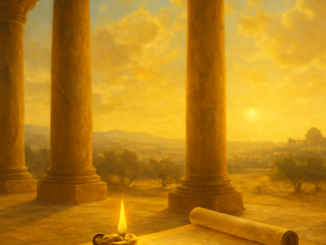
Golden seven-branched lampstand flanked by two olive trees in soft light
Christianity

Zechariah’s Golden Lampstand: A Mirror of the Inner Self

In the Book of Zechariah, there stands a lampstand. Not an ordinary one, but a golden lampstand with seven lamps, fed by two olive trees that channel their oil directly into its reservoir. This striking image from the fourth chapter of the prophetic text invites us to pause and reflect. What does it mean to receive light without effort of your own? And what might this ancient vision tell us about the way we build ourselves — and the world around us — today? A Lampstand That Feeds Itself Imagine a lamp that never needs refilling. The oil flows on its own; the flame never dies. In Zechariah’s vision, this golden lampstand stands at the center, flanked by two olive trees. The prophet asks what it all means, and the answer is profound: “Not by might, nor by power, but by my Spirit.” With those words, the focus shifts away from human effort toward a deeper, inexhaustible source. The lampstand becomes a symbol of what happens when we open ourselves to something greater than our own will. In Freemasonry, light plays a central role. The search for light is the search for knowledge, for insight, for that which was hidden […]

Cathedral foundation stones symbolizing Masonic stewardship and sustainability
Philosophy & Ethics

Sustainability as Philosophy: The Freemason as Steward

Imagine this: a cathedral whose first stone was laid by someone who knew they would never live to see it finished. Medieval master builders didn’t work for themselves — they worked for generations yet to come. In an age where sustainability is largely defined by carbon targets and climate goals, Freemasonry invites us to ask a deeper question: what does it truly mean to build for eternity? The Operative Roots of Sustainable Thinking Freemasonry traces its origins to the guilds of stonemasons and master builders. These craftsmen didn’t build disposable architecture. Every stone was carefully selected, every joint crafted to endure for centuries. This wasn’t romantic idealism — it was necessity. A cathedral that collapsed meant the end of a reputation, and often the end of a life. When Freemasonry evolved from operative to speculative in the eighteenth century, it carried this mentality with it. The physical building blocks became symbols, but the philosophy remained intact: what you create must stand the test of time. Not because someone forces you, but because you understand that your work is part of something far greater than yourself. Stewardship: A Forgotten Philosophical Concept In modern sustainability discussions, you rarely hear the word stewardship. […]

Ancient temple illuminated by light symbolizing Isaiah and Freemasonry
Christianity

Isaiah and Freemasonry: Prophetic Images of Light and Building

Somewhere around 740 BCE, in the kingdom of Judah, a voice rose — not from a man who had chosen the role of prophet, but from one who had been called to it. In a vision filled with smoke and seraphim, he glimpsed something his contemporaries could not yet grasp: a future in which light would drive out darkness and a broken people would rise again as builders of a new age. The images woven through the Book of Isaiah continue to resonate millennia later, and their echoes are remarkably vivid in the symbolic language of Freemasonry. A Calling in the Temple The sixth chapter of Isaiah contains one of the most striking calling visions in all of biblical literature. The prophet finds himself in the temple when he sees a throne surrounded by six-winged beings. One of the seraphim touches a burning coal to his lips, purifying him of unrighteousness. This moment of transformation — from the impure to the pure — lies at the heart of everything Isaiah will go on to proclaim. For Freemasons, this theme feels deeply familiar. The candidate who enters the lodge undergoes a symbolic purification of his own. He leaves the profane world […]

Ancient temple ruins symbolizing the Masonic journey of inner rebuilding
Christianity

Ezra and the Rebuilding of the Temple: A Symbolic Journey

In 538 BCE, something remarkable happened. After decades of exile in Babylon, thousands of people returned to Jerusalem with a single sacred purpose: to rebuild the destroyed temple. The biblical Book of Ezra tells this story of return and reconstruction. But beneath the historical narrative lies a deeper layer — a symbolic journey that still resonates within Freemasonry and in the heart of every person striving for inner renewal. The Historical Context of Ezra The Book of Ezra describes a pivotal period in the history of the Jewish people. King Cyrus of Persia issued a remarkable decree in 538 BCE: the exiles were permitted to return to their homeland and rebuild their temple. This was no ordinary political maneuver — the returning exiles experienced it as divine intervention. Ezra, a scribe and priest, played a key role in this return and the spiritual reformation that followed. The returning exiles found a desolate landscape. The temple, once the spiritual center of their existence, lay in ruins. What followed was a years-long process of reconstruction, plagued by opposition, doubt, and internal conflict. Yet they persevered. Stone by stone, the sanctuary rose once more from the dust. It is this image of patient, […]