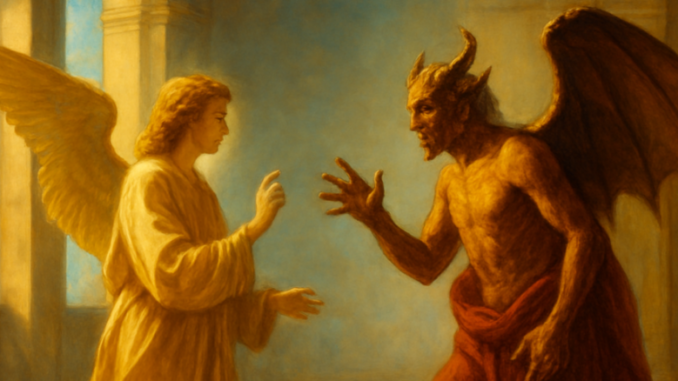
The heavy doors of the Sistine Chapel slam shut. Somewhere in Dan Brown’s fictional world, white smoke rises above Rome while a deadly conspiracy unfolds beneath the vaulted ceilings during the papal election. It’s a scene that captivated millions of readers worldwide — but how much of what the book describes about the conclave actually aligns with reality? And what can Freemasons recognize in the way ritual, secrecy, and brotherhood are portrayed in this story?
A Thriller as a Lens on an Ancient Ritual
In his novel Angels & Demons, Dan Brown paints a picture of the conclave built largely on dramatic tension and compressed timelines. The book presents the papal election as an event that unfolds within mere hours, under extreme pressure, in an atmosphere thick with conspiracy. The cardinals are locked inside the Sistine Chapel, cut off from the outside world, while a mysterious enemy kidnaps and murders them one by one according to an ancient pattern. The conclave is not portrayed as a peaceful, spiritual process but as a battleground where power, faith, and secret societies collide.
Dan Brown’s Premises About the Papal Election
Brown’s narrative rests on several striking assumptions about how the conclave works. First, Angels & Demons suggests that the favorite for the papacy — the so-called preferiti — is more or less determined before the conclave even begins. The four most promising cardinals are singled out as targets in the book, as if the outcome of the vote is virtually predetermined. This reinforces the notion that the conclave is not so much an open election as a confirmation of an already forged balance of power.
Second, the book presents the timeframe as extremely short and rigidly defined. In reality, a conclave can last days or even weeks, but in the novel the pressure is ratcheted up by a ticking clock tied to an existential threat. Brown transforms the conclave into a race against time, complete with a deadline that has nothing to do with canon law and everything to do with the plot structure of a thriller.
A third notable claim concerns the role of the camerlengo — the official who administers the affairs of the Church during the period between two popes. In Angels & Demons, this figure is given an extraordinarily prominent and active role, to the point of personally intervening in the course of the conclave. Brown portrays the camerlengo as someone with nearly unlimited power and freedom of movement, while in reality his actual authority within Church tradition is far more limited and ceremonial in nature.
Secrecy as a Dramatic Device
What Dan Brown’s book does particularly effectively is amplify the secrecy that surrounds the conclave. The sealed doors, the oath of silence, the burning of ballots — these are all real elements of the procedure that Angels & Demons inflates into an atmosphere of impenetrable mystery. The cardinals are presented as members of a hermetically sealed order whose rituals are incomprehensible to outsiders. The book deliberately plays on the human fascination with the hidden and the unknown.
And this is precisely where the story touches on something Freemasons will immediately recognize. Freemasonry, too, has rituals that take place behind closed doors, bound by a pledge of discretion, and often surrounded by speculation and projection from those on the outside. The way Dan Brown describes the conclave mirrors a pattern we see throughout the history of closed societies: the unknown automatically becomes suspect, and silence is filled with conspiracy.
Where secrecy serves to protect a ritual, the outside world inevitably succumbs to the temptation of seeing a plot behind it. This is true for the conclave, for Freemasonry, and for every tradition that chooses silence over spectacle.
Ritual as a Carrier of Meaning
In Freemasonry, ritual plays a central role as an instrument of inner growth and fraternal connection. It is not merely a formality or a piece of theater but a deliberately crafted experience that invites the participant to reflect. The philosopher Michel de Montaigne wrote centuries ago about the importance of forms and customs as carriers of deeper truth. For Montaigne, rituals are not empty shells but windows to self-knowledge. Anyone who reads Montaigne’s essays will recognize an attitude closely related to the way Freemasons approach their own rituals — not as dogma, but as invitation.
The conclave, as it is actually conducted, shares this quality. The rounds of voting, the burning of ballots, the appearance of smoke above the Sistine Chapel — these are ritual acts that reach far beyond their practical function. They mark a transition, a transformation. In Angels & Demons, however, Dan Brown largely reduces these rituals to scenery for an action plot. The deeper layer of meaning — the conclave as spiritual exercise — fades into the background.
Similarities in Form, Differences in Purpose
Both the conclave and Freemasonry share elements that Dan Brown touches upon in his novel:
- Enclosed spaces where the ritual unfolds, invisible to the outside world.
- An oath or pledge of confidentiality that binds the participants.
- Specific officials with ceremonial duties who guide the proceedings.
- The use of fire, light, and smoke as signs of progress and completion.
The crucial difference lies in purpose. The conclave is directed toward choosing a leader within a religious hierarchy. The Masonic ritual, by contrast, is focused on the personal deepening of each individual member. One seeks an external outcome — the election of a pope. The other seeks an internal transformation — the ongoing work of building a better self. Both processes, however, rely on the power of ritual to create a space set apart from ordinary life, a space where something meaningful can occur precisely because it is shielded from the noise and scrutiny of the everyday world.
What Fiction Reveals About Our Fascination with the Hidden
Dan Brown’s success with Angels & Demons — and indeed with all of his novels — tells us something important about human nature. We are drawn to what is concealed. We project our fears and fantasies onto closed doors and whispered oaths. The enormous popularity of Brown’s fiction demonstrates just how powerful the lure of secrecy is, even when — or perhaps especially when — the reality behind the doors is far more contemplative and purposeful than any thriller could convey.
For Freemasons, this dynamic is deeply familiar. The gap between what outsiders imagine happens in a Lodge and what actually takes place is often vast. What fills that gap is not conspiracy but curiosity — and sometimes, unfortunately, suspicion. Brown’s portrayal of the conclave is a reminder that any tradition rooted in discretion will inevitably become a canvas for the imagination of those who stand outside it.
Angels & Demons may be a work of fiction, but it raises real questions about how we perceive ritual, secrecy, and tradition. Dan Brown’s dramatized conclave departs significantly from the actual procedure, yet it captures something genuine about the tension between the hidden and the visible. For Freemasons, the novel serves as both a mirror and a caution: a mirror of how closed rituals are perceived by the wider world, and a caution against letting fiction define the narrative. True meaning, whether in the Sistine Chapel or in a Masonic Lodge, is found not in the spectacle but in the silence — in the space where reflection begins and transformation becomes possible.
Copyright text & image: devrijmetselaar.nl
Texts are based on the ideas and content of the author of devrijmetselaar.nl, reviewed, corrected, and supplemented with the assistance of OpenAI. Images are created based on the ideas of the author of devrijmetselaar.nl using OpenAI/DALL-E.
Frequently Asked Questions
How accurate is Dan Brown's depiction of the papal conclave in Angels & Demons?
Dan Brown's portrayal of the conclave is largely fictionalized for dramatic effect. While the book captures some elements of the papal election process, it significantly compresses timelines (presenting hours instead of days or weeks), exaggerates the role of the camerlengo, and invents conspiracy elements that have no basis in actual canon law or Freemasonry. The novel prioritizes thriller conventions over historical accuracy.
What does Angels & Demons claim about how the papal favorite is determined?
The book suggests that the preferiti (the favorite cardinals for the papacy) are largely predetermined before the conclave begins, implying the election is more of a confirmation of already established power dynamics rather than an open democratic process. This portrayal oversimplifies the actual complexity and unpredictability of papal elections.
How does the book portray the camerlengo's role compared to reality?
Angels & Demons gives the camerlengo an extraordinarily prominent and active role with nearly unlimited power and freedom of movement during the conclave. In reality, the camerlengo's authority is much more limited and administrative in nature. Brown amplifies this character's influence to serve the plot's dramatic needs rather than reflecting actual canon law.

Be the first to comment