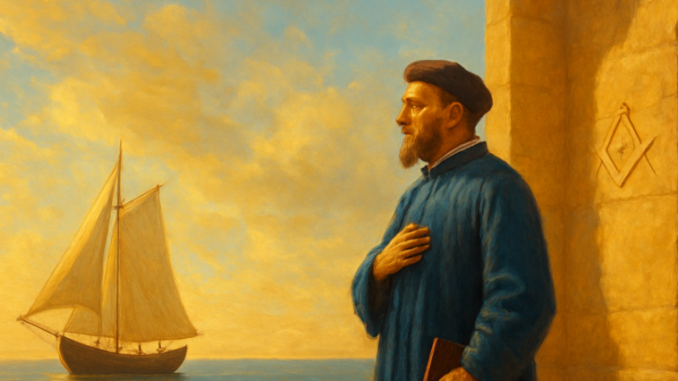
It is late in the evening. A Freemason sits alone in the vestibule of the lodge after the meeting, his ritual gloves still in hand. The words of the night linger in his mind — brotherhood, trust, the realization that everything you truly need already lives within you. He reaches into his bag, pulls out a well-worn copy of Michel de Montaigne’s Essays, and opens it to the fortieth essay of the first book: That We Lack Nothing. What he reads feels like an echo of everything he has just experienced in the temple.
A Philosopher Who Embraced Enough
Michel de Montaigne wrote his essay That We Lack Nothing as a meditation on the human tendency to always want more, even though nature has equipped us with everything we truly need. He argued that our dissatisfaction does not stem from any actual deficiency but from the unchecked expectations we impose upon ourselves. Nature, he maintained, has given every creature precisely what it needs to live and to thrive. Humanity is no exception — yet we make ourselves unhappy through our own doing.
This is not naïve optimism. Montaigne was a sharp observer of human suffering — of war, disease, and loss. His point is more subtle: it is not the world that fails us, but our own inability to see what we already possess. In saying this, he places himself in a tradition stretching back to Seneca and Epictetus, to the Stoic conviction that inner wealth does not depend on external circumstances. But where Seneca emphasizes discipline and willpower, Montaigne chooses a warmer, more human tone. He invites us to self-reflection without self-flagellation.
The Rough Ashlar That Is Already Whole
Within Freemasonry, the image of the rough ashlar that must be shaped into a perfect cube is one of the most powerful metaphors for personal development. But Montaigne’s essay raises a surprising question: what if the rough ashlar is not so much imperfect as it is undiscovered? What if the Mason’s work does not consist of adding something new, but of removing the veils that prevent us from seeing what is already there?
This idea resonates deeply with the Masonic journey from darkness to light. The candidate who first enters the lodge is blindfolded — not because he is blind, but to make him aware of what he fails to see when he believes he is seeing. The light he receives is not a foreign light from without. It is a recognition of what was always present. Montaigne would have understood this immediately. His entire philosophical project revolved around one question: what do I actually know, and what do I merely think I know?
Freemasonry does not teach us that we are lacking. It teaches us that we have not yet discovered how complete we already are.
Brotherhood as a Mirror of Wholeness
Montaigne was no hermit. Although he retreated to his famous tower study to think and write, he remained deeply connected to the people around him. His friendship with Étienne de La Boétie he described as one of the most formative experiences of his life — a bond that transcended habit or utility. “Because it was he, because it was I,” he wrote, as the only explanation for their inexplicable connection.
In Freemasonry, brotherhood is not a casual concept. It is the recognition that through connection with others we can reach deeper into ourselves. The lodge functions as a space where brethren hold up a mirror to one another — not to expose shortcomings, but to make each other’s fullness visible. This is precisely what Montaigne meant when he argued that we lack nothing: the other person is not a supplement to a deficiency, but a confirmation of what we carry within ourselves. True brotherhood arises not from need, but from recognition.
The Virtue of Enough
One of the core values of Freemasonry is the practice of virtue — not as outward display, but as an inner disposition. Montaigne aligns seamlessly with this view. In his essay, he argues that true virtue does not consist of accumulating more knowledge, more possessions, or more status, but of making right use of what we have already been given. He refers to Aristotle, who held that happiness comes from fulfilling one’s own nature rather than chasing someone else’s ideals. And he echoes Plato, who argued repeatedly in his dialogues that the soul already contains all truth and merely needs to be reminded.
For the Freemason, this translates into the daily practice of self-reflection. The ritual in the lodge is not a magical procedure that adds something to who you are. It is a structured invitation to pause and consider what you already know, already feel, and already are. The level, the square, and the compasses are not tools that create something new. They reveal the proportions that are already there but that vanish in daily life beneath the noise of superficial occupations.
Values That Resonate Across Centuries
Several core values unite Montaigne’s philosophy and the Masonic tradition in ways that feel remarkably alive today:
Self-reflection: Both Montaigne and Freemasonry share the conviction that looking honestly at yourself is the foundation of all growth.
Inner growth: Both traditions see development not as acquiring something external, but as unveiling what is already present within.
Brotherhood: The deepest connections arise not from lack, but from the mutual recognition of shared humanity.
Virtue as the art of living: Not the rigid following of rules, but the cultivation of an inner disposition that honors your own nature.
Why This Essay Still Speaks to Us Today
We live in an age where the feeling of insufficiency functions almost as the engine of society itself. Advertising, social comparison, and the constant stream of information feed the notion that we are never enough, never know enough, never have enough. Montaigne wrote his essay more than four hundred years ago, yet his message is more urgent than ever. Freemasonry offers a space where that message can be truly heard — a place where the relentless pressure to accumulate gives way to the quiet discipline of discovering what was always there.
The lodge is not a retreat from the world. It is a lens through which we can see the world — and ourselves — more clearly. Montaigne’s insight that we lack nothing is not an invitation to complacency. It is a call to awareness: to stop measuring ourselves against phantoms and to begin the more demanding, more rewarding work of truly knowing ourselves. In this, the philosopher and the Craft speak with one voice.
Montaigne’s quiet conviction that we already possess what we need finds a living home in the Masonic lodge. The rough ashlar does not need to become something other than what it is — it needs to be uncovered, understood, and honored. Brotherhood is not the filling of a void but the celebration of a shared completeness. In a world that profits from our sense of insufficiency, both Montaigne and Freemasonry remind us of a more ancient truth: the light we seek has been within us all along. The real work is learning to see it.
Copyright text & image: devrijmetselaar.nl
Texts are based on the ideas and content of the author of devrijmetselaar.nl, reviewed, corrected, and supplemented with the assistance of OpenAI. Images are created based on the ideas of the author of devrijmetselaar.nl using OpenAI/DALL-E.
Frequently Asked Questions
How does Montaigne's philosophy of sufficiency relate to Freemasonry?
Montaigne's essay 'That We Lack Nothing' echoes core Masonic teachings about inner wisdom and self-discovery. Both traditions emphasize that humans already possess what they truly need within themselves, and that personal development involves recognizing and uncovering this existing inner wealth rather than acquiring something external. This parallels the Masonic journey from darkness to light, where the candidate discovers illumination that was always present.
What does Montaigne mean when he says 'we lack nothing'?
Montaigne argues that nature has equipped every creature, including humans, with everything necessary to live and thrive. Our dissatisfaction does not stem from actual deficiency but from unrealistic expectations we impose on ourselves. Our unhappiness comes not from what the world fails to provide, but from our inability to recognize and appreciate what we already possess. This is grounded in Stoic philosophy but expressed with a warmer, more human approach than earlier Stoic thinkers.
How does the Masonic symbol of the rough ashlar connect to Montaigne's philosophy?
The rough ashlar traditionally represents personal development through refinement and shaping. However, Montaigne's philosophy suggests a different interpretation: the ashlar is not imperfect but rather undiscovered. The Mason's work involves removing the veils that obscure what is already present, not adding something new. This reframes Masonic development as a process of revelation and recognition rather than external transformation, aligning with the journey from darkness to light.

Be the first to comment