
A stone that stands unmoved while the storm rages around it. This image, as familiar in the builder’s craft as in philosophy, strikes at the heart of what Michel de Montaigne explores in the twelfth essay of his first book: human constancy. But which thinkers whispered those ideas into his ear? Which philosophical traditions formed the foundation upon which he built his reflections on steadfastness? The answers lie hidden in a rich intellectual heritage reaching back to antiquity.
The Stoic Foundation
When Montaigne writes about constancy, he is unmistakably walking through the colonnades of the Stoa. Stoic philosophy, founded by Zeno of Citium in the third century BC, placed the imperturbability of the human mind at its center. For the Stoics, true virtue lay in accepting what lies beyond our control while mastering our own reactions. This idea forms the backbone of Montaigne’s approach to the subject.
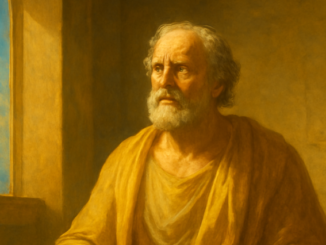
Particularly influential was the work of Seneca, the Roman philosopher and statesman whose letters and essays Montaigne studied with great enthusiasm. Seneca’s De Constantia Sapientis (On the Constancy of the Wise Man) addresses precisely the theme Montaigne would later rework. The wise man, Seneca argued, cannot truly be insulted or harmed, for his inner fortress remains impervious to external attacks. Montaigne adopted this idea — but, characteristically, he also questioned it.
Marcus Aurelius and the Inner Citadel
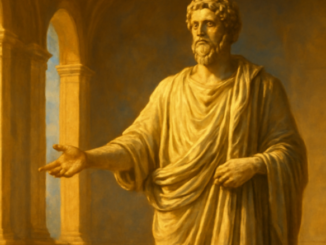
Another Stoic voice that resonates through Montaigne’s essay is that of Marcus Aurelius, the philosopher-emperor whose Meditations offer a blueprint for inner peace amid chaos. Marcus Aurelius wrote his reflections during military campaigns, while plague and war raged around him. His notion that the soul forms a citadel — impregnable when properly guarded — echoes deeply in Montaigne’s treatment of constancy.
True constancy lies not in denying our emotions, but in consciously choosing which emotions we allow to guide us.
Yet Montaigne diverges subtly from his Stoic predecessors. Where they sometimes preached an almost superhuman imperturbability, Montaigne shows greater understanding for human weakness. He acknowledges that we flinch at sudden danger, that our bodies react before our reason can intervene. This honesty about the human condition makes his essay far more accessible than the sometimes austere Stoic texts.
Plutarch as Guide and Inspiration
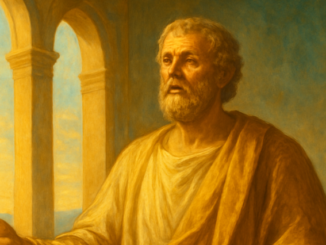
Alongside the Stoics, Montaigne drew abundantly from the work of Plutarch, the Greek biographer and essayist whose Moralia and Lives of the Noble Greeks and Romans were among his favorite reading. Plutarch offered Montaigne not only philosophical insights but also a method: the use of concrete examples drawn from the lives of historical figures to illustrate abstract virtues.
In his essay on constancy, Montaigne follows this Plutarchian model by recounting stories of men who maintained their composure under pressure. This narrative approach — anchoring philosophy in lived human experience — distinguishes Montaigne’s work from purely theoretical treatises. The anecdote becomes a mirror in which the reader may recognize himself.
Renaissance Humanism and the Rediscovery of Antiquity
Montaigne’s intellectual context extends well beyond individual thinkers. He wrote during an era when the Renaissance was transforming European thought. The rediscovery of classical texts — made possible by the printing press and the fall of Constantinople, which drove Greek scholars westward — created unprecedented access to ancient wisdom. Montaigne benefited enormously from this and possessed a library that served as a veritable treasure house of classical thought.
Renaissance humanism emphasized the dignity of the individual and the value of classical learning for moral development. This movement viewed the study of Greek and Roman texts not as a merely academic pursuit, but as practical preparation for a virtuous life. Montaigne embodied this ideal by connecting philosophy with everyday experience — making the wisdom of the ancients relevant to ordinary human struggles.
Skepticism as Counterbalance
A crucial nuance in Montaigne’s thinking stems from Pyrrhonian skepticism, a philosophical tradition that casts doubt on all claims to certain knowledge. Montaigne’s famous motto Que sais-je? (What do I know?) bears witness to this influence. When he writes about constancy, he does so with notable restraint. He claims no absolute truth, but rather examines how human beings cope with adversity.
This skeptical element prevents his essay from drifting into dogmatism. Montaigne presents constancy not as an attainable ideal that everyone must pursue, but as a complex human capacity that deserves careful inquiry. He wonders whether apparent courage is sometimes nothing more than indifference or even ignorance. This questioning stance is what makes his work timelessly relevant.
The Symbolic Dimension of the Stone
When we consider constancy through a symbolic lens, the image of the rough stone being polished into a perfect ashlar comes powerfully to mind. This transformation, so deeply embedded in the tradition of building, represents the human journey toward inner steadfastness. The stone does not resist passively; it is shaped through conscious labor into something that can withstand storms.
Montaigne’s essay invites us to see ourselves as such stones: raw material refined through study, reflection, and experience. The philosopher describes not an endpoint but a process. Constancy is not a state one achieves once and for all, but a quality one must continually cultivate. Every trial thus becomes an opportunity to further shape one’s character — just as the chisel prepares the stone for its place in the greater edifice.
Montaigne wove together Stoic resilience, Plutarchian storytelling, Renaissance humanism, and Pyrrhonian doubt into a rich tapestry of thought on human constancy. His essay remains a powerful reminder that steadfastness is not about suppressing our humanity, but about refining it. For those who see their own lives as an ongoing work of moral architecture — building character stone by stone, trial by trial — Montaigne’s philosophical roots offer both a mirror and a guide. The rough ashlar awaits the chisel, and the work, as always, continues.
Copyright text & image: devrijmetselaar.nl
Texts are based on the ideas and content of the author of devrijmetselaar.nl, reviewed, corrected, and supplemented with the assistance of OpenAI. Images are created based on the ideas of the author of devrijmetselaar.nl using OpenAI/DALL-E.
Frequently Asked Questions
What is the connection between Montaigne's philosophy of constancy and Freemasonry?
Montaigne's exploration of constancy reflects core Masonic values of self-improvement and inner fortitude. Like the unmoved stone in a storm, Freemasons seek to develop steadfast character and moral strength, drawing on the same philosophical traditions that inspired Montaigne's work. This pursuit of constancy through reason and virtue remains central to Masonic teaching and personal development.
How do Stoic principles relate to Masonic teachings?
Stoic philosophy, which emphasizes virtue, self-mastery, and accepting what we cannot control, aligns closely with Masonic principles of character building and ethical conduct. Freemasons, like the Stoics, believe in developing inner strength and wisdom to navigate life's challenges with dignity and purpose. Both traditions teach that true freedom comes from controlling our reactions and choices rather than external circumstances.
Why does Montaigne's approach to constancy differ from earlier Stoics, and what does this teach us?
While Stoics like Seneca advocated for near-perfect imperturbability, Montaigne recognized human weakness and emotion as natural parts of the human experience. This compassionate philosophy mirrors Freemasonry's understanding that self-improvement is a gradual journey of acknowledging our flaws while striving toward virtue. Montaigne's honesty about human nature makes philosophical wisdom more attainable and meaningful for all seekers.
What role do historical examples play in understanding constancy, as Montaigne learned from Plutarch?
By using real historical figures as examples, Plutarch and Montaigne demonstrate that constancy is not merely abstract theory but a practical virtue demonstrated in lived experience. Freemasonry similarly honors this approach through the study of great historical and legendary figures, teaching that virtue becomes meaningful when we see it exemplified and strive to emulate it in our own lives.

Be the first to comment