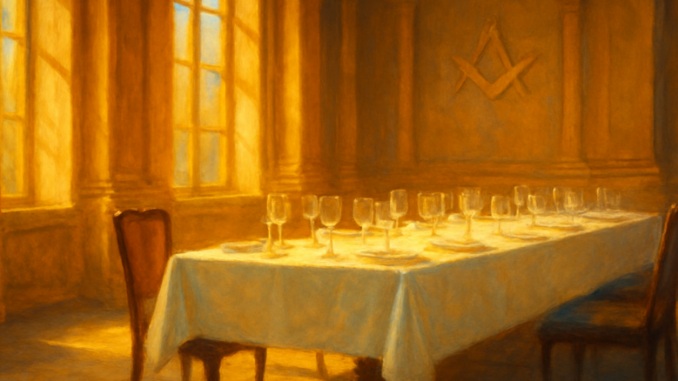
Picture a long table draped in white linen, set in one of the grand halls of a royal palace. Seated around it are not ministers or diplomats, but individuals who have distinguished themselves through talent, dedication, and the ability to move others. Among them, two musicians whose songs have touched millions. This is the so-called “outstanding achievers’ lunch” — a moment when the head of state pauses to honor individual merit. And it is precisely in that pause that a story begins, one far older than any royal house.
A Lunch That Reaches Beyond the Table
The news that a beloved musical duo was invited to dine with the royal couple naturally draws attention. It is a remarkable gesture: the head of state inviting individuals who have achieved something extraordinary in their field. No political agenda, no business interests — just pure recognition of personal quality. The guests are chosen not for their position in society, but for what they contribute through their work and character.
Anyone familiar with the traditions of Freemasonry will recognize something striking in this ritual. The lodge is a place where people are judged not by social rank, but by inner merit. Since the eighteenth century, when James Anderson published his famous Constitutions in 1723, the principle has held that every brother is valued for who he is and what he does — not for the title he carries or the wealth he possesses. The royal lunch, perhaps unintentionally, breathes that very same spirit.
The Masonic Tradition of Merit
Freemasonry has long maintained a deeply rooted system of recognition. It doesn’t come with red carpets or champagne, but in a more intimate way. When an Entered Apprentice develops through self-study, reflection, and brotherly engagement, he may be advanced to the degree of Fellow Craft and later raised to Master Mason. These degrees are not honorary titles in the conventional sense. They mark an inner growth that is observed and acknowledged by the brethren around him. It is recognition that comes from within the community, not imposed from without.
Aristotle wrote in his Nicomachean Ethics that true honor is not something you can bestow upon yourself. It is granted by others who recognize your virtue. Centuries later, Voltaire echoed this sentiment when he observed that merit can neither be hidden nor forced. In the lodge, this idea has remained very much alive. A brother who truly grows does not need to ask for recognition. His development is noticed, weighed, and confirmed at the right moment.
True recognition is not about applause for achievements — it is about seeing the person behind the work. That is what Freemasonry and the royal lunch share: the conviction that personal merit is the foundation of a just society.
Why We Need to Be Seen
There is something deeply human in the need for recognition. Not the superficial recognition of popularity or fame, but the feeling that someone truly sees what you contribute. The psychologist and philosopher William James — a contemporary of many Freemasons in nineteenth-century America — called the craving for appreciation the deepest drive in human nature. It is not vanity. It is the affirmation that you matter, that your work leaves a trace.
In an age where social media flood us with fleeting likes and thumbs-up icons, genuine recognition has become scarce. The royal lunch breaks that pattern. Two musicians who normally perform for thousands on stage are personally invited — not to perform, but to be seen as people who add something of true value. Something similar happens in the lodge when a brother receives words of appreciation after a lecture or a period of personal growth. Not publicly, not in front of cameras, but in the privacy of the temple, face to face with his fellow brethren.
The Quiet Power of the Gesture
What connects the royal lunch and Freemasonry may well be the understanding that the most powerful gestures are often the quietest. Johann Wolfgang von Goethe, himself a devoted Freemason for much of his life, wrote that the deed is everything and glory is nothing. He did not mean that recognition is unimportant, but that it only gains value when it springs from an honest appreciation of the deed itself — not from a desire to impress.
Wolfgang Amadeus Mozart, also a Freemason and a contemporary of Goethe, composed some of his most moving works for the lodge. Not for the general public, but for a small circle of brethren. The recognition he received there was no less valuable than the applause in Vienna’s concert halls. On the contrary — it was precisely the intimacy that gave it weight.
Recognition as a Building Block of Community
In today’s society, merit is often measured in numbers: ratings, followers, revenue. The royal lunch reminds us that a different standard exists. And Freemasonry has carried that standard for centuries. It is not about how many people you reach, but about the depth with which you do so. Not about the loudness of your success, but about the honesty with which you practice your craft.
In the lodge, every brother is received as an equal, regardless of his social status. Recognition follows inner growth, not outward display. The ritual of advancement marks a personal milestone, comparable in spirit to the gesture of a royal invitation. Both in the lodge and at the royal table, it is the quality of character that counts.
An Ancient Principle in Modern Dress
It would be easy to dismiss the royal achievers’ lunch as a charming but inconsequential gesture. But look more closely, and you will find a principle that reaches back to the oldest traditions of human community. From the ancient mystery schools to the medieval guilds, from Anderson’s Constitutions to the quiet rituals practiced in lodges around the world today, the message is consistent: what matters most is not what you have, but what you give — and who you become in the process.
The Masonic tradition teaches that every individual carries rough stone within, waiting to be shaped through effort, reflection, and moral discipline. When that shaping is recognized — whether across a royal table or within the pillared space of a lodge — it affirms something essential about our shared humanity. Recognition, in its truest form, is not a reward. It is a mirror held up to remind us of the best we can be.
Whether it takes place in a palace or a lodge room, the act of genuinely recognizing another person’s merit carries a quiet but profound power. It reminds us that beneath the noise of modern life, the oldest values still hold: integrity, dedication, and the willingness to grow. Freemasonry has understood this for centuries. The royal lunch, in its own way, speaks the same timeless language. And in a world hungry for authenticity, that language has never been more relevant.
Copyright text & image: devrijmetselaar.nl
Texts are based on the ideas and content of the author of devrijmetselaar.nl, reviewed, corrected, and supplemented with the assistance of OpenAI. Images are created based on the ideas of the author of devrijmetselaar.nl using OpenAI/DALL-E.
Frequently Asked Questions
What is the connection between Freemasonry and the royal lunch mentioned in the article?
The article draws a parallel between the royal lunch honoring outstanding achievers and Masonic traditions. Both recognize individuals based on merit and personal quality rather than social rank or position. The royal lunch reflects the same spirit that has guided Freemasonry since James Anderson's Constitutions of 1723, where brothers are valued for who they are and what they contribute, not for their titles or wealth.
How does Freemasonry recognize personal achievement and merit?
Freemasonry recognizes merit through a system of degrees—Entered Apprentice, Fellow Craft, and Master Mason—that mark inner growth and development. These degrees are not honorary titles but represent genuine personal advancement observed and acknowledged by the lodge community. Recognition in Freemasonry comes from within the brotherhood and is based on self-study, reflection, and brotherly engagement rather than external credentials or self-promotion.
What historical principle did James Anderson establish regarding merit in Freemasonry?
James Anderson's Constitutions, published in 1723, established the foundational principle that every brother is valued for who he is and what he does, regardless of his social rank, title, or wealth. This principle has remained central to Freemasonry for nearly three centuries and emphasizes that true recognition and honor come from the community's acknowledgment of a person's virtue and character.




Be the first to comment