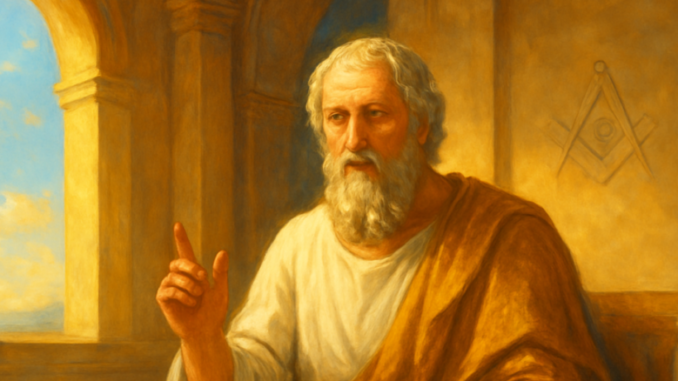
Imagine finding yourself in a debate where your opponent has no interest in truth — only in winning. How do you respond? This is precisely the situation Socrates faces in Plato’s dialogue Gorgias. It is a text that challenges you to confront a fundamental question: what matters more, persuasive speech or righteous action? This question has echoed through the centuries and strikes at the very heart of what Freemasons pursue in their rituals and labour.
The Sophists and Their Challenge to Philosophy
To understand Plato’s Gorgias, you need to transport yourself to fifth-century Athens. The city was alive with intellectual activity, and one group of thinkers commanded particular attention: the Sophists. These were itinerant teachers who, for a fee, instructed young Athenians in the art of speaking and persuading. Figures such as Protagoras, Hippias, and of course Gorgias of Leontini were celebrated for their eloquence.
The Sophists represented a radically new perspective. Protagoras declared that “man is the measure of all things,” suggesting that truth is relative. For them, rhetoric was not a means of discovering truth but a technique for persuading others, regardless of the content. This relativism posed the direct intellectual challenge against which Plato, through the voice of Socrates, pushes back in the Gorgias.
Socrates and the Search for the Good Life
Standing opposite the Sophistic tradition was Socrates with his radically different approach. Where the Sophists sold answers, Socrates asked questions. His method — the dialectic — consisted of systematically interrogating assumptions until his interlocutor uncovered the weaknesses in his own thinking. This was no trick for winning debates; it was a sincere quest for insight.
In the Gorgias, Socrates defends a position that must have shocked many of his contemporaries: it is better to suffer injustice than to commit it. This idea runs directly counter to the prevailing belief that power and success are the true measures of a well-lived life. Socrates places the health of the soul above all external advantages.
True eloquence does not serve power — it serves truth and justice.
Pythagoras and the Background of the Soul
Plato’s thinking about the soul in the Gorgias is deeply influenced by the Pythagorean tradition. Pythagoras, the legendary philosopher-mathematician of the sixth century BCE, taught that the soul is immortal and that earthly life is a period of purification. This view resonates when Socrates tells the myth of judgment after death, in which souls are assessed by their deeds rather than their words or worldly standing.
The Pythagorean influence also explains why Plato places such emphasis on inner harmony. Just as Pythagoras regarded musical proportions as expressions of cosmic order, Plato sees justice as the proper ordering of the soul. An unjust person is literally in disharmony with himself — a discord that no amount of clever rhetoric can resolve.
The Gorgias and Later Philosophical Traditions
The themes of the Gorgias reverberate through later philosophical movements. The Stoics — thinkers such as Seneca and Marcus Aurelius — built upon the Socratic insight that virtue is the only true good. For them, a person’s inner character mattered far more than outward circumstances. Seneca wrote extensively about the importance of a clear conscience over public approval.
The Renaissance humanists, too, drew on this Platonic inheritance. Erasmus and Montaigne criticised the hollow rhetoric of their own age and advocated for a philosophy that could genuinely improve daily life. Montaigne’s essays, in which he uses himself as the testing ground, are steeped in the same spirit of honest self-examination that Socrates demonstrates in the Gorgias.
Rhetoric, Justice, and the Freemason
You might wonder what these ancient philosophical debates mean for someone stepping into a lodge today. The tension Plato exposes — between appearance and reality, between persuasive power and truth — has not disappeared. In a world saturated with communication strategies and carefully constructed images, the question remains as urgent as ever: do you stand behind what you say, or do you say whatever advances your position?
Freemasonry invites you to work on yourself the way a stonemason works on rough stone. This process demands exactly the kind of honesty Socrates champions. The rituals and symbols are not rhetorical tricks; they are tools for self-knowledge. The square reminds you to measure your actions against justice — not against what others want to hear. The plumb line calls you to stand upright in your convictions, even when applause is not forthcoming.
In this light, the Masonic lodge becomes something like the Socratic dialogue itself: a space where superficial answers are stripped away and where the earnest pursuit of truth and moral integrity takes precedence over mere eloquence.
A Timeless Invitation
The Gorgias is not an easy text. Plato confronts you with uncomfortable questions about your own motives and the way you engage with others. Are you willing to be wrong if it brings you closer to the truth? Can you accept that righteous action sometimes earns no applause?
These questions never lose their relevance. Whether you live in ancient Athens or in the modern world, the choice between appearance and truth remains a daily challenge. Plato’s dialogue is therefore not merely a historical document — it is a living invitation to examine your own speech and conduct.
The philosophical richness of the Gorgias lies in the confrontation Plato stages: Sophistic cleverness against Socratic sincerity, power against justice. The influences of Pythagoras, the echoes in later Stoic and Renaissance thought, and the enduring relevance for anyone committed to self-improvement all make this a text that rewards repeated reading.
For those who walk the path of self-knowledge — whether as philosophers, Freemasons, or simply as seekers of a more examined life — Plato offers a dependable guide: seek not words that persuade, but a life that speaks for itself.
Copyright text & image: devrijmetselaar.nl
Texts are based on the ideas and content of the author of devrijmetselaar.nl, reviewed, corrected, and supplemented with the assistance of OpenAI. Images are created based on the ideas of the author of devrijmetselaar.nl using OpenAI/DALL-E.
Frequently Asked Questions
What is the main difference between the Sophists and Socrates in Plato's Gorgias?
The Sophists were itinerant teachers who taught rhetoric as a technique for persuasion and winning arguments, viewing truth as relative. Socrates, by contrast, used the dialectic method of asking questions to systematically uncover truth and genuine understanding. While Sophists sold answers for profit, Socrates pursued insight through sincere inquiry into justice and the good life.
How does Plato's Gorgias relate to Freemasonry?
The central question of Gorgias—whether persuasive speech or righteous action matters more—strikes at the heart of what Freemasons pursue in their rituals and labour. The dialogue's emphasis on the health of the soul, truth, and justice over external power and success aligns with Masonic principles of self-improvement and moral development.
What is Socrates' controversial position on justice in the Gorgias?
Socrates defends the shocking claim that it is better to suffer injustice than to commit it. This position directly contradicts the prevailing belief of his time that power and success are the true measures of a well-lived life. Instead, Socrates places the health and virtue of the soul above all external advantages.

Be the first to comment