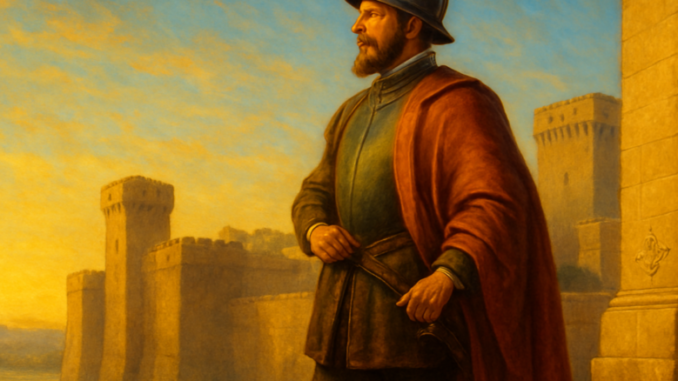
Imagine standing at the head of a fortress, surrounded by enemy troops. The walls are crumbling, supplies are dwindling, and your men look to you for guidance. What do you do? Negotiate? Fight to the bitter end? Seek an honorable way out? In his fifth essay from the first book, Michel de Montaigne examines exactly this dilemma — and in doing so, he offers surprisingly practical wisdom for anyone who has ever faced a difficult choice.
The Central Question of the Essay
Montaigne opens with a deceptively simple question: is it permissible for the commander of a besieged fortress to negotiate with the besieging enemy? In his era, this was a burning issue. The code of military honor demanded that a commander hold out to the last. But Montaigne, ever the clear-headed thinker, questions whether that rule is truly as absolute as it was claimed to be.
At the heart of the essay lies the tension between rigid rules and practical judgment. Montaigne argues that circumstances determine what is fair and wise. A commander who negotiates from a position of weakness acts very differently from one who negotiates from strength and secures favorable terms. It is not the act itself that matters, but the intention and the context in which it takes place.
Historical Examples and the Problem of Hindsight
As is his custom, Montaigne draws liberally from classical antiquity and the events of his own time. He cites cases in which commanders were condemned for surrendering their post too early, but also instances where negotiation was regarded as the wiser course. These examples are not meant as definitive answers — they serve as material for reflection.
One of Montaigne‘s most important observations is this: the outcome of a decision often determines how we judge it in retrospect. A commander who negotiates and wins is praised for his cleverness. The same commander who negotiates and loses is reviled as a coward. Montaigne sees a fundamental injustice in this tendency. We should judge people by their reasons, he insists, not merely by their results.
This insight resonates deeply within Freemasonry, where the emphasis is placed on a man’s character and intentions rather than the outward appearance of his actions. The Craft teaches us that integrity is measured not by what the world sees, but by what we know to be true within ourselves.
What This Essay Teaches About Decision-Making
This essay is far more than a historical curiosity. It offers a practical framework for making difficult decisions. Montaigne shows us that blind obedience to rules is not the same thing as courage. True courage requires the ability to assess a situation clearly and then act according to your best judgment — even when others will criticize you for it.
Consider the following principles that emerge from the essay:
First, judge each situation on its own merits, not solely by general rules. Second, ask yourself whether you are acting from a position of strength or weakness — this fundamentally changes how you should approach a negotiation or a compromise. Third, be aware that others will judge you by your results, even when that judgment is unfair. And fourth, take full responsibility for your choice, regardless of the outcome.
In your own life, these principles apply whenever you face a genuine dilemma. Perhaps it is a professional decision in which loyalty to your team conflicts with a better opportunity elsewhere. Perhaps it is a personal situation where you must decide whether to hold firm or seek a compromise. Montaigne would encourage you not to automatically choose the socially acceptable path, but to choose what you believe is right after careful deliberation.
The Role of Trust and Honor
A recurring theme in this essay is the question of trust. When a commander negotiates, he must be able to trust that the enemy will keep his word. Conversely, the enemy must be able to trust that the commander is neither bluffing nor deceiving. This mutual trust forms the foundation of every agreement.
Montaigne makes a point that Freemasons will immediately recognize: it is not the act itself that is honorable or dishonorable, but the spirit in which it is carried out. Honor does not reside in blindly following convention. It lies in acting consistently from your own principles, even when doing so is difficult.
A commander who negotiates because he genuinely believes it will spare the lives of his men acts more honorably than one who fights to the last man out of fear for his reputation. The first acts from conviction; the second from vanity. This distinction is crucial — and it applies far beyond the battlefield.
Practical Lessons for Daily Life
How do you apply this centuries-old wisdom to your own circumstances? Begin by asking the right questions. When facing a difficult choice, ask yourself: am I acting out of fear or out of conviction? Am I following rules because they make sense, or because I am afraid of being judged?
Next, assess your true position. Are you negotiating from strength or from weakness? This matters greatly. Someone negotiating from strength can afford to be generous. Someone negotiating from weakness must be more careful about what they concede.
Finally, accept that you cannot control how others will judge your decisions. You can only ensure that you act to the best of your ability and with sincere intentions. Everything else lies beyond your control. This realization is liberating — it removes the pressure to always be proven right and replaces it with the responsibility to act with integrity. For Freemasons, this echoes the moral teaching that we labor not for the applause of the world, but for the approval of our own conscience and the Great Architect.
Montaigne’s essay on the besieged commander may seem like a historical relic at first glance. But look deeper, and you will find a timeless guide to making hard decisions. It is not about finding the perfect answer — it is about asking the right questions. When am I acting from strength, and when from weakness? What are my true reasons? And am I willing to take responsibility for my choice, regardless of how others judge it after the fact? These are questions that remain relevant every single day, whether you are defending a fortress or simply trying to do the right thing in a complicated world.
Copyright text & image: devrijmetselaar.nl
Texts are based on the ideas and content of the author of devrijmetselaar.nl, reviewed, corrected, and supplemented with the assistance of OpenAI. Images are created based on the ideas of the author of devrijmetselaar.nl using OpenAI/DALL-E.
Frequently Asked Questions
How does Montaigne's essay relate to Freemasonry?
Montaigne's emphasis on character, intention, and personal integrity aligns perfectly with Masonic principles, which teach that a man's true measure lies in his inner virtue rather than external circumstances. The essay's focus on thoughtful judgment and moral courage reflects the Craft's commitment to developing men of wisdom and principle. Freemasonry similarly teaches that right action comes from understanding context and acting with integrity, even when facing criticism or difficult choices.
What does the essay teach about courage?
Montaigne redefines courage not as blind obedience to rigid rules, but as the ability to assess a situation clearly and make sound judgments based on circumstances. This understanding of courage as reasoned action rather than reckless stubbornness is fundamental to Masonic teaching, which encourages members to develop wisdom alongside bravery. True courage, the essay suggests, requires both moral clarity and the strength to stand by your decision despite potential criticism.
Why is Montaigne's view on judgment important for Freemasons?
Montaigne warns against judging decisions solely by their outcomes, arguing instead that we should evaluate people by their reasoning and intentions. This principle is vital in Freemasonry, where members are taught to develop moral discernment and to support one another based on character rather than results. The essay reinforces the Masonic ideal that a man of integrity acts according to his best judgment and conscience, regardless of how circumstances may later appear to others.
What practical wisdom can I apply from this essay?
The essay teaches you to evaluate each decision on its own merits rather than blindly following general rules, and to consider whether you are acting from genuine wisdom or mere fear. Masons can apply this by cultivating careful judgment, understanding the full context of their choices, and having the courage to act according to their informed conscience. This approach develops the kind of thoughtful leadership and personal integrity that Freemasonry seeks to cultivate in its members.

Be the first to comment