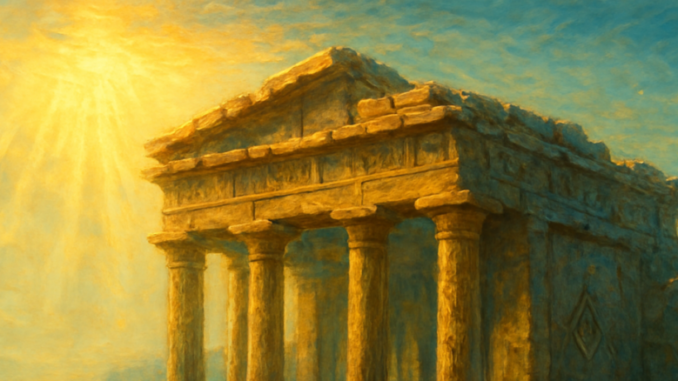
What if the most important lesson of a vanished civilization lies not in its existence, but in its destruction? More than two thousand years ago, Plato wrote about a mighty island empire brought low by its own hubris. Since then, the story has captivated philosophers, adventurers, and seekers alike. But for the Freemason, this myth may hold a deeper significance — one that has nothing to do with geography or archaeology, and everything to do with the eternal human quest for wisdom, the dangers of moral decay, and the possibility of rebuilding what was lost.
The Origin of an Enduring Mystery
In his dialogues Timaeus and Critias, Plato introduced the story of a powerful civilization said to have existed some nine thousand years before his own era. This island empire, located beyond the Pillars of Heracles, reportedly possessed unparalleled knowledge of architecture, mining, and statecraft. Its inhabitants had built temples of silver and gold, carved canals that crisscrossed the entire island, and created a society that initially lived in harmony with the divine order.
But here the real lesson begins. Plato did not write this story as history. He used it as a philosophical instrument — a mirror in which his contemporaries could recognize the dangers inherent in their own civilization. The question he posed was not “Did this island actually exist?” but rather: “What happens to a society that neglects its moral foundations?”
Hubris as the Root of Decline
The turning point in Plato’s narrative is deeply telling. As long as the island’s inhabitants honored their divine heritage and valued virtue above wealth, their civilization flourished. But as generations passed, the divine element in their blood grew thin — a metaphor Plato used for the gradual erosion of moral values. The people became greedy, warlike, and blinded by their own power. The gods, so the story goes, resolved to punish them, and the island vanished beneath the waves in a single day and night.
The sunken island is not a geographical riddle but a moral warning: any civilization that trades wisdom for arrogance is building toward its own destruction.
This message resonates deeply with the core values of Freemasonry. The Craft constantly warns against the dangers of unbridled ambition and reminds its members that true greatness lies not in outward power, but in inner refinement. The rough ashlar that must be shaped — a central symbol in Freemasonry — points precisely to this process of self-improvement and the tempering of our baser impulses.
Lost Wisdom and the Search for Light
In the centuries after Plato, the myth grew into a powerful symbol for lost knowledge. Renaissance thinkers such as Marsilio Ficino, and later Francis Bacon, speculated about the wisdom that may have perished with the island. Bacon even wrote The New Atlantis as a utopian vision of a society that kept science and morality in balance. This tradition of searching for lost insight and rebuilding an ideal commonwealth finds a clear echo in Freemasonry.
The Freemason sees himself as a builder — not only of physical structures, but of a better world. The temple construction referenced in Masonic ritual points to the building of an inner temple of wisdom, but also to the ideal of a more just society. In this sense, the story of the sunken island is not merely a warning; it is also an invitation. What was lost can be rebuilt, provided the right foundations are laid.
The Lesson of the Catastrophe
There is another dimension to this story that is rarely examined. The fall of the island empire was not the result of an external enemy or a natural disaster in the usual sense. It was the consequence of inner decay. The gods only intervened after the inhabitants had already lost their moral compass. This places responsibility exactly where Freemasonry places it as well: with the individual and the community themselves.
Aristotle, Plato’s student, would later write about virtue as the mean between two extremes. The inhabitants of the mythical island lost that mean. Their technical progress outpaced their moral development — an imbalance that is strikingly recognizable in our own time. When we consider artificial intelligence, climate change, or geopolitical tensions, the same question echoes: do we possess the wisdom to use our power responsibly?
The Counterbalance: Architecture of the Soul
Here Freemasonry offers a perspective that reaches beyond pessimism. The Craft acknowledges that decline is always possible, but it emphasizes with equal conviction that rebuilding can always begin. Every Freemason who enters the Lodge starts symbolically as an Apprentice — regardless of social standing or prior knowledge. This ritual setting aside of outward distinctions reflects a profound understanding: true wisdom does not automatically flow from power or success.
Consider the principles that the Atlantis myth and Freemasonry share in common: self-knowledge as the foundation for all progress; brotherhood as a counterweight to isolating individualism; ritual as a reminder of timeless values; and building metaphors as a call to constructive action.
The tale of the vanished island is therefore no invitation to melancholy over lost gold and faded glory. It is a call to vigilance and, at the same time, to hope. What was built can be rebuilt — provided the builders acknowledge their moral responsibility.
A Question That Endures
Plato left his dialogue Critias unfinished. We do not know exactly how he intended to describe the punishment of the gods. Some scholars see this as a deliberate choice: the story was meant to remain open, so that each generation could draw its own conclusions. Perhaps that is the deepest lesson of all. The sunken island remains beneath the waves, but the questions it raises continue to surface — in philosophy, in culture, and within the quiet, reflective work of the Lodge.
For the Freemason, the myth of the lost island is more than an ancient curiosity. It is a living allegory — a reminder that civilizations rise and fall on the strength of their moral foundations, and that the work of building a just and wise society is never finished. Each time a Brother takes up the symbolic tools of the Craft, he answers Plato’s unfinished question in his own way: not with words alone, but with the patient, deliberate labor of shaping a better self and a better world.
Copyright text & image: devrijmetselaar.nl
Texts are based on the ideas and content of the author of devrijmetselaar.nl, reviewed, corrected, and supplemented with the assistance of OpenAI. Images are created based on the ideas of the author of devrijmetselaar.nl using OpenAI/DALL-E.
Frequently Asked Questions
What is the main purpose of Plato's Atlantis story according to this article?
According to the article, Plato did not write the Atlantis story as literal history, but as a philosophical instrument—a mirror in which his contemporaries could recognize the dangers in their own civilization. The real question Plato posed was not whether the island actually existed, but rather what happens to a society that neglects its moral foundations.
How does the fall of Atlantis relate to Freemasonry?
The article explains that the Atlantis myth resonates deeply with core Freemasonry values. The story serves as a moral warning against unbridled ambition and the trade of wisdom for arrogance. Freemasonry uses symbols like the rough ashlar to represent the process of self-improvement and inner refinement, reminding members that true greatness lies in inner development, not outward power.
What was the root cause of Atlantis's destruction in Plato's account?
According to Plato's narrative, Atlantis declined due to hubris and moral decay. As long as the inhabitants honored their divine heritage and valued virtue above wealth, the civilization flourished. However, over time, the people became greedy and warlike, blinded by their own power. The gods resolved to punish them, and the island vanished beneath the waves in a single day and night—serving as a metaphor for the consequences of abandoning moral foundations.

Be the first to comment