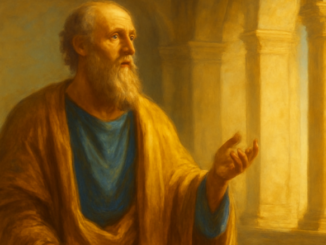
Ancient Greek temple columns symbolizing Plato's philosophical quest for courage
Plato – Content & Summary

Plato’s Laches: A Timeless Search for True Courage

In fifth-century Athens, among the olive groves and gymnasiums where young men prepared for the challenges of life, a deceptively simple question pressed itself with great urgency: what does it truly mean to be courageous? Plato’s dialogue Laches transports us into a conversation where this question was not treated as an abstract philosophical puzzle, but as a living concern of fathers who wanted to raise their sons to become virtuous citizens. The answers that Socrates and his interlocutors found — or rather, failed to find — continue to shed light on our own struggles with bravery, fear, and moral integrity. The Historical Backdrop of the Dialogue The Laches unfolds against the backdrop of an Athens that had just endured the opening phase of the Peloponnesian War. Courage was no abstract virtue — it was a daily necessity. The two generals who feature in the dialogue, Laches and Nicias, were both seasoned veterans intimately familiar with the realities of the battlefield. Laches would later fall at the Battle of Mantinea; Nicias would lead a disastrous expedition to Sicily. Plato chose these historical figures deliberately: their ultimate fates cast a long shadow over the entire conversation, as though the philosopher wanted to […]
Open book showing Montaigne's Essays with focus on the essay about fear
Michel de Montaigne – Content & Summary

Montaigne on Fear: Summary and Analysis of Essay 17

In 1580, a collection of essays appeared that would permanently reshape Western literature. Michel de Montaigne, the French nobleman and philosopher, wrote about everything that occupied his restless mind — from friendship to cannibalism. In the seventeenth essay of his first book, he turned his attention to a universal human experience: fear. This relatively short piece reveals just how profoundly Montaigne understood the human psyche, centuries before modern psychology would even begin to take shape. The Core Idea of the Essay Montaigne opens with a paradox that sets the tone for his entire argument: fear is the emotion he fears most. What seems like a clever play on words actually conceals a profound truth. Montaigne is not primarily concerned with the concrete dangers that threaten us, but with what fear does to the human mind. Fear robs us of our capacity for reason and strips us of our dignity. It transforms a soldier into a coward and a wise man into a fool. The central thesis of the essay is that fear is a more powerful and more disruptive emotion than any other passion. Even anger, grief, or desire leave the human mind somewhat intact. Fear, by contrast, takes complete […]

Open book of Montaigne's Essays symbolising courage and moral reflection
Michel de Montaigne – Content & Summary

Montaigne on Cowardice: Courage as a Practical Virtue

Imagine walking away at the very moment your presence matters most. Not because you are weak, but because fear has overpowered your will. In his fifteenth essay, Michel de Montaigne posed an uncomfortable question: does flight deserve punishment, or is cowardice already its own punishment? Written in the sixteenth century, this brief but penetrating essay remains strikingly relevant for anyone who reflects on courage, character, and the choices we make under pressure. The Heart of the Essay In ‘On the Punishment of Cowardice,’ Montaigne examines a practical moral question: how should society deal with soldiers who flee out of fear? He describes how, in his own time, cowardice on the battlefield was often punished by death. Yet he wonders whether such punishment is truly just. Can a person be punished for something that seems to lie beyond his control? Montaigne draws a crucial distinction. There is a difference between someone who deliberately abandons his post and someone who is overwhelmed by blind panic. The first acts out of free will; the second is a victim of his own nature. This distinction has direct consequences for how we think about responsibility and character — not only in warfare, but in every […]

Freemasons in lodge discussing different perspectives in brotherhood
Personal Development & Leadership

Two Opinions, One Goal: Psychology and Brotherhood

In 1958, a sports psychologist advised the Brazilian national football coach to leave two young players at home before the World Cup. Those players would go on to become legends. The advice was ignored, Brazil won the tournament, and the psychologist faded into the shadows of history. Yet hidden within this story lies a deeper truth about brotherhood, trust, and the courage to offer a dissenting opinion — even when the world seems to prove you wrong. The Outsider’s Perspective Imagine you are a scientist — a pioneer in the field of sports psychology at a time when the discipline is barely taken seriously. You are tasked with evaluating the mental readiness of a group of footballers. After careful analysis, you arrive at a conclusion that runs directly counter to what everyone wants to hear. Two young players, however talented, show signs of emotional instability that, according to your tests, make them unfit for the pressure of a World Cup. You know your recommendation will be unpopular. You know your reputation is on the line. And yet you speak what you believe to be true. This is the outsider’s perspective: someone who is not part of the group, who has […]