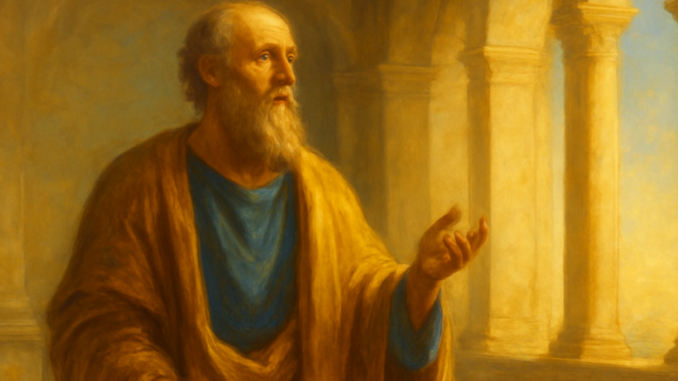
In fifth-century Athens, among the olive groves and gymnasiums where young men prepared for the challenges of life, a deceptively simple question pressed itself with great urgency: what does it truly mean to be courageous? Plato’s dialogue Laches transports us into a conversation where this question was not treated as an abstract philosophical puzzle, but as a living concern of fathers who wanted to raise their sons to become virtuous citizens. The answers that Socrates and his interlocutors found — or rather, failed to find — continue to shed light on our own struggles with bravery, fear, and moral integrity.
The Historical Backdrop of the Dialogue
The Laches unfolds against the backdrop of an Athens that had just endured the opening phase of the Peloponnesian War. Courage was no abstract virtue — it was a daily necessity. The two generals who feature in the dialogue, Laches and Nicias, were both seasoned veterans intimately familiar with the realities of the battlefield. Laches would later fall at the Battle of Mantinea; Nicias would lead a disastrous expedition to Sicily. Plato chose these historical figures deliberately: their ultimate fates cast a long shadow over the entire conversation, as though the philosopher wanted to warn us that theoretical definitions of courage do not automatically translate into wise action.
The discussion begins with what appears to be a straightforward practical question. Two fathers, Lysimachus and Melesias, want to know whether they should have their sons trained in armed combat. They consult the two generals, who offer conflicting advice. When the conversation reaches an impasse, Laches suggests calling upon Socrates — a man renowned not only for his wisdom but also for his genuine courage at the Battle of Delium, where eyewitnesses reported that he conducted himself fearlessly during a chaotic retreat.
The Search for a Definition
Socrates, characteristically, redirects the discussion from the practical question to the fundamental one: before we can decide how to instill courage, we must first understand what courage actually is. This is the Socratic method at its finest. Rather than offering ready-made answers, he begins by exposing the limits of what we think we know.
Laches makes the first attempt. He defines courage as standing firm and not fleeing from the enemy. But Socrates quickly demonstrates that this definition falls short: sometimes retreat is the courageous choice, as the Scythian warriors showed when they fought while falling back. Moreover, courage is not confined to the battlefield — it manifests in the face of illness, poverty, political pressure, and even in confronting our own desires and temptations.
True courage is not the absence of fear, but the capacity to act according to what is genuinely good despite that fear.
Where Knowledge and Bravery Intertwine
Nicias offers a more refined definition: courage is the knowledge of what truly ought to be feared and what ought not. This intellectualist approach sounds convincing at first. The courageous person is not blindly brave but understands which dangers are worth confronting and which are not.
Yet this definition proves equally problematic under scrutiny. If courage is merely a form of knowledge, does it not become part of a broader wisdom? And if someone possesses complete knowledge of good and evil, past and future, would that person not possess all virtues simultaneously? The dialogue ends in aporia — an impasse. None of the proposed definitions survives the rigors of Socratic examination.
This open ending is not a failure but a pedagogical triumph. Plato reveals that courage cannot be neatly defined in isolation, because it is woven into the fabric of the entire human soul and intertwined with other virtues such as wisdom, temperance, and justice.
What This Means for Freemasons
Plato’s line of inquiry resonates deeply with the symbolic tradition of Freemasonry. In the lodge, the candidate is sent on a journey — not only through physical spaces but through inner landscapes of fear and uncertainty. The courage demanded on this path is precisely the kind of courage Socrates sought: not the blind bravery of someone who fails to perceive danger, but the conscious choice to step into the unknown, trusting one’s own inner compass.
The chisel and the gavel, symbols of self-refinement, echo the Socratic insight that courage cannot be separated from self-knowledge. Those who do not know themselves cannot discern what truly deserves to be feared. The rough ashlar is not shaped into a perfect cube through reckless blows, but through continuous reflection on what must be removed and what must be preserved.
Several key themes from the Laches speak directly to the Masonic experience:
Courage as part of a constellation of virtues, never as an isolated trait. The necessity of rigorous self-examination before one can presume to lead others. The willingness to acknowledge one’s own ignorance as the first step toward genuine wisdom. And perhaps most importantly: standing firm where it truly matters, even when no one is watching.
A Lesson from the Past for the Present
The Laches reminds us that courage cannot be measured by spectacular deeds alone. The fathers in the dialogue wanted to raise their sons to be brave men, but Socrates showed them that such an endeavor must begin with an honest question: do we ourselves actually know what courage is? In an age when courage is often confused with loudness or indifference to consequences, Plato offers a powerful corrective. True bravery requires knowledge, reflection, and the willingness to examine one’s own assumptions.
For anyone walking the path of self-improvement — whether within the walls of a lodge or in the quiet of a personal study — the central question of the Laches remains as vital as ever. Not whether we appear courageous, but whether we truly understand what it means to be courageous. Asking that question may itself be the first courageous act.
The dialogue Laches leaves us with more questions than answers — and that is precisely the point. Plato’s Socrates invites us into a lifelong inquiry into the nature of courage, an inquiry that does not end with a tidy definition but penetrates every aspect of how we live. For every Freemason and every seeker striving toward personal growth and moral depth, this classical work remains an indispensable companion on the journey toward the light.
Copyright text & image: devrijmetselaar.nl
Texts are based on the ideas and content of the author of devrijmetselaar.nl, reviewed, corrected, and supplemented with the assistance of OpenAI. Images are created based on the ideas of the author of devrijmetselaar.nl using OpenAI/DALL-E.
Frequently Asked Questions
What is the main question explored in Plato's Laches dialogue?
The main question is: what does it truly mean to be courageous? Rather than treating courage as an abstract philosophical puzzle, Plato presents it as a living concern through a conversation between Socrates and two Athenian generals, Laches and Nicias, who are consulted by fathers wanting to raise virtuous sons.
Why did Plato choose historical military figures like Laches and Nicias for this dialogue?
Plato deliberately chose these seasoned generals because they were intimately familiar with battlefield realities during the Peloponnesian War. Their ultimate fates—Laches falling at the Battle of Mantinea and Nicias leading a disastrous expedition to Sicily—cast a shadow over the dialogue, warning that theoretical definitions of courage do not automatically translate into wise action.
How does Socrates approach finding the definition of courage in the dialogue?
Socrates uses the Socratic method by redirecting the practical question about military training into a fundamental inquiry about what courage actually is. Rather than offering ready-made answers, he exposes the limits of the interlocutors' assumptions, such as challenging Laches' initial definition that courage means standing firm and not fleeing from enemies.

Be the first to comment