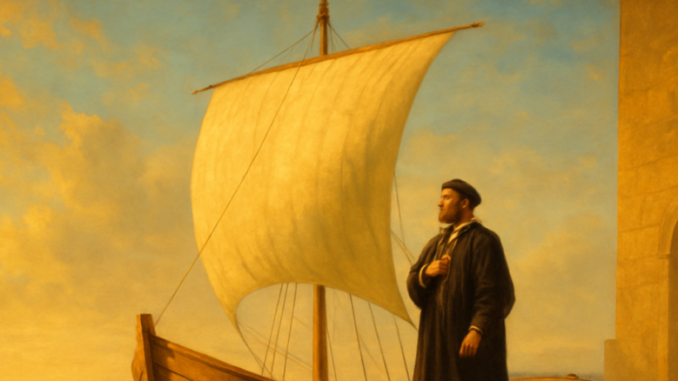
Imagine walking away at the very moment your presence matters most. Not because you are weak, but because fear has overpowered your will. In his fifteenth essay, Michel de Montaigne posed an uncomfortable question: does flight deserve punishment, or is cowardice already its own punishment? Written in the sixteenth century, this brief but penetrating essay remains strikingly relevant for anyone who reflects on courage, character, and the choices we make under pressure.
The Heart of the Essay
In ‘On the Punishment of Cowardice,’ Montaigne examines a practical moral question: how should society deal with soldiers who flee out of fear? He describes how, in his own time, cowardice on the battlefield was often punished by death. Yet he wonders whether such punishment is truly just. Can a person be punished for something that seems to lie beyond his control?
Montaigne draws a crucial distinction. There is a difference between someone who deliberately abandons his post and someone who is overwhelmed by blind panic. The first acts out of free will; the second is a victim of his own nature. This distinction has direct consequences for how we think about responsibility and character — not only in warfare, but in every arena of life where we are tested.
Lessons from Antiquity
As is typical of his essays, Montaigne draws liberally from classical antiquity. He references the Roman practice of decimation, in which every tenth soldier from a fleeing legion was executed as a deterrent. This brutal method was intended to instill courage in the survivors. But Montaigne questions whether fear can truly be conquered by more fear.
He also cites the example of generals who deliberately left their troops an escape route rather than cornering them. An army with no way out fights more desperately, but not necessarily more bravely. True courage, Montaigne suggests, does not arise from having no options. It comes from the conscious choice to hold your ground when retreat is entirely possible.
Courage as a Matter of Character
What makes this essay so enduringly valuable is Montaigne’s nuanced view of human behaviour. He refuses to condemn cowardice outright. Instead, he investigates its roots. Is cowardice a flaw of character, or an unfortunate trait some people are simply born with? If the latter is true, how just is it to punish someone for something he never chose?
Courage is not the absence of fear, but the choice to act rightly despite it.
Yet Montaigne is no moral relativist. He readily acknowledges that cowardice is harmful — to the individual and to those who depend on him. A soldier who flees endangers his comrades. But the remedy, in his view, lies not primarily in punishment. It lies in the cultivation of courage as a virtue — a process that begins long before anyone sets foot on a battlefield. This is an insight with deep resonance for anyone engaged in the work of self-improvement and the building of moral character.
Practical Lessons for Everyday Life
Most of us will never stand on a battlefield, yet we readily recognise the situations Montaigne describes. The moment you should have spoken up but stayed silent. The time you looked the other way when someone needed help. The decision to take the easy path when you knew what the right one was.
Montaigne’s essay suggests several practical principles that remain as useful today as they were four centuries ago:
First, recognise your own fears before they ambush you. Self-knowledge is the foundation upon which courage is built. Second, practise courage in small situations so that you are prepared when the larger tests arrive. Third, judge others with the same compassion you would want applied to yourself. And finally, see cowardice not as a final verdict on someone’s character, but as a signal — an invitation to grow.
Montaigne teaches us that courage is not a fixed trait you either possess or lack. It is a skill that can be developed through honest self-reflection. Where am I inclined to flee? Which fears are quietly shaping my decisions without my awareness? By asking these questions, you begin to lay the foundation for genuine courage.
Why Montaigne Still Matters
This essay is part of Montaigne’s larger project: examining the human condition without prejudice. He was not a moralist dispensing judgement from on high, but an inquirer who subjected himself to scrutiny before anyone else. His famous motto — Que sais-je? (What do I know?) — reflects the same intellectual humility that runs through this essay.
For modern readers, Montaigne offers a refreshing perspective. In an age of quick judgements and public shaming, he reminds us that human behaviour is rarely black and white. Cowardice and courage are not absolute categories. They are points on a spectrum along which we all move, depending on circumstance, preparation, and the inner work we have done on ourselves.
Michel de Montaigne’s essay on cowardice is far more than a historical treatise on military discipline. It is an invitation to look honestly at ourselves and to acknowledge that courage is a daily practice. Not by denying our fears, but by knowing them — and still choosing to do what is right. That is the essence of character formation that Montaigne holds before us, a message that has lost none of its power in more than four hundred years.
Copyright text & image: devrijmetselaar.nl
Texts are based on the ideas and content of the author of devrijmetselaar.nl, reviewed, corrected, and supplemented with the assistance of OpenAI. Images are created based on the ideas of the author of devrijmetselaar.nl using OpenAI/DALL-E.
Frequently Asked Questions
What is Montaigne's main argument about punishing cowardice?
Montaigne questions whether soldiers who flee out of fear should be punished by death, arguing that there is an important distinction between deliberate abandonment of duty (which involves free will) and being overwhelmed by blind panic (which may be beyond a person's control). He suggests that cowardice may already be its own punishment without requiring additional legal consequences.
How does Montaigne define true courage?
According to Montaigne, true courage is not the absence of fear, but the conscious choice to act rightly despite fear. He argues that genuine courage arises from freely choosing to hold your ground when retreat is entirely possible, rather than from being forced into a situation with no way out.
Does Montaigne believe cowardice is a choice or an inborn trait?
Montaigne investigates whether cowardice is a flaw of character that people choose or an unfortunate trait some people are simply born with. This distinction matters significantly for determining moral responsibility, as punishing someone for an inborn trait raises serious questions about justice.


Be the first to comment