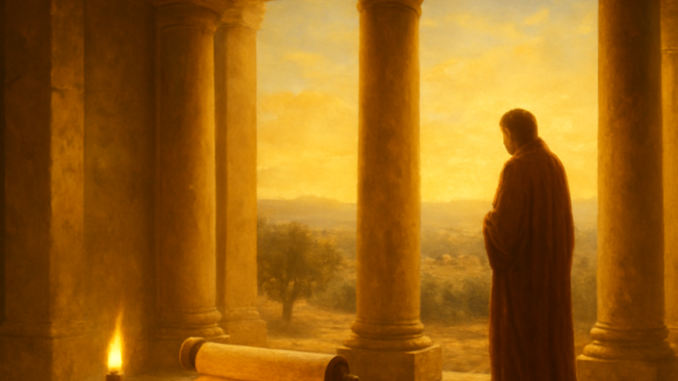
Imagine you have reached the end of a long journey. Everything you have learned, everything you have built, is at risk of being lost — unless you pass it on to someone else. This was precisely the situation the Apostle Paul found himself in when he wrote his second letter to Timothy. For Freemasons, this scenario resonates deeply. The question of how we transmit our insights and virtues to the next generation lies at the heart of both this New Testament epistle and Masonic ritual.
The Heart of Paul’s Second Letter to Timothy
The second letter to Timothy is often regarded as Paul’s spiritual last will and testament. Written from a Roman prison, Paul knew his time was short. Yet the letter contains no self-pity or fear. Instead, he focuses entirely on preparing his student Timothy to carry the work forward. The epistle offers concrete guidance on steadfastness, preserving sound doctrine, and enduring hardship like a good soldier.
What makes this letter remarkable is its deeply personal tone. Paul mentions specific people by name, shares memories, and speaks candidly about his own struggles. He compares the spiritual life to an athletic contest and to a farmer patiently waiting for the harvest. These are not abstract metaphors — they evoke recognizable situations in which perseverance and faithfulness are everything.
Passing the Light: Mentorship in Practice
In Freemasonry, mentorship plays an essential role. When a candidate is initiated, he is assigned a mentor who guides him through his first steps. This is no mere formality — it is a living tradition of knowledge transmission. Paul did exactly the same with Timothy. He wrote: “The things you have heard me say in the presence of many witnesses, entrust to reliable people who will also be qualified to teach others” (2 Timothy 2:2). This principle of successive transmission lies at the heart of both traditions.
Wisdom only becomes valuable when it is passed on; knowledge that dies with its bearer has missed its purpose.
In practical terms, this means a Freemason actively looks for opportunities to guide younger Brethren. Not by delivering lengthy lectures, but by being available for questions, by setting an example through personal conduct, and by patiently waiting until the student arrives at his own insights. Paul called this “fanning into flame the gift” that already existed within Timothy.
Fighting the Good Fight: Steadfastness as a Virtue
One of the most famous passages from the letter reads: “I have fought the good fight, I have finished the race, I have kept the faith” (2 Timothy 4:7). This is not the language of war but a description of inner discipline. For Paul, it was about persevering despite setbacks, remaining true to one’s principles when the path grew difficult.
In Masonic terms, we recognize this as the journey from the rough ashlar to the perfect ashlar. The shaping of one’s own character is not a single event but a lifelong process. The mallets and chisels with which we work are symbolic, but the labor is very real. It demands daily choices: remaining honest when dishonesty would be easier, staying patient when frustration beckons, holding onto sincerity when cynicism seems more appealing.
Practical Steps for Today
How do we translate this ancient wisdom into concrete actions in our own lives? Here are several suggestions drawn from both the letter to Timothy and the Masonic tradition:
First, identify someone in your circle who would benefit from your experience and commit to speaking with them regularly. Second, write down the most important lessons life has taught you — not for publication, but as an exercise in thinking clearly about what you want to pass on. Third, when you face a difficult situation, ask yourself: “How would I want my student to see me act right now?” Finally, evaluate your own “work” on a monthly basis. Where have you grown? Where is there still rough stone to be shaped?
The Flame That Must Not Die
Paul uses the image of a flame that must be fanned into life. This image resonates powerfully with the symbolism of light in Freemasonry. The light a candidate receives at his initiation is not meant to be kept for himself. It is a flame that must be passed on, from generation to generation.
Marcus Aurelius wrote in his Meditations that we are like torchbearers in a relay race. Our task is not to run the entire race ourselves, but to pass the burning torch to the next runner. This Stoic insight aligns seamlessly with what Paul conveyed to Timothy and with what Freemasons have practiced since time immemorial.
Confronting Finitude
What gives the second letter to Timothy its particular urgency is the awareness of finitude. Paul knew he did not have long to live. Rather than sinking into despair, this realization spurred him to action. For us as readers, centuries later, the message is clear: do not wait until it is too late to share your knowledge and wisdom. Begin today to help form the next generation.
The second letter to Timothy is far more than a historical document. It is a practical guide for anyone who reflects on what they will leave behind. For Freemasons, it holds up a mirror: are we actively passing on our insights? Are we fanning the flame in others? The answers to these questions determine not only our own legacy but also the future of the Brotherhood itself. The torch is burning. The question is — to whom will you pass it?
Copyright text & image: devrijmetselaar.nl
Texts are based on the ideas and content of the author of devrijmetselaar.nl, reviewed, corrected, and supplemented with the assistance of OpenAI. Images are created based on the ideas of the author of devrijmetselaar.nl using OpenAI/DALL-E.
Frequently Asked Questions
What is the main connection between 2 Timothy and Freemasonry?
Both emphasize the transmission of knowledge and virtues to the next generation through mentorship. Paul's letter to Timothy focuses on preparing his student to carry spiritual work forward, just as Freemasonry assigns mentors to guide candidates through their journey. The principle of successive transmission—where wisdom is passed from one reliable person to another—lies at the heart of both traditions.
How does mentorship work in Freemasonry according to this article?
When a candidate is initiated into Freemasonry, he is assigned a mentor who guides him through his first steps. This is a living tradition of knowledge transmission. Effective mentorship involves being available for questions, setting an example through personal conduct, and patiently waiting until the student arrives at his own insights, rather than delivering lengthy lectures.
Why did Paul write his second letter to Timothy?
Paul wrote from a Roman prison, knowing his time was short, to prepare Timothy to carry forward the spiritual work. The letter is considered Paul's spiritual last will and testament, offering concrete guidance on steadfastness, preserving sound doctrine, and enduring hardship. Rather than expressing self-pity, Paul focused entirely on ensuring his teachings would not be lost when passed to the next generation.




Be the first to comment