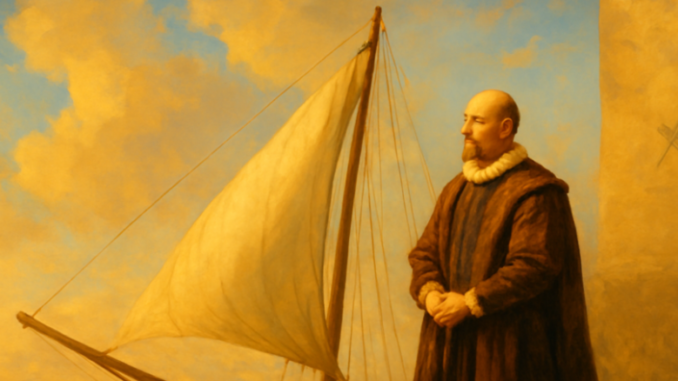
Imagine sitting at a table with someone from an entirely different culture. You eat differently, greet differently, dress differently. Yet when you look into their eyes, you recognize the same curiosity, the same longing for connection. Michel de Montaigne captured exactly this feeling in his essay ‘Of Custom,’ showing how deeply habits are embedded within us — and how liberating it can be to see past them. For Freemasons, this essay strikes at the heart of their work: looking beyond outward differences to discover what truly unites people.
Why Customs Make Us Blind
In this forty-ninth essay from his first book, Montaigne assembled a colorful parade of customs from every corner of the world. Peoples who ate naked, cultures where blowing your nose was considered rude, societies with radically different views on property and marriage. His aim was never to shock. It was to reveal how arbitrary many of our daily habits truly are. What you experience as ‘normal’ is utterly foreign to someone else — and vice versa.
This insight has immediate consequences for everyday life. Think about how you react when a colleague tackles a problem differently than you would. Or how uncomfortable you might feel encountering an unfamiliar ritual while traveling abroad. That discomfort isn’t a sign that the other person is doing something wrong. It’s a sign that your own habits run so deep you’ve mistaken them for universal truths. Montaigne invited his readers to recognize that mechanism — and to break through it.
The Freemason as a Conscious Observer
Within Freemasonry, self-reflection plays a central role. During initiation, a candidate is asked to quite literally stand still with himself in what is known as the Chamber of Reflection — a dark, solitary room designed for introspection. That first step is no coincidence: it is an invitation to confront your own prejudices, assumptions, and automatic reactions. This is precisely what Montaigne proposed. The French essayist and the Masonic tradition share a deep conviction that genuine growth begins with honestly examining your own framework of thought.
Here is a concrete way to put this into practice. Choose a moment this week when you catch yourself judging someone else’s behavior. Pause, and ask yourself two questions: ‘Is my reaction based on a universal truth, or on a learned habit?’ and ‘What would I see if I considered the other person’s custom as equally valid as my own?’ These are not abstract philosophical exercises. They are tools for daily use, much like the working tools that serve as guides for moral conduct in Freemasonry.
Brotherhood Beyond Cultural Borders
One of the most powerful aspects of Montaigne’s essay is that he establishes no hierarchy between cultures. He does not place European customs above those of other peoples. In fact, he uses the sheer diversity of human habits to demonstrate that no single culture holds the exclusive right to ‘the correct way of living.’ This aligns seamlessly with one of Freemasonry’s core values: universal brotherhood. In a lodge, people meet regardless of their background, faith, or social standing. That meeting can only be truly sincere when everyone is willing to set aside their own cultural lens.
Those who come to understand that their own customs are not the only measure open the door to genuine brotherhood — because real connection only emerges when judgment falls silent.
Throughout his essays, Montaigne repeatedly referenced classical thinkers like Plutarch and Seneca, who likewise emphasized that wisdom begins with acknowledging your own ignorance. Socrates, the Greek philosopher who declared that he only knew that he knew nothing, forms in many ways the philosophical foundation beneath both Montaigne’s essays and the Masonic quest for light and knowledge. The Freemason does not seek definitive answers, but ever-deeper understanding.
Three Practical Steps to Examine Your Customs
It is tempting to leave things at intellectual insight, but Montaigne’s essay calls for action. Below are three concrete steps you can take today, inspired by both his philosophy and Masonic practice.
1. Keep a habit journal. For one week, write down one moment each day when you reacted automatically out of habit rather than conscious choice. Note what happened, how you responded, and what alternative might have been possible. This mirrors the self-reflection Freemasons practice after every lodge meeting.
2. Deliberately seek out the unfamiliar. Attend a cultural event outside your comfort zone, read a book from a tradition you know nothing about, or have a genuine conversation with someone whose lifestyle differs significantly from yours. Montaigne did this through his extensive reading and travels. For a Freemason, the lodge itself serves as such a place — an encounter with the unexpected.
3. Practice suspending your judgment. When you catch yourself labeling another person’s custom as ‘strange,’ consciously replace that word with ‘different.’ It sounds simple, but the effect is remarkably powerful. It shifts your perspective from rejection to curiosity — precisely the attitude that both Montaigne and Freemasonry champion.
Virtue as a Living Practice
Montaigne stressed that virtue is not a theoretical concept but something that must be practiced daily. The same principle holds true in Freemasonry: moral perfection is not a final destination but an ongoing process of refining and polishing. James Anderson, who drafted the first constitutions of modern Freemasonry in 1723, already emphasized that a Freemason must adhere to the moral law, regardless of his particular religious beliefs. That moral law is not a rigid code — it is a living compass that must be continually recalibrated against the reality around you.
Montaigne’s essay aids in that recalibration. By revealing how relative our customs are, it loosens the grip of habit and creates space for something far more meaningful: a morality rooted not in convention, but in genuine understanding and compassion for others.
Montaigne’s meditation on customs offers Freemasons — and anyone committed to personal growth — a timeless reminder. Our habits shape us far more than we realize, and the courage to question them is the first step toward true connection. When we stop mistaking our customs for universal truths, we create room for the kind of brotherhood that transcends borders, beliefs, and backgrounds. That journey from blind habit to conscious awareness is, in essence, what both Montaigne’s philosophy and the Masonic path are all about: not arriving at final answers, but continually seeking deeper light.
Copyright text & image: devrijmetselaar.nl
Texts are based on the ideas and content of the author of devrijmetselaar.nl, reviewed, corrected, and supplemented with the assistance of OpenAI. Images are created based on the ideas of the author of devrijmetselaar.nl using OpenAI/DALL-E.
Frequently Asked Questions
What is Montaigne's main argument in his essay 'Of Custom'?
Montaigne argues that many of our daily habits and customs are arbitrary rather than universal truths. By presenting examples of vastly different customs from cultures around the world, he reveals how what we consider 'normal' is often simply a learned habit. His aim is to show readers how deeply embedded these habits are in us and how liberating it can be to recognize and look past them to discover our common humanity.
How does Montaigne's philosophy connect to Freemasonry?
Both Montaigne and Freemasonry share the conviction that genuine growth begins with honest self-examination and looking beyond outward differences to discover what truly unites people. Freemasons practice this through the Chamber of Reflection during initiation, where candidates confront their own prejudices and assumptions. This mirrors Montaigne's invitation to recognize how our habits can blind us and to break through that blindness.
What practical exercise does the article suggest for applying Montaigne's ideas?
The article suggests pausing when you catch yourself judging someone else's behavior and asking two questions: 'Is my reaction based on a universal truth, or on a learned habit?' and 'What would I see if I considered the other person's custom as equally valid as my own?' This exercise helps readers move from abstract philosophy to concrete practice in their everyday lives.


Be the first to comment