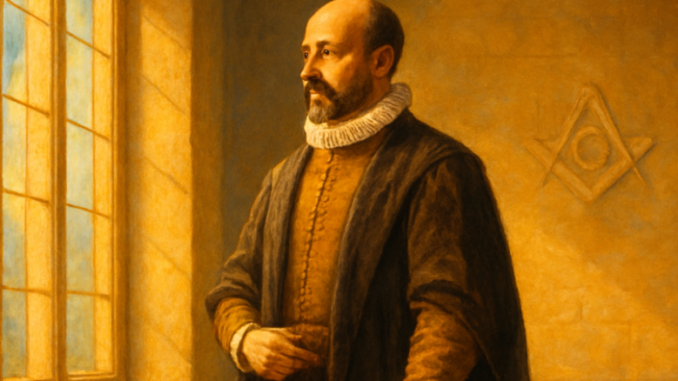
Picture this: every morning you do exactly the same thing. You get out of bed, make coffee, and take the same route to work. After a few months, you no longer even notice these actions — they have become invisible. That very phenomenon is what fascinated Michel de Montaigne in his essay ‘Of Custom,’ the forty-ninth essay of the first book of his famous Essays. He reveals how habit works like a veil, preventing us from truly seeing the world around us. And for anyone willing to examine their own assumptions — especially those who walk the path of Freemasonry — this centuries-old essay offers surprisingly practical wisdom.
The Central Idea: Custom as Second Nature
The core theme of this essay is as simple as it is powerful: custom exerts an extraordinary force over our thoughts and actions. Montaigne argues that what we experience as ‘normal’ or ‘natural’ is almost always the result of learned behavior and cultural conditioning. What one society takes for granted, another considers bizarre or reprehensible.
Montaigne draws extensively on classical sources, including Aristotle, who described custom as a ‘second nature.’ That concept forms the backbone of the entire essay: habit embeds itself so deeply within us that we can no longer distinguish it from our true character. We mistake the familiar for the universal, the habitual for the essential.
What makes Montaigne’s approach so compelling is that he does not write as a detached philosopher. He admits that he himself struggles to see through his own habits. He confesses how it took him years to realize that certain daily actions had become so ingrained that he performed them without a moment’s thought. And therein lies the danger: when you stop thinking about why you do something, you lose the capacity to make conscious choices.
Montaigne’s Examples From Around the World
What makes this essay so vivid is the sheer flood of examples Montaigne provides. He drew from travel accounts, classical history, and his own observations to show just how radically customs differ between peoples. Among the most striking examples he offers:
He describes peoples who ate their dead as a sign of honor, while Europeans considered this utterly barbaric. He points to societies where appearing naked in public was entirely normal, without any sense of shame. He notes cultures where greeting strangers involved rituals that would be considered deeply offensive elsewhere. He even highlights the surprising differences in table manners and eating habits between neighboring European regions — differences far greater than most people assumed.
Montaigne’s purpose is not to shock or to suggest that all moral values are relative. His aim is more precise: he wants to compel the reader to recognize that their own moral compass has been largely shaped by upbringing and environment, not by universal truth. In doing so, he connects with a tradition of philosophical humility found among the Greek skeptics and later continued by thinkers like Blaise Pascal.
The Practical Lesson: Learn to Question Your Assumptions
What can you actually do with Montaigne’s insight? More than you might think. The essay is essentially an invitation to a specific exercise you can practice daily. Choose one moment each day to ask yourself: am I doing this because I consciously choose to, or simply because I have always done it this way?
This can be something small — the route you take to work, the order in which you start your morning. But it can also be something far more significant: the way you approach conflict, or the assumptions you make about other people before you have even spoken to them.
Montaigne emphasizes that this self-reflection is not an end in itself but a means of becoming freer. Those who see through their habits do not necessarily need to abandon them, but they regain the ability to engage with them consciously. That distinction is crucial: it is not about rejecting traditions, but about reclaiming freedom of choice.
Custom is not the enemy — it is a veil. Those who recognize it can choose to look through it and live more deliberately.
Questioning Habit in Freemasonry
Montaigne’s message speaks directly to a core practice within Freemasonry. The work in the lodge is essentially designed to help brethren reflect on what they take for granted. The rituals and customs practiced in the lodge are never intended as empty repetition. They are deliberate actions that invite reflection. It is precisely by performing an action with full attention — such as entering the temple or listening to a piece of Masonic instruction — that we become aware of how often we operate on autopilot in daily life.
Freemasonry has always held the principle that self-knowledge begins with examining one’s own prejudices and ingrained patterns. This is exactly what Montaigne proposes in his essay. The rough ashlar — a well-known symbol within the fraternity — represents the unworked self that can only attain its true form through conscious chiseling. Habits that are never questioned are like unworked pieces of stone: they take up space, but they do not contribute to a thoughtfully constructed edifice.
The parallel runs even deeper. In the lodge, brethren are encouraged to look beyond the surface of ritual and find personal meaning within each symbol and each gesture. This mirrors Montaigne’s call to look beyond the surface of daily routine and rediscover the choices that lie hidden beneath layers of habit.
Concrete Steps to Begin Today
Montaigne’s essay is not an academic treatise to admire from a distance. It demands action. Here are three concrete ways to apply his insight in your own life:
1. Change one fixed habit this week — deliberately. Take a different route, eat at a different time, or strike up a conversation with someone you would normally walk past. Pay attention to what shifts in your experience. Small disruptions in routine have a way of waking up the mind.
2. Write down one thing each evening that you did ‘because that’s just how it’s done.’ Then ask yourself: who taught me this? Would I still choose this if I were deciding from scratch? This simple journaling exercise, practiced consistently, gradually reveals the invisible architecture of your daily life.
3. Have a conversation with someone from a different cultural background about an everyday subject — eating habits, greetings, child-rearing. Listen without judging and notice which assumptions you bring to the table. You may be surprised at how many of your certainties turn out to be customs rather than truths.
These exercises are simple, but their effect is cumulative. The more frequently you question your own assumptions, the more clearly you begin to see the invisible forces that shape your thinking and behavior. And that clarity — that willingness to keep examining the self — is at the very heart of both Montaigne’s philosophy and the Masonic journey.
Montaigne reminds us that the most powerful forces in our lives are often the ones we no longer notice. Custom wraps itself around our thinking so completely that we mistake it for reality. By learning to recognize this veil — whether through daily self-reflection or through the deliberate practice of Masonic ritual — we reclaim something essential: the freedom to choose how we live, rather than merely following paths worn smooth by repetition. The rough stone does not shape itself. It requires the conscious, patient work of a hand that knows what it is doing and, more importantly, why.
Copyright text & image: devrijmetselaar.nl
Texts are based on the ideas and content of the author of devrijmetselaar.nl, reviewed, corrected, and supplemented with the assistance of OpenAI. Images are created based on the ideas of the author of devrijmetselaar.nl using OpenAI/DALL-E.
Frequently Asked Questions
What is Montaigne's main argument about custom and habit in his essay?
Montaigne argues that custom exerts an extraordinary force over our thoughts and actions, becoming so deeply embedded that we mistake it for our true nature. He contends that what we experience as 'normal' or 'natural' is almost always the result of learned behavior and cultural conditioning rather than universal truth. Drawing from Aristotle, he describes custom as a 'second nature' that prevents us from consciously examining our own actions and making deliberate choices.
How does Montaigne's essay relate to Freemasonry?
The article suggests that Montaigne's essay offers practical wisdom for Freemasons, particularly for those willing to examine their own assumptions. By understanding how habit and custom create invisible patterns in our thinking, Freemasons can better pursue self-examination and conscious awareness—principles central to Masonic philosophy and personal development.
What examples does Montaigne use to illustrate how customs vary between cultures?
Montaigne provides vivid cross-cultural examples to demonstrate radical differences in customs, including societies that ate their dead as a sign of honor (considered barbaric by Europeans), cultures where public nudity was normal without shame, peoples with greeting rituals that would be offensive elsewhere, and varying table manners and etiquette customs across different societies.


Be the first to comment