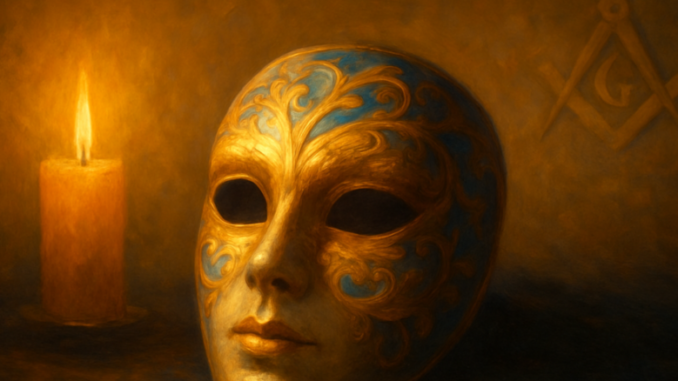
Few films have sparked as much speculation about secret societies as Stanley Kubrick’s final masterpiece. When Eyes Wide Shut premiered in 1999, it was immediately linked to Freemasonry, occult rituals, and hidden power structures. But how accurate is that association? And what does it reveal about the gulf between how outsiders perceive ritual spirituality and how a Freemason experiences it from within? In this article, we set these two perspectives side by side: the cinematic portrayal of the secret ritual and the genuine spiritual experience inside the lodge.
The Outsider’s Perspective: Eyes Wide Shut as a Vision of Fear
Kubrick based his film on Traumnovelle (Dream Story), a novella by the Viennese writer Arthur Schnitzler, who explored the blurred boundaries between dream, desire, and reality around the turn of the twentieth century. In the film adaptation, the protagonist is drawn into a nocturnal ritual behind locked doors: masked figures, strict hierarchy, erotic undercurrents, and an atmosphere of looming danger. The viewer is deliberately kept in the dark. What is real? What is imagined? And who is pulling the strings?
This perspective is familiar to anyone who looks at closed societies from the outside. The unknown breeds unease. Where secrecy exists, the human mind suspects conspiracy. Countless commentators interpreted the masked ceremony in the film as a reference to Masonic rituals — even though Kubrick himself never explicitly made that connection. The reaction is telling: the outsider sees masks and suspects deception, precisely because their eyes remain wide shut to the inner meaning of the ritual.
The Freemason’s Perspective: Ritual as Spiritual Opening
Within Freemasonry, ritual serves an entirely different purpose than the film suggests. It is not about power, mystification, or exclusion — it is about inner transformation. The candidate who enters the lodge for the first time is blindfolded. Not to deceive, but to help them understand that true seeing begins when the outer eyes close. In that darkness, space opens for self-reflection, for releasing prejudice, for confronting one’s own vulnerability.
Where Kubrick presents ritual as something oppressive and impenetrable, the Freemason experiences it as an exercise in trust and surrender. The blindfold is removed at the moment the candidate receives the light. That light is not a spotlight exposing secrets — it is a metaphor for awakening consciousness. This is spirituality in its most direct form: the search for meaning beyond the surface of the visible world. Philosophers like Plato described this centuries ago in his Allegory of the Cave, where prisoners see only shadows and discover reality only when they turn toward the light.
What Both Worlds Share: The Power of the Invisible
Despite the fundamental differences between the cinematic image and the Masonic reality, both perspectives touch the same core truth: the conviction that more exists than the eye immediately perceives. Kubrick was a master at evoking this sensation. His films compel the viewer to look beyond the literal narrative, to peel back layers of meaning. In that sense, he shared a sensibility with Freemasonry, even if he expressed it very differently.
The mystical tradition has known this principle for centuries. Meister Eckhart, the medieval theologian and mystic, spoke of the necessity of letting go of all images in order to reach the essence of the divine. Baruch de Spinoza, whose philosophy profoundly influenced the Enlightenment and Freemasons across Europe, argued that God and nature are one, and that true knowledge arises from intuitive insight rather than surface observation. Johann Wolfgang von Goethe, himself a Freemason, put it this way: the highest state a person can attain is wonder. And wonder requires the humility to acknowledge that you do not know everything.
Spirituality in Freemasonry begins where the outer eyes close and inner sight awakens — not as an escape from reality, but as a deepening of it.
Eyes Wide Shut or Wide Open: What We Can Learn
The enduring fascination with the film — and with closed rituals in general — tells us something important about the human psyche. We long for the secret, the hidden, the inaccessible, precisely because it confronts us with the limits of our understanding. The outsider fills that void with fantasy, fear, or sensationalism. The initiate fills it with silence, reflection, and brotherhood.
Neither perspective is inherently right or wrong. The filmmaker who portrays rituals as sinister power plays taps into a genuine human experience: the discomfort we feel when facing the unknown. The Freemason who experiences those same rituals as moments of profound spiritual meaning taps into an equally genuine experience: the comfort and strength of shared contemplation. What unites both worlds is the recognition that reality does not exhaust itself in what is visible.
Beyond the Mask
Perhaps the deepest lesson of this comparison is that the mask — whether worn at a Venetian ball or in a film scene — always has two sides. On the outside, it conceals. On the inside, it protects a space of vulnerability and honesty. In Freemasonry, no literal masks are worn, but the principle is closely related: the ritual creates a sheltered space in which brothers and sisters can reveal their true selves, free from the masks that everyday life so often demands.
The question that remains is both personal and timeless. Are our eyes wide shut because we refuse to see what is truly there? Or are they closed as a deliberate choice — so that the inner eye may perceive more clearly? The answer depends on the questioner, and that may be the most Masonic insight of all.
Kubrick’s final film endures not because it accurately depicts Freemasonry, but because it mirrors our universal tension between fear of the unknown and the longing to understand it. For those outside the lodge, the ritual remains a projection screen for suspicion and fascination. For those within, it is a living practice of self-discovery and spiritual awakening. In the end, the difference between eyes wide shut and eyes wide open is not about what we see — it is about whether we have the courage to look inward.
Copyright text & image: devrijmetselaar.nl
Texts are based on the ideas and content of the author of devrijmetselaar.nl, reviewed, corrected, and supplemented with the assistance of OpenAI. Images are created based on the ideas of the author of devrijmetselaar.nl using OpenAI/DALL-E.
Frequently Asked Questions
Is Eyes Wide Shut actually about Freemasonry?
While many commentators have interpreted the masked ceremony in Eyes Wide Shut as a reference to Masonic rituals, Stanley Kubrick himself never explicitly made that connection. The film was based on Arthur Schnitzler's novella Traumnovelle and explores themes of secrecy, desire, and reality. The association with Freemasonry arose largely because outsiders viewing the film's mysterious rituals and masked figures assumed they must represent Masonic practices, demonstrating how the unknown breeds speculation and suspicion.
Why do Freemasons use blindfolds in their rituals?
In Freemasonry, the blindfold worn by candidates entering the lodge is not used to deceive, but rather to facilitate inner spiritual transformation. It symbolizes that true seeing begins when the outer eyes close, creating space for self-reflection, releasing prejudice, and confronting one's own vulnerability. The blindfold is removed when the candidate receives the light, which represents an awakening of consciousness rather than the exposure of secrets.
How does the Freemason's experience of ritual differ from how it's portrayed in Eyes Wide Shut?
In Eyes Wide Shut, ritual is depicted as oppressive, mysterious, and centered on power and exclusion. In contrast, Freemasons experience ritual as an exercise in trust, surrender, and inner transformation. Rather than being about mystification or conspiracy, Masonic ritual serves as a spiritual opening that emphasizes personal awakening and self-discovery. This contrast reveals a fundamental gap between how outsiders perceive secret societies and how members authentically experience their spirituality from within.

Be the first to comment