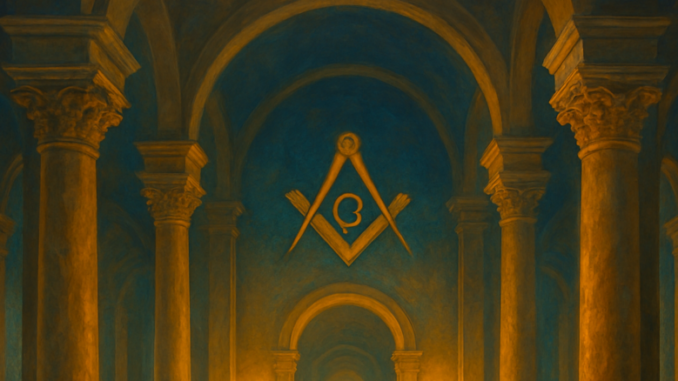
Few novels have stirred up as much speculation about hidden meanings in art as Dan Brown’s The Da Vinci Code. The book portrays Leonardo da Vinci as a master who embedded secret messages in his paintings — invisible to the untrained eye, yet legible to initiates. But how much of this is actually supported by evidence? And how does the novelist’s gaze compare to that of the Freemason, who is equally accustomed to looking beneath the surface of images? In this article, we place two perspectives side by side: that of the art historian and that of the Masonic tradition.
Dan Brown’s Claims About Leonardo da Vinci
In The Da Vinci Code, several bold assertions are made about Leonardo’s work. The most prominent of these centre on The Last Supper, the famous mural in Milan. According to the novel, the figure seated to the right of Christ is not the apostle John but Mary Magdalene. Brown further claims that Leonardo deliberately painted a V-shape between Christ and this figure as a reference to the sacred feminine. Beyond that, the novel suggests Leonardo was a member of a secret society known as the Priory of Sion, using his art to pass messages to fellow members. These are powerful claims that captivated millions of readers — but how many of them survive a fact-check?
What Does Art History Actually Tell Us?
Let’s start with the claim about The Last Supper. Art historians have agreed for centuries that the youthful figure beside Christ represents the apostle John. In fifteenth-century Italian painting, it was common to depict John as a young, beardless man, often with soft, almost feminine features. This was not an invention of Leonardo — it was a widespread convention rooted in Byzantine iconography. The claim that the figure is actually Mary Magdalene finds no support in the scholarly literature. Leading Leonardo scholars, including the British art historian who authored the standard biography of the artist, have repeatedly refuted this interpretation.
Then there is the V-shape. It is true that a visible gap exists between Christ and John, but this space is a natural result of the composition. Leonardo arranged the apostles in groups of three to create movement and dramatic tension. There is no historical document suggesting he intended a hidden symbol here.
This does not mean Leonardo was not a man of riddles. His mirror writing, his coded notebooks, and his fascination with mathematical proportions are all well documented. But there is a fundamental difference between an artist who enjoyed intellectual puzzles and an artist who was part of a conspiracy.
The Priory of Sion: A Myth Debunked
The claim that Leonardo was a member of the Priory of Sion rests on documents discovered in the 1960s at the Bibliothèque nationale de France. French investigations have conclusively demonstrated that these documents were forgeries, fabricated by a Frenchman who established a fictitious society in 1956 and then manufactured a false historical lineage for it. This is not a matter of interpretation — it has been confirmed by archivists, historians, and even by the forger himself, who later admitted to the deception.
Dan Brown presents the Priory of Sion in The Da Vinci Code as though it were historical fact. It is not. Treating fiction as history, no matter how compellingly it is written, does a disservice both to Leonardo’s genuine legacy and to the reader’s quest for understanding.
The Masonic Perspective: Reading Symbols as a Craft
Now let us shift perspective. Freemasons are, by nature and training, deeply familiar with reading symbols. In the lodge, everything is saturated with meaning — light and darkness, rough and polished stone, the square and compasses. But there is a crucial difference between how Freemasonry approaches symbols and how Dan Brown treats them.
In Freemasonry, a symbol is not a secret code concealing one specific message. It is more like a mirror that invites the observer to reflect. As the philosopher and mathematician Gottfried Wilhelm Leibniz once observed, one and the same sign can be understood on different levels, depending on the maturity of the observer. A symbol opens a conversation; it does not close one with a single answer.
Freemasonry shares with Leonardo a deep appreciation for geometry, proportion, and the search for harmony. Leonardo’s Vitruvian Man, based on the work of the Roman architect Vitruvius, shows the human figure as the measure of all things, inscribed within both circle and square. These are forms that also play a central role in the Masonic tradition. But the fact that a shared language of forms exists does not prove that Leonardo was a Freemason.
Organised speculative Freemasonry, as we know it today, only came into being with the founding of the first Grand Lodge in London in 1717 — nearly two centuries after Leonardo’s death in 1519. Historical honesty requires us to make this distinction, however tempting it may be to claim the great master as one of our own.
A symbol is not a code to be cracked, but a window to be opened. This is true for the art of Leonardo da Vinci, and equally true for the rituals of Freemasonry.
What Both Perspectives Share
Despite the differences, there is a striking similarity between the novel reader and the Freemason: both refuse to settle for the surface. The extraordinary popularity of The Da Vinci Code reveals a deeply human desire to look behind appearances, to search for connections, and to sense that there is more than meets the eye. That desire is not misplaced. It is precisely the longing that has drawn men and women to the lodge door for centuries.
The difference lies in the method. Where Dan Brown writes toward a spectacular reveal, bending facts to fit his narrative, Freemasonry invites a slow, personal process of discovery. No conspiracies, no hidden bloodlines — just the quiet, patient work on one’s own inner temple. The Masonic path does not promise a dramatic conclusion. It promises something far more valuable: a way of seeing that grows deeper over time.
Dan Brown’s The Da Vinci Code is a brilliant thriller, but it is fiction — and should be read as such. Leonardo da Vinci was undeniably a genius of extraordinary depth, a man who delighted in mystery and encoded much of his thinking in symbols. Yet the claims about Mary Magdalene, the Priory of Sion, and secret messages in The Last Supper do not withstand historical scrutiny. For the Freemason, the lesson is perhaps this: the urge to look deeper is admirable, even essential — but the discipline to distinguish between what we wish to find and what is actually there is what separates genuine insight from mere speculation. A symbol is not a code to be cracked. It is a window to be opened.
Copyright text & image: devrijmetselaar.nl
Texts are based on the ideas and content of the author of devrijmetselaar.nl, reviewed, corrected, and supplemented with the assistance of OpenAI. Images are created based on the ideas of the author of devrijmetselaar.nl using OpenAI/DALL-E.
Frequently Asked Questions
Did Leonardo da Vinci really paint Mary Magdalene in The Last Supper?
No. Art historians have agreed for centuries that the youthful figure beside Christ represents the apostle John, not Mary Magdalene. In fifteenth-century Italian painting, it was common to depict John as a young, beardless man with soft features following Byzantine iconography traditions. Leading Leonardo scholars have repeatedly refuted Dan Brown's interpretation.
Is the V-shape between Christ and John in The Last Supper a deliberate hidden symbol?
No. While a visible gap does exist between these figures, it is a natural result of Leonardo's compositional technique. He arranged the apostles in groups of three to create movement and dramatic tension. There is no historical documentation suggesting Leonardo intended this space as a hidden symbol.
Was Leonardo da Vinci a member of the Priory of Sion secret society?
There is no scholarly evidence supporting this claim from Dan Brown's novel. While Leonardo was documented as a man fascinated by riddles, mirror writing, coded notebooks, and mathematical proportions, the novel's assertion that he was part of a secret society to pass messages to fellow members lacks historical support.




Be the first to comment