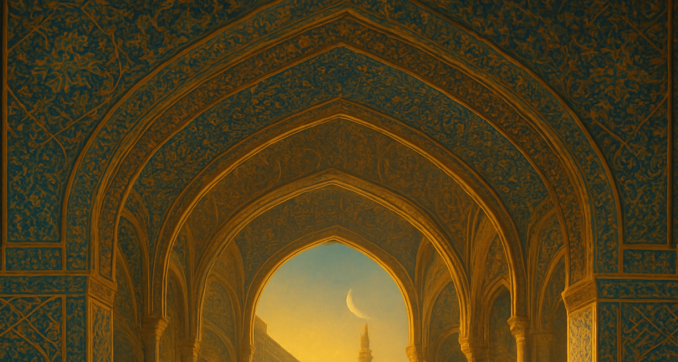
There is a chapter in the Quran that opens with a disarming question: was there not a time when the human being was nothing worth mentioning? Surah 76, titled Al-Insan (The Human), traces the journey of humanity from utter insignificance to conscious moral action. Remarkably, that journey mirrors the path a Freemason walks within the lodge. Two traditions, two languages, two worlds — yet both circle the same essential question: what makes a human being truly human?
The Quranic Perspective: Humanity as a Trial
Surah Al-Insan is one of the shorter chapters of the Quran, generally classified among the Medinan revelations, though some scholars assign it a Meccan origin. It opens with a reference to the creation of the human being from a mixed drop — an image that underscores the humbleness of our beginnings. Immediately afterward, the purpose of that creation is stated: the human being has been placed on earth to be tested, and for that purpose has been given hearing and sight.
The chapter then draws a sharp distinction. There are those who are grateful and those who remain ungrateful. The grateful — those who endure their trials with patience and compassion — are promised a garden of abundance: bronze goblets, silken garments, shade that never recedes. The imagery is lush and layered, but the core message is clear: the person who serves others, who shares food with the orphan, the captive, and the needy, especially when they need that food themselves, reaches their true destination. It is not power or possession that determines the worth of a life, but the willingness to overcome the self and serve others.
The Masonic Perspective: Humanity as a Rough Stone
Freemasonry begins from a remarkably similar starting point, though expressed in an entirely different symbolic language. Upon entering the lodge, the candidate is presented as a rough ashlar — unworked material that must be shaped through labor, reflection, and brotherly correction into a perfect cube. Just as in the Quranic vision, the human being starts in a state of imperfection. And just as in Surah Al-Insan, it is not the outside world that brings about transformation, but the inner willingness to be shaped.
Masonic ritual emphasizes that true light does not come from without but is discovered by laying aside prejudice and self-interest. The Entered Apprentice degree teaches listening. The Fellowcraft degree teaches observation. The Master Mason degree confronts the candidate with mortality and the question of what remains once all externalities are stripped away. Hiram Abiff, the legendary master builder whose story is central to the third degree, chooses death rather than betray his inner values. That is the same moral courage Surah Al-Insan describes when it speaks of those who give away food despite their own hunger.
Where These Two Traditions Meet
At first glance, the worlds of the Quran and Freemasonry seem far apart. The Quran is a revealed text within a monotheistic tradition; Freemasonry is a fraternity that deliberately positions itself above specific creeds and welcomes people of all convictions. Yet they converge on fundamental points.
Both take human imperfection as a starting point, not a final verdict. Both regard trial and effort as necessary conditions for moral growth. Both value service to others as the highest expression of humanity. And both use the contrast between light and darkness as a guiding metaphor for the inner journey.
The Persian poet and mystic Rumi wrote centuries ago about the wound being the place where light enters. Aristotle argued that virtue is not a state but an action — a continuous exercise. Both insights resonate in Surah Al-Insan and in the ritual work of the lodge alike. The human being is not a finished product but a continuously becoming being.
Gratitude as the Key
A striking element in Surah Al-Insan is its emphasis on gratitude. The grateful person is not rewarded for correctly performing a ritual or reciting a formula, but because their daily actions reflect genuine awareness. They see what they have received and act accordingly. Freemasonry holds a remarkably similar attitude. The keystone of the Masonic edifice is not knowledge or rank, but the humble recognition that every light one receives carries a responsibility. Goethe, himself a Freemason, expressed this memorably in his conviction that action is the true test of understanding.
The philosopher Spinoza, who lived in Amsterdam and whose thinking on the unity of the divine and nature has inspired Jewish, Christian, and Muslim thinkers alike, argued that true freedom comes from understanding one’s place within the whole. That is precisely what Surah Al-Insan holds before its reader: you were nothing, you became something, and the question now is what you will do with that awareness.
What We Can Learn from Both Paths
Comparing these two traditions is not an exercise in equating them. The Quran speaks from revelation; Freemasonry speaks from a deliberately chosen method of self-examination. But it is precisely in the difference that the richness lies. Those willing to look at both perspectives with an open mind will discover that the human search for meaning is more universal than any institutional boundary. Montaigne wrote in his essays that we learn more from difference than from resemblance — a thought that remains particularly relevant in this context.
Both the Quran and Freemasonry teach that a human being is not born complete but carries the charge to shape themselves through service, self-reflection, and moral courage. The rough stone does not become a perfect ashlar by waiting. The soul does not grow by standing still.
Surah Al-Insan invites us to ask the very question that echoes in every lodge meeting: am I a better person today than I was yesterday? Not better in terms of wealth, status, or influence — but better in awareness, in compassion, in the willingness to give what costs us something. Whether that question is posed in the language of scripture or in the symbolism of stonemasons’ tools, it remains the most important question any human being can ask. And perhaps the most honest answer is always the same: not yet — but I am working on it.
Copyright text & image: devrijmetselaar.nl
Texts are based on the ideas and content of the author of devrijmetselaar.nl, reviewed, corrected, and supplemented with the assistance of OpenAI. Images are created based on the ideas of the author of devrijmetselaar.nl using OpenAI/DALL-E.

Be the first to comment