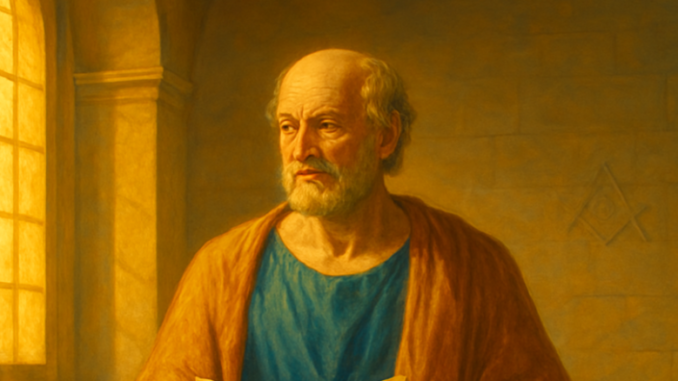
In the year 62 AD, Lucius Annaeus Seneca penned a letter from his villa to his student Lucilius that shattered the conventions of the Roman Empire. In a society where slavery was as unremarkable as the air people breathed, this Stoic philosopher did something unprecedented: he argued for the inherent dignity of every human being, regardless of social status. His words still echo nearly two millennia later through the lodge rooms where Freemasons gather as equals — where rank and title are left at the door.
A Radical Voice in Ancient Rome
Seneca opens his forty-seventh letter with a direct assault on the Roman attitude toward slaves. Where most Romans regarded their slaves as property — as “speaking tools,” to borrow Aristotle’s chilling phrase — Seneca states plainly that they are, first and foremost, human beings. He reminds Lucilius that fortune is fickle: today’s slave could have been tomorrow’s master, and vice versa. This was a revolutionary thought in an era when the social order was considered divinely ordained.
The philosopher describes how wealthy Romans humiliated their slaves during banquets. While the host gorged himself on lavish dishes, slaves were forced to stand in silence, every sound punished with the lash. Seneca condemns this practice not only as cruel but as morally corrosive for the master himself. For whoever dehumanizes others ultimately forfeits his own humanity.
The True Master Must First Master Himself
At the heart of Seneca’s argument lies a quintessentially Stoic insight: true freedom does not reside in the ownership of others but in the mastery of oneself. He writes that many a master is more enslaved by his own passions than his slaves are to him. Anger, greed, lust — these are the real tyrants. The man who neither knows nor governs himself is, in reality, the greatest slave of all.
True brotherhood is not born from ignoring differences, but from recognizing the shared humanity that transcends all outward distinctions.
This insight forms a natural bridge to Freemasonry. When candidates first enter a lodge, they are divested of metals and outward signs of wealth or status. Rich and poor, educated and unschooled — all stand equal before the altar. This ritual is not empty symbolism but a physical reminder of what Seneca understood two thousand years ago: that human dignity does not depend on social position.
From Master and Servant to Brothers on the Level
The level is one of the most eloquent symbols in Freemasonry. This builder’s tool reminds us that all people are equal regardless of their earthly circumstances. It is as though Seneca himself could have devised it. In his letter, he describes how he regularly dined with his slaves, discussed philosophy with them, and took their counsel seriously. He was far ahead of his time.
The Stoic emphasizes that we should not judge people by what they do, but by how they do it. A slave who fulfills his duties with integrity stands morally higher than a senator who lies and cheats. This principle resonates deeply in Freemasonry, where it is not a brother’s profession that matters but his inner character. The question is not what career you pursue, but whether you are a good person.
Virtue as a Universal Bond
Seneca’s ethics rest on the conviction that virtue is the only true good. Wealth, fame, power — these are external goods that can be stripped away at any moment. But character, wisdom, and justice — these inner treasures are inalienable. Freemasonry shares this conviction wholeheartedly. The rough ashlar that every Entered Apprentice symbolizes must be shaped into a smooth, perfect cube, fit for the greater edifice. That shaping is the lifelong work of refining one’s own character.
Consider the parallels between Seneca’s teachings and Masonic practice. Self-reflection: Seneca urges a daily examination of one’s own conduct — the Masonic equivalent of working the rough stone. Brotherhood: he treated his slaves as fellow human beings, not as possessions — just as Masons treat every brother as an equal. Moral growth: the true master works on his own shortcomings before correcting others — mirroring the Masonic injunction to improve oneself before seeking to improve the world. Equality: neither fortune nor birth determines the worth of a person — a truth enacted every time brethren meet on the level.
A Timeless Lesson for Today
Although slavery has been abolished in the Western world, Seneca’s insights remain painfully relevant. We live in an age of increasing polarization, in which people are routinely reduced to their group identity, political persuasion, or economic status. The Stoic philosopher reminds us that behind every label is a human being — a fellow traveler on the journey of life, a potential friend.
In the lodge, Freemasons practice weekly what Seneca preached: seeing every person as an equal, listening without judgment, working on their own rough stone before presuming to criticize others. It is no coincidence that the Enlightenment — the era in which Freemasonry flourished — was also the period in which Stoic philosophy enjoyed a powerful renaissance. Thinkers such as Voltaire and Montesquieu, both familiar with the lodge, were avid readers of Seneca.
The Chain of Human Connection
Seneca concludes his letter with the idea that friendship is possible between people of every station. More than that, the finest friendships are those that arise precisely where social conventions are broken. Every Freemason recognizes this principle in the Chain of Union, where each brother clasps the hand of the next regardless of origin or background. It is a living symbol of what the Stoic described so long ago.
The forty-seventh letter of Seneca is far more than a historical document. It is a mirror that asks us: how do we treat those whom society regards as lesser? Do we see in every encounter an opportunity for genuine connection? The answers to these questions determine not only the quality of our relationships but ultimately the quality of our own lives.
Nearly two thousand years after it was written, Seneca’s voice remains as powerful and as necessary as ever. His call for human dignity, self-mastery, and true equality transcends every era and every border. For Freemasons, his forty-seventh letter reads almost like a philosophical blueprint for the Craft itself — a reminder that the work of shaping the rough stone begins not with grand gestures, but with the simple, radical act of seeing every person as a brother.
Copyright text & image: devrijmetselaar.nl
Texts are based on the ideas and content of the author of devrijmetselaar.nl, reviewed, corrected, and supplemented with the assistance of OpenAI. Images are created based on the ideas of the author of devrijmetselaar.nl using OpenAI/DALL-E.



Be the first to comment