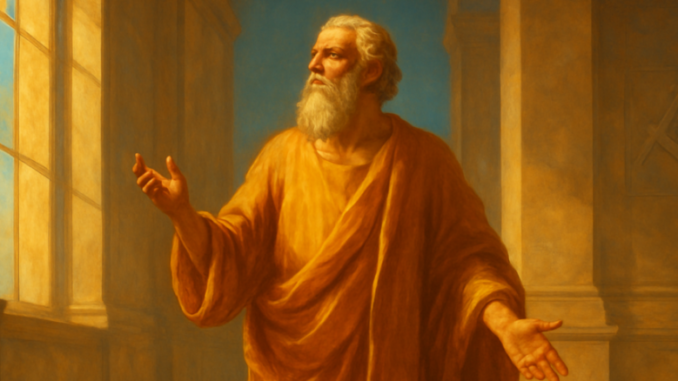
It is early morning. Through the narrow slit of a prison window, the first light falls on the sleeping figure of Socrates. His old friend Crito has been sitting beside him for hours, waiting for the right moment to wake him with an urgent proposal: escape, while you still can. What follows is one of the most powerful conversations in Western philosophy — a dialogue that continues to stir Freemasons and seekers of truth in their deepest convictions about duty, honor, and right action.
A Friend With an Escape Plan
The dialogue of the Crito takes place in the prison of Athens, where Socrates awaits his death sentence. Crito, a wealthy and devoted friend, has arranged everything for an escape. He has bribed the guards, prepared escape routes, and organized safe haven abroad. His arguments are deeply human and sympathetic: Socrates still has a family, his death would be a loss for philosophy, and besides, the verdict is unjust. Why would a wise man submit to a judgment based on false accusations?
Socrates listens patiently. He acknowledges his friend’s good intentions but refuses to make decisions driven by emotion or public opinion. Instead, he proposes they examine the matter the way they always have — by reasoning together, step by step, until they arrive at the truth.
The Core Principle: Never Answer Injustice With Injustice
The central theme of the Crito revolves around one fundamental question: is it ever justified to commit injustice, even in response to injustice done to you? Socrates answers with an emphatic no. He reminds Crito of principles they have upheld together for years — that one must never willingly do wrong, that it is better to suffer injustice than to commit it, and that a promise or agreement, once given, must be honored.
It is never right to do wrong, not even when you yourself have been wronged.
This principle forms the backbone of the entire dialogue. Socrates argues that escaping from prison would mean violating the laws of Athens — the very laws under which he has lived his entire life and whose protection he has enjoyed. To flee would amount to breaking an implicit agreement, a form of betrayal against the community that shaped him.
The Voice of the Laws: A Powerful Thought Experiment
Perhaps the most remarkable passage in the Crito is the prosopopoeia — a literary device in which Socrates personifies the Laws of Athens and lets them speak directly to him. These Laws address him and ask: what are you planning, Socrates? Do you intend to destroy us? If every citizen who disagrees with a verdict simply escapes, what remains of the rule of law?
The Laws remind Socrates that they have given him everything: his upbringing, his marriage, his citizenship. He lived in Athens for seventy years without ever choosing to leave. By staying, he implicitly consented to the laws and their rulings. To flee now would be an act of cowardice and inconsistency — a betrayal of everything he professed to stand for.
Duty Above Self-Interest
What makes the Crito so timeless is its emphasis on inner integrity over outward advantage. Socrates does not choose death because he does not value life — he chooses it because he refuses to betray his principles. His reasoning is rigorous but clear: a person who truly strives for virtue cannot be selective in their obedience. Those who accept the laws when they work in their favor must also accept them when the outcome is painful.
This stance resonates deeply with the values cherished in Masonic lodges. A Freemason pledges loyalty to certain principles not because they are always easy to follow, but precisely because they serve as a compass in times of doubt. The ritual reminds every Brother that words carry weight, that promises are sacred, and that true honor lies in holding fast when no one is watching.
The Symbolism of Steadfastness
In Freemasonry, much is said about the rough stone that must be shaped into a perfect ashlar. This image represents the lifelong work of refining one’s own character. The Crito offers a concrete example of what such inner refinement truly means: the ability to hold fast to your principles, even when the world offers you an easy way out.
Socrates’ refusal to flee is not passive resignation — it is an active choice for consistency. He embodies what Freemasons call the square: the symbol of uprightness and moral rectitude in all one’s dealings. His death becomes not a defeat, but an ultimate demonstration of the principles he advocated throughout his entire life.
Relevance for the Modern Seeker
The questions Plato raises in the Crito have never grown old. In an era when laws sometimes appear unjust and civil disobedience is often celebrated, this dialogue forces us to think more deeply. When is resistance justified? What are the limits of personal freedom within a community? And perhaps most importantly: which principles are worth your very life?
For Freemasons, the Crito holds up a mirror. The lodge is a space where Brothers build together toward a better world, but that construction always begins with one’s own conduct. The oath taken at initiation is not mere formality — it is a living promise that must resonate in every action. Socrates reminds us that true freedom does not consist of evading consequences, but of fully accepting responsibility for who we are and what we promise.
The Crito is far more than an ancient philosophical dialogue. It is a compelling case for moral steadfastness — a lesson in bearing the consequences of your own choices. Socrates’ refusal to flee speaks to everyone who wrestles with the tension between personal desire and principled action. For Freemasons and seekers of truth alike, his example endures as a powerful reminder: the measure of a person is not found in the promises they make, but in the promises they keep — especially when keeping them comes at the greatest cost.
Copyright text & image: devrijmetselaar.nl
Texts are based on the ideas and content of the author of devrijmetselaar.nl, reviewed, corrected, and supplemented with the assistance of OpenAI. Images are created based on the ideas of the author of devrijmetselaar.nl using OpenAI/DALL-E.
Frequently Asked Questions
What is the main ethical principle that Socrates defends in Plato's Crito?
Socrates defends the principle that it is never right to do wrong, even in response to injustice done to you. He argues that one must never willingly commit injustice, that it is better to suffer injustice than to commit it, and that promises and agreements must be honored. This principle forms the backbone of his refusal to escape from prison.
Why does Socrates refuse Crito's offer to help him escape from prison?
Although Socrates acknowledges Crito's good intentions and sympathizes with his arguments about family and the injustice of the verdict, he refuses to escape because doing so would violate the laws of Athens. He argues that escaping would constitute breaking an implicit agreement with the community that has shaped him throughout his life, which would amount to committing injustice himself.
What is the prosopopoeia in the Crito, and why is it significant?
The prosopopoeia is a literary device in which Socrates personifies the Laws of Athens and allows them to speak directly to him. This thought experiment is one of the most remarkable passages in the dialogue and serves to demonstrate how the abstract principles of justice and duty become concrete and compelling when the laws themselves question Socrates about his intended actions.


Be the first to comment