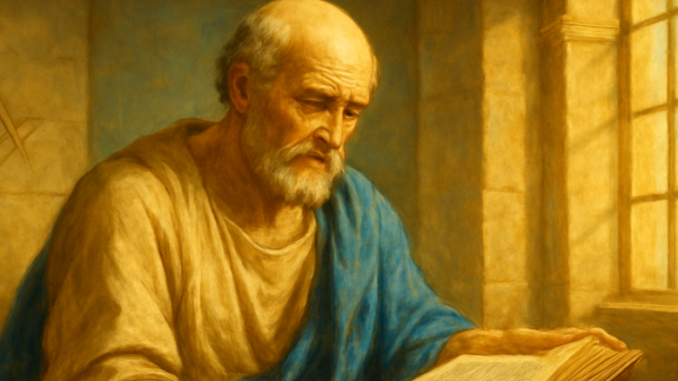
A candle flickers as a Freemason closes his book and stares out the window. How many texts has he skimmed this week? How many pearls of wisdom has he brushed against without truly absorbing them? In his mind, the voice of a Roman philosopher echoes — one who recognized this very same restlessness nearly two thousand years ago. Lucius Annaeus Seneca wrote his friend Lucilius a letter that remains as relevant today as it was then: a meditation on the art of truly reading and the path toward inner peace.
The Heart of Seneca’s Message
In his second letter to Lucilius, Seneca addresses a problem that feels strikingly modern: the tendency to jump from one book to the next without ever putting down deep roots in any of them. He compares this behavior to someone who constantly moves from place to place and, as a result, never forms real friendships. To be everywhere is to be nowhere. This idea forms the backbone of the letter and touches on a fundamental human longing — the desire to find stillness in a world overflowing with stimulation.
The Stoic philosopher does not argue for narrow-mindedness or intellectual stagnation. On the contrary, he acknowledges the value of variety. But he warns that superficially pruning in many gardens will bring none of them to bloom. True wisdom comes through depth — through chewing on ideas until they become part of who you are. Seneca uses the powerful image of the bee, which gathers nectar from many flowers and transforms it into honey. We must do the same with what we read: digest it, process it, and make it our own.
Selective Reading as a Way of Life
Seneca counsels Lucilius to limit himself to a select number of proven masters. Choose authors whose value has been demonstrated across the centuries, he writes. Do not wander aimlessly through libraries, but return again and again to the same sources until you have absorbed their essence. This is not a call to intellectual poverty — it is an invitation to richness through depth. The philosopher compares it to food: whoever eats too much too quickly digests nothing. Whoever eats with moderation and attention builds a strong body.
True wisdom does not arise from reading widely, but from processing a few things deeply until they become an inseparable part of who you are.
This approach resonates powerfully with Freemasonry, where the emphasis falls squarely on gradual development and deepening understanding. An Entered Apprentice does not rush through all the degrees; he takes the time to internalize each step before advancing. The ritual repeats itself not out of laziness, but because repetition paves the way to deeper comprehension. Seneca would have recognized this principle immediately.
Taming the Restlessness of the Mind
The second major theme of the letter concerns the inner restlessness that plagues so many. Seneca describes how some people constantly change their surroundings, hoping a new environment will cure their dissatisfaction. They travel from city to city, from coast to mountain, but their unease travels with them. The problem does not lie in the place — it lies in the soul. You carry yourself with you wherever you go, Seneca writes. A change of scenery is no remedy for a troubled mind.
This observation touches on a universal truth that is also taught within the lodge. The rough ashlar is not located somewhere outside of us — it is our own unpolished self. No journey, no new possession, no external change can substitute for the inner work required to achieve genuine peace. The Freemason learns that transformation must come from within, through patient and honest labor upon oneself.
Practical Wisdom for Every Day
Seneca closes his letter with a piece of practical advice borrowed from the works of Epicurus. This is remarkable, because Seneca was a Stoic and Epicurus belonged to an entirely different philosophical school. Yet Seneca does not hesitate to learn from his intellectual rival. He quotes: “Poverty, measured against the purpose of nature, is great wealth.” In doing so, he demonstrates his own principle in action — take what is good wherever you find it, regardless of the source.
The key lessons from Seneca’s second letter can be distilled into a handful of guiding principles. Limit your reading to proven masters and return to them repeatedly. Process what you read into personal wisdom, just as the bee transforms nectar into honey. Seek peace not through external change but through inner work. And remain willing to learn from everyone — even from those who hold opposing views.
The Letter Through a Masonic Lens
For the Freemason, Seneca’s letter contains deeply familiar truths. The emphasis on gradual deepening mirrors the degree system, in which knowledge is unlocked step by step. The warning against superficiality echoes the seriousness with which ritual must be approached. And the call to learn from all wise voices, regardless of background, aligns perfectly with the universal character of a Brotherhood that unites people of every persuasion.
The bee as a symbol deserves special attention here. In many Masonic traditions, the beehive represents industry, cooperation, and the transformation of raw material into something precious. Seneca uses the same image to describe intellectual processing. What we read must be digested, blended with our own thinking, and transformed into personal wisdom. This is not a passive exercise — it is active work on one’s own inner temple.
Seneca’s second letter to Lucilius is a timeless guide for anyone struggling with information overload and inner restlessness. His message is simple but demanding: choose carefully what you take in, process it thoroughly, and seek peace not outside yourself but within. For the Freemason, this letter holds a familiar truth — the path toward light does not run through superficial knowledge, but through the deep processing of a few precious insights that slowly become part of who you are.
Copyright text & image: devrijmetselaar.nl
Texts are based on the ideas and content of the author of devrijmetselaar.nl, reviewed, corrected, and supplemented with the assistance of OpenAI. Images are created based on the ideas of the author of devrijmetselaar.nl using OpenAI/DALL-E.
Frequently Asked Questions
What is the main problem Seneca identifies in his second letter to Lucilius?
Seneca addresses the tendency to jump from one book to the next without ever putting down deep roots in any of them. He compares this behavior to someone who constantly moves from place to place and never forms real friendships, arguing that 'to be everywhere is to be nowhere.' This restlessness prevents true absorption of wisdom and inner peace.
What does Seneca recommend as an alternative to reading widely?
Rather than wandering aimlessly through many texts, Seneca counsels limiting oneself to a select number of proven masters whose value has been demonstrated across centuries. He advocates returning again and again to the same sources until their essence is fully absorbed, comparing this to how a bee gathers nectar from many flowers but transforms it into something singular and valuable.
How does Seneca's teaching relate to Freemasonry?
Seneca's emphasis on gradual development and deepening understanding resonates powerfully with Freemasonry's approach to personal growth. Just as an Entered Apprentice does not rush through all the degrees but takes time to fully understand each level, Freemasonry values processing knowledge deeply rather than accumulating it quickly, making true wisdom an inseparable part of one's character.




Be the first to comment