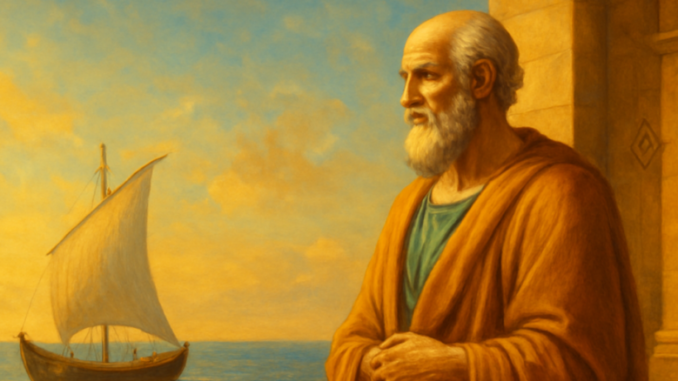
Imagine living in the Roman Empire, surrounded by wealth and power, while all around you human beings are treated as property. Now imagine picking up a pen and arguing that a slave can be your friend. That is exactly what Lucius Annaeus Seneca did nearly two thousand years ago. His forty-seventh letter to Lucilius is no ordinary ethical treatise — it is the culmination of centuries-old philosophical traditions that placed the human being at the center of moral concern, regardless of social status. For anyone drawn to Freemasonry, with its emphasis on brotherhood and equality, this ancient letter holds up a surprisingly clear mirror.
The Stoic Revolution from Within
When Seneca took up his pen to write about the treatment of slaves, he drew on a rich Stoic tradition that had been building for three centuries before him. Zeno of Citium, the founder of Stoicism, introduced a radical idea: all human beings share in the same divine logos, the universal reason that permeates the cosmos. This meant that the social hierarchies of the Greek and Roman world were ultimately artificial. What makes someone truly human is not birth or possessions, but the capacity for rational thought and moral choice.
Seneca’s philosophical teacher, Attalus, emphasized simplicity and the equality of all souls. Chrysippus, the third head of the Stoic school, had already argued that slavery was a matter of external circumstance, not of inner nature. Your body could be chained, but your mind remained free. This idea appears almost word for word in Letter 47, where Seneca writes that fortune determines who becomes a slave and who becomes a master, but that true freedom resides within.
Epicurus and the Boundaries of Friendship
Although Seneca was a committed Stoic, he never hesitated to learn from other philosophical schools. Epicurus, often considered the Stoics’ rival, plays a surprising role in his thinking about human relationships. Epicurus taught that true friendship is founded on mutual trust and sincerity, not on social standing. In his own philosophical community, the Garden, slaves were welcomed as equals. Seneca quotes Epicurus frequently throughout his letters and embraces the insight that friendship is one of the highest goods a person can pursue.
This Epicurean element enriches Seneca’s argument considerably. He does not merely ask Lucilius to treat slaves humanely out of duty — he urges him to see them as potential friends. Sharing a meal, engaging in conversation, laughing together: these are not signs of weakness but of wisdom. Here we see Seneca weaving different philosophical traditions into a fabric that is entirely his own and remarkably alive.
The Roman Context: Seneca as Dissident
To appreciate how radical Seneca’s position was, you have to understand the world he lived in. Roman society ran on slavery. Slaves were legally not persons but things, and their treatment depended entirely on the whims of their owners. At the same time, an undercurrent of unease existed. Plutarch, the Greek philosopher and biographer who lived slightly later, also wrote about the importance of mildness toward slaves and the dangers of domestic tyranny.
True brotherhood recognizes no chains: it sees in every person a fellow traveler on the journey toward wisdom.
Seneca moved through the imperial court under Nero — an environment of intrigue, excess, and violence. His plea for humanity was not merely academic; it was a deeply personal stance in a world where power routinely corrupted. His Stoicism gave him the tools to step back from the madness around him and search for what was universal and enduring: human dignity itself.
The Echo in Freemasonry
You may wonder what any of this has to do with Freemasonry. The connection runs deeper than you might expect. Freemasonry, as it developed from the eighteenth century onward, drew eagerly from the wellsprings of classical antiquity. The principle that all brethren are equal within the lodge, regardless of their rank in the outside world, reflects precisely the Stoic ideal that Seneca articulated.
James Anderson, who compiled the Constitutions of Freemasonry in 1723, emphasized that within the lodge only personal merit matters — not birth or wealth. This is a direct echo of Seneca’s argument: judge a person by their character, not by their circumstances. The symbols of Freemasonry — the square and compasses — point toward the shaping of the inner self. Just as the Stoics taught that you must cultivate your own mind, the Freemason learns that he is a rough stone that must be shaped and refined.
The Rough Ashlar and the Free Mind
The symbol of the rough ashlar deserves special attention here. In Freemasonry, the rough ashlar represents the individual in an unworked state — full of imperfections yet brimming with potential. The perfect ashlar is the ideal: a person who, through self-reflection and discipline, has refined their character. Seneca would have recognized this image immediately. His entire philosophy revolves around the idea that we must shape ourselves, and that external circumstances such as wealth or servitude say nothing about our inner worth.
When Seneca writes that a slave can be a free person in spirit, while a master can be enslaved by his own passions, he touches upon the same truth that every Freemason discovers in the lodge. The chains that truly bind us are not made of iron — they are forged from ignorance, fear, and pride. The path to freedom runs through self-knowledge and the recognition that every human being, regardless of station, wages the same inner struggle.
An Invitation to Reflect
Seneca’s Letter 47 is far more than a historical document. It is an invitation to examine yourself honestly: how do you treat the people around you who hold less power or status? Do you see in them fellow travelers, or merely functionaries? The Stoic wisdom that Seneca distilled from centuries of philosophical thought — from Zeno to Epicurus — remains as urgent now as it was in ancient Rome. The insight that every person carries an inviolable spark of dignity within them is the philosophical bedrock upon which both Stoicism and Freemasonry stand.
For the Freemason, reading Seneca is not an exercise in antiquarian curiosity. It is encountering a kindred spirit — someone who understood, long before the first lodges were constituted, that the real work of building happens not with stone and mortar, but within the human heart. The rough ashlar awaits the chisel. The question is whether we have the courage to begin.
Seneca’s Letter 47 bridges nearly two millennia to remind us that human dignity is not granted by society — it is inherent in every person. The Stoic conviction that inner freedom transcends external circumstance finds a powerful parallel in Freemasonry’s commitment to equality within the lodge. Whether you encounter these ideas through ancient philosophy or through Masonic ritual, the message is the same: true brotherhood begins when we look past rank and status and recognize the shared humanity in every individual we meet. That recognition is not just a philosophical ideal — it is the foundation upon which a more just and compassionate world can be built.
Copyright text & image: devrijmetselaar.nl
Texts are based on the ideas and content of the author of devrijmetselaar.nl, reviewed, corrected, and supplemented with the assistance of OpenAI. Images are created based on the ideas of the author of devrijmetselaar.nl using OpenAI/DALL-E.



Be the first to comment