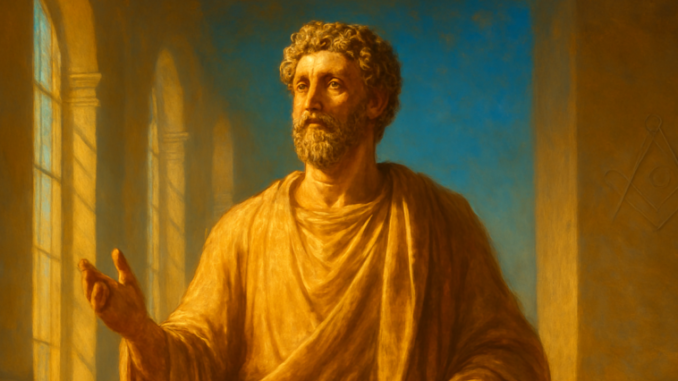
What if our worst enemy doesn’t dwell outside us, but inhabits the silent space between perception and conclusion? Marcus Aurelius — the Roman emperor who philosophized amid war and plague — proposed a radical thesis in the eighth book of his Meditations: it is not events that torment us, but the judgments we pass upon them. This idea, deceptively simple on the surface, carries the weight of centuries of philosophical tradition and casts a surprising light on the ethical quest that Freemasons know well.
The Stoic Legacy of Judgment
To understand the intellectual world of Marcus Aurelius, we must travel back to the Stoa of Zeno of Citium, the philosophical school that emerged in Athens around 300 BCE. The Stoics developed a psychology of judgment that was revolutionary for their time. They drew a sharp distinction between phantasia — the initial impression that reality makes upon us — and synkatathesis — the assent we choose to give or withhold from that impression.
Epictetus, the freed slave whose lectures Marcus Aurelius studied as a young man, refined this doctrine into a practical art of living. His famous distinction between what lies within our power and what does not forms the backbone of Book VIII. What lies within our power are exclusively our judgments, our impulses, our desires. Everything beyond that does not belong to us. This insight, born from Epictetus’ own experience as a slave, transformed Marcus Aurelius from a powerful ruler into a humble student of the inner life.
Seneca and the Art of the Pause
Where Epictetus analyzed the structure of judgment, Seneca explored its dynamics. In his letters to Lucilius — which Marcus Aurelius knew intimately — Seneca describes how premature judgments poison our lives. “We suffer more often in imagination than in reality,” he observed. This habit of anticipating suffering that may never come is a form of mental slavery we impose upon ourselves.
Marcus Aurelius took up this idea but gave it his own distinctive turn. Where Seneca primarily warned against future suffering, Marcus directed his attention to the present moment. Each moment offers a choice: do we react from conditioning and habit, or do we take the time to examine what truly stands before us? This question resonates deeply with the Masonic tradition, where the rough ashlar of character must be shaped through conscious, deliberate work into a more perfect whole.
The judgment we pass upon reality determines whether that reality enslaves us or sets us free.
Plutarch and the Mirror of Self-Reflection
A less obvious influence on Marcus Aurelius can be found in the work of Plutarch, the Greek writer who lived in the century before the emperor. Plutarch wrote extensively on moral psychology and the dangers of unconscious judgment. His essay On Curiosity warns against the tendency to judge others without first examining our own shortcomings. This thought returns in Book VIII, where Marcus reminds himself that the faults he sees in others are often mirror images of his own weaknesses.
Plutarch also introduced the concept of the inner daemon, or guardian spirit — a notion Marcus Aurelius adopted and refined into his teaching on the hegemonikon, the ruling principle of the soul. This inner compass, which can be distorted by prejudice but purified through philosophy, forms the heart of Stoic ethics as Marcus practiced them. For Freemasons, this idea of an inner guiding principle finds a natural parallel in the quest for moral and spiritual illumination that defines the Craft.
The Skeptical Undercurrent
Although Marcus Aurelius was not a skeptic in the technical, philosophical sense, a skeptical undertone runs through Book VIII. The Pyrrhonian tradition, which questioned every certainty, had forced the Stoics to refine their epistemology. Marcus’ repeated calls to suspend judgment until we truly understand what is happening betray a caution indebted to the skeptical tradition.
This intellectual humility connects ancient philosophy to Freemasonry in a profound way. In the Lodge, a Brother is invited to set aside his prejudices — not by replacing them with new certainties, but by cultivating an attitude of inquiry and openness. The blindfold worn by the candidate during initiation symbolizes precisely this: the willingness to temporarily abandon old ways of seeing in order to admit new perspectives. It is an act of trust, not in a doctrine, but in the process of discovery itself.
Historical Context and Personal Struggle
Marcus Aurelius likely wrote the eighth book of his Meditations during the Marcomannic Wars, while defending the Roman Empire against invading tribes along the Danube frontier. The circumstances were grim: plague ravaged the army, betrayal loomed at court, and the emperor struggled with chronic health problems.
In this context, his philosophy of judgment takes on an urgency that far transcends academic exercise. How do you judge fairly an enemy who threatens your family? How do you prevent bitterness from clouding your decisions? Marcus’ answer was neither denial nor suppression, but transformation: by examining the judgment, it loses its grip on us. By understanding that even our enemy acts according to his own internal logic, space opens up for wisdom rather than mere reaction.
The Rough Ashlar and the Purified Judgment
Freemasonry cherishes the symbol of the rough ashlar — the unworked stone that must be shaped through labor into something finer. In the light of Marcus Aurelius’ philosophy, we can read this symbol anew: the rough ashlar is not just character in the broadest sense, but specifically the untrained faculty of judgment. Every prejudice is an irregularity in the stone; every unexamined assumption is a protrusion that must be chipped away.
The Freemason’s working tools — the gavel and the chisel — become instruments of epistemological purification. Their purpose is not to impose a predetermined form, but to remove whatever obstructs clear seeing. Marcus Aurelius would have recognized this symbolism immediately. The Stoic discipline of examining every impression before granting it assent mirrors the Mason’s discipline of working the stone: patient, deliberate, and always guided by an aspiration toward truth rather than comfort.
In both traditions, the goal is not perfection in any final sense, but the ongoing commitment to self-improvement. The perfect ashlar is an ideal we approach, never fully reach, yet the striving itself ennobles the one who undertakes it. Marcus understood this well. He did not claim to have conquered his own biases — his Meditations are, after all, notes to himself, a daily practice of remembering what he knew but found so difficult to live by.
The philosophical roots of Marcus Aurelius’ teaching on judgment stretch from the ancient Stoa through Epictetus’ fierce independence, Seneca’s psychological insight, and Plutarch’s moral mirror. Together, they form a tradition that speaks directly to the Masonic endeavor of shaping the self. The next time you find yourself in the grip of a hasty conclusion — about a Brother, about a situation, about the world — consider pausing in that silent space between perception and response. That pause is where philosophy lives, where the rough stone begins to take shape, and where the ancient wisdom of the emperor-philosopher meets the timeless work of the Craft.
Copyright text & image: devrijmetselaar.nl
Texts are based on the ideas and content of the author of devrijmetselaar.nl, reviewed, corrected, and supplemented with the assistance of OpenAI. Images are created based on the ideas of the author of devrijmetselaar.nl using OpenAI/DALL-E.
Frequently Asked Questions
What is the main philosophical thesis of Marcus Aurelius presented in this article?
Marcus Aurelius proposed that it is not events themselves that torment us, but the judgments we pass upon them. This radical idea suggests that our worst enemy lies not outside us, but in the space between our perception and the conclusions we draw from it.
How did Epictetus' distinction between what is and isn't in our power influence Marcus Aurelius?
Epictetus taught that only our judgments, impulses, and desires lie within our power, while everything else does not. This doctrine, refined from his experience as a freed slave, became the backbone of Marcus Aurelius' philosophy and transformed him from a powerful ruler into a humble student of the inner life.
What is the connection between Stoic philosophy and Freemasonry mentioned in the article?
The article suggests that the Stoic emphasis on conscious judgment and deliberate self-examination resonates deeply with the Masonic tradition, where character is intentionally refined and shaped from its rough state into a more perfect whole through conscious, deliberate work.

Be the first to comment