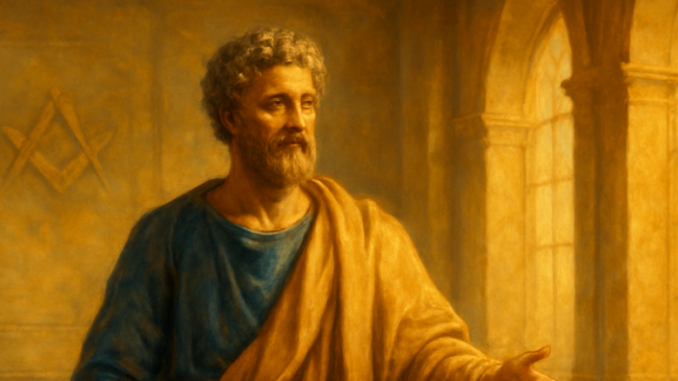
In Book X of his Meditations, Marcus Aurelius articulates an attitude that is both radical and profoundly liberating: amor fati — the love of fate. Not mere resignation, but an active embrace of everything life brings. For Freemasons, this strikes a deeply familiar chord. The lodge teaches that the path toward light does not run only through triumphs but especially through the trials that shape us. How do these two traditions, separated by nearly two millennia, relate to one another? And what can we learn when we place the Stoic emperor alongside the symbolic workshop?
The Stoic Perspective: Fate as Teacher
Marcus Aurelius never wrote his Meditations for publication. They were private exercises in the art of living. In Book X, a central theme resurfaces: we have no power over external events, but we have full authority over our response to them. The emperor speaks of the universe as a coherent whole, in which every part serves a purpose. Setbacks are not punishments — they are threads in a larger tapestry that we can only partially perceive.
This worldview does not call for passivity. Marcus Aurelius constantly urges himself to act, to fulfill his duties, to serve the community. The difference between Stoicism and fatalism lies in one’s inner orientation: those who love their fate stop wasting energy resisting what cannot be changed. That energy is redirected toward what they can influence — their own character, their own virtue, the quality of their own actions.
The Masonic Perspective: The Rough Ashlar and Life’s Circumstances
A Freemason enters the lodge as a rough ashlar — an unpolished stone drawn from the quarry of life, symbolizing the imperfect human being who, through dedicated labor upon himself, can achieve a more refined form. But what tools does he use? The gavel and chisel are not merely symbols of willpower and precision. They also represent life’s circumstances that act upon us — sometimes gently, sometimes with tremendous force.
Within this symbolism lies a deep kinship with the Stoicism of Marcus Aurelius. The Freemason learns not to flee from hardship but to see difficulties as the hammer blows that shape the rough stone. Where an outsider might see only adversity, the initiate recognizes an opportunity for growth. The lodge offers no escape from fate. Instead, it provides a framework within which one learns to integrate fate into a meaningful whole.
What Both Perspectives Share
Both Stoic philosophy and Freemasonry place the inner self at the center. External wealth, status, or good fortune are not the measures of a life well lived. What matters is the quality of one’s character — whether one has lived in harmony with virtue and truth. Marcus Aurelius called this living according to nature, by which he meant the rational, social, and moral nature of the human being. The Freemason speaks of building the inner temple, a metaphor expressing precisely the same priority.
Acceptance of fate is not resignation born of weakness — it is the most powerful act of inner freedom: the transformation of every circumstance into building material for one’s own temple.
Both traditions also emphasize our bond with others. Marcus Aurelius wrote repeatedly about the human being as a social creature, part of a greater body. Freemasonry translates this into the concept of brotherhood: the recognition that we are all travelers on the same road, that the growth of one is bound to the well-being of all. Acceptance of fate is not an individualistic affair. It is an attitude that creates space for compassion, for mutual support, for carrying each other’s burdens together.
Lessons for the Modern Seeker
The comparison between Marcus Aurelius and Freemasonry reveals that wisdom follows universal patterns. Two traditions, born in different eras and contexts, arrive at remarkably similar insights about the art of living. This is no coincidence. It suggests that certain truths about the human condition are rediscovered time and again by those who reflect honestly and deeply on existence and meaning.
For today’s seeker, this convergence offers a rich source of inspiration. The Stoic texts of Marcus Aurelius, Epictetus, and Seneca can be read as complements to the symbolic work of the lodge. Conversely, the ritual structure of Freemasonry gives an embodied dimension to philosophical principles that might otherwise remain abstract. The ritual makes tangible what philosophy articulates.
Practical Resonances
Self-reflection: Marcus Aurelius began and ended his days with self-examination. The Freemason is likewise encouraged to regularly pause and reflect upon his own thoughts and deeds.
The practice of virtue: Both traditions view virtue not as a theoretical ideal but as a daily discipline that requires constant practice.
Community and service: The individual never stands apart from the community. Personal growth must also serve the greater whole.
Acceptance as strength: What happens to us does not define us. What defines us is how we respond — and what we build from the material life hands us.
Two Paths, One Destination
The Stoic and the Freemason speak different languages, employ different images, and emerge from different worlds. Yet they point toward the same horizon. Marcus Aurelius would likely have felt at home in a lodge where men gather to work on themselves and on the world around them. And many a Freemason recognizes in the Meditations a kindred spirit who wrestled with the very same questions that echo through the temple.
The love of fate is ultimately a love of life in all its dimensions — including the shadow side. It is the recognition that both light and darkness are necessary, that the chisel causes pain but also gives form, that brotherhood means helping to bear one another’s burdens. In this shared wisdom, philosophy and Freemasonry find common ground — not as identical systems, but as kindred paths leading toward the same enduring truths about what it means to be fully human.
When we read Marcus Aurelius alongside the teachings of Freemasonry, we discover that the ancient art of accepting one’s fate and the Masonic commitment to shaping the rough ashlar are expressions of the same deep human impulse: to find meaning in every experience, to grow through adversity, and to walk the path not alone but in brotherhood. These two traditions, centuries apart, remind us that the most profound wisdom is timeless — and that the work upon ourselves is the most sacred labor we will ever undertake.
Copyright text & image: devrijmetselaar.nl
Texts are based on the ideas and content of the author of devrijmetselaar.nl, reviewed, corrected, and supplemented with the assistance of OpenAI. Images are created based on the ideas of the author of devrijmetselaar.nl using OpenAI/DALL-E.


Be the first to comment