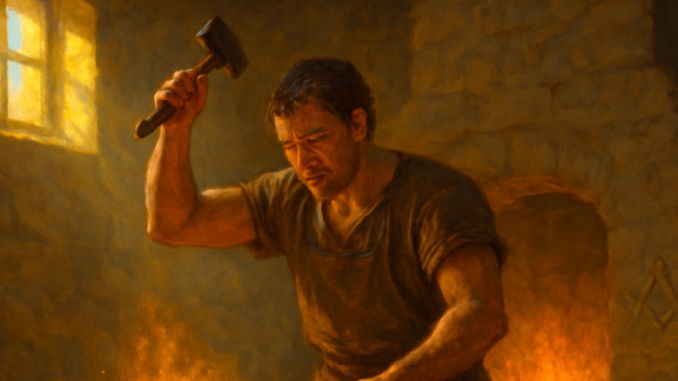
The summer of 2026 is shattering temperature records, yet something remarkable is happening on the work floor: heat waves are barely causing worker absenteeism. Where does this resilience come from? The answer reaches far beyond modern air conditioning — it stretches back to an ancient tradition of laboring under extreme conditions. The cathedral builders, the blacksmiths at their glowing forges, and the stonemasons under the scorching sun understood something we seem to have forgotten. Their secret was hidden in the deliberate formation of character.
The Blacksmith and His Inner Fire
In the Middle Ages, the smithy was one of the most brutally hot workplaces anyone could enter. Temperatures soared to unbearable heights while the craftsman spent hours forcing iron into shape. Yet blacksmiths rarely abandoned their duties. The reason was not merely physical toughness — it was something far deeper: the cultivation of an inner disposition that could withstand external hardship. The smith learned not only to master metal, but above all, to master himself.
This tradition of inner formation found its way into the lodges of operative masons. Before an apprentice was allowed to begin complex stonecutting techniques, he first had to prove he could persevere. It was not the tools that made the master, but the character forged through grueling labor. The heat was not an enemy — it was a teacher.
Cathedral Builders and the Summer Months
Europe’s great cathedrals did not rise in spite of the summer heat, but partly thanks to the ability of craftsmen to work within it. Historical documents from the thirteenth century show that building lodges maintained strict daily schedules during warm periods. Work began at sunrise, paused during the hottest hours, and resumed in the cool of the late afternoon. This was not weakness — it was wisdom.
The true master knows not only his tools, but also his own limits and capabilities.
This practical wisdom reflects a deeper insight that also lies at the heart of speculative Freemasonry: self-knowledge as the foundation of all growth. The builder who understood his physical limitations ultimately constructed more solidly than the one who recklessly pushed on until exhaustion took hold.
Personality as the Rough Ashlar
In Masonic symbolism, the rough ashlar occupies a special place. This unworked block of stone represents the individual at the beginning of his inner journey. Through labor, reflection, and perseverance, this stone is gradually shaped into a useful building block. The heat of life, the pressure of circumstances, and the friction of setbacks are not obstacles in this process — they are essential shapers.
What modern researchers observe about workers who continue to function despite extreme temperatures echoes this ancient principle. The employee who does not falter during a heat wave has — consciously or not — developed a personality that can withstand external pressure. This is not simply a matter of physical conditioning, but of mental and emotional formation.
The Four Qualities of Resilience
Historical sources on craftsmen and their training point to specific character traits that enabled them to perform under harsh conditions. These qualities still form the core of what Masonic tradition considers a well-balanced personality.
Patience: the ability to endure discomfort without making rash decisions.
Self-knowledge: a clear understanding of one’s own capabilities and limitations.
Discipline: the inner strength to maintain routines when circumstances push back.
Perspective: the awareness that temporary discomfort is part of a larger whole.
These qualities were never considered innate talents. They were understood as skills that could be developed. The apprenticeship in the old guilds served not only to transmit technical competence, but precisely to make this kind of character formation possible.
From Past to Present
The lesson we can draw today from workers’ ability to endure heat waves goes well beyond workplace conditions. It points to an underlying human capacity that has been nurtured and passed down through the centuries. Freemasonry has preserved this tradition in its symbolic language and ritual practice, where the formation of character remains central.
When we read that modern workers barely falter despite extreme heat, we are not simply looking at a statistic. We are seeing evidence of a human capacity that generations of craftsmen, builders, and thinkers have cultivated. The question is not whether we can withstand life’s heat, but whether we are willing to undertake the inner work that makes us equal to it.
The heat of a summer day is only one of many trials that life places before us. The wisdom of ancient craftsmen teaches us that resilience is no accident — it is the result of deliberate formation. In the tradition of Freemasonry, this insight remains alive: the rough ashlar becomes useful only through the heat of the fire and the pressure of the chisel. Those who shape their character with patience and self-knowledge will not only endure the summer heat, but every challenge life brings.
Copyright text & image: devrijmetselaar.nl
Texts are based on the ideas and content of the author of devrijmetselaar.nl, reviewed, corrected, and supplemented with the assistance of OpenAI. Images are created based on the ideas of the author of devrijmetselaar.nl using OpenAI/DALL-E.
Frequently Asked Questions
What does Freemasonry teach about building character through difficult circumstances?
Freemasonry teaches that character is forged through perseverance and self-mastery, much like the ancient craftsmen who worked in extreme conditions. The symbolic rough ashlar represents the individual's inner journey, where life's pressures and challenges serve as essential tools for personal growth and development. Rather than viewing hardship as an obstacle, Masonic philosophy sees it as a necessary teacher that shapes and refines our character.
How does the concept of the 'rough ashlar' relate to personal development in Freemasonry?
The rough ashlar is a fundamental Masonic symbol representing an unworked stone—the individual at the start of their inner journey. Through labor, reflection, and perseverance, this stone is gradually shaped into a useful building block, just as a person develops through life's experiences. The heat, pressure, and friction of life's circumstances are not obstacles but essential shapers that help transform the rough stone into a refined and capable individual.
What is the Masonic principle of self-knowledge, and why is it important?
Self-knowledge is a cornerstone of Masonic philosophy, teaching that understanding one's own limits and capabilities is fundamental to all growth and achievement. Ancient craftsmen understood that knowing when to rest and work within one's capabilities led to superior results, a wisdom reflected in cathedral-building practices. This principle demonstrates that true mastery comes not from reckless persistence, but from the wisdom to work in harmony with both our strengths and our limitations.
How does ancient craftsmanship connect to modern Freemasonry?
Ancient crafts like blacksmithing and stonemasonry embodied the principles that speculative Freemasonry would later formalize—the belief that work, discipline, and perseverance forge character and inner strength. The medieval apprentice's journey to mastery mirrors the Masonic path, where initiation and progression represent the gradual refinement of personality and capability. This connection reveals that Freemasonry draws its wisdom from timeless truths about human development that transcend centuries.
Can Freemasonry help me develop resilience in facing life's challenges?
Yes, Freemasonry provides a philosophical framework for understanding how life's difficulties can strengthen character rather than diminish it. Through Masonic symbols, teachings, and practices, members learn to view challenges as opportunities for inner growth and self-mastery. The organization's emphasis on perseverance, self-knowledge, and continuous improvement equips members with the mental and spiritual tools to build genuine resilience in facing adversity.



Be the first to comment