You know the feeling: a season when everything falls apart. Loss, setback after setback, and the people around you don’t seem to understand. In moments like these, a question surfaces — one that humanity has grappled with for thousands of years: why is this happening to me? The Book of Job from the Old Testament confronts us with exactly this question. But it also offers a surprisingly practical framework for anyone willing to look deeper. For Freemasons in particular, this ancient book of wisdom contains symbols that speak directly to the inner journey every Brother or Sister undertakes.
The Heart of the Story: A Righteous Man Put to the Test
Job is a prosperous, upright man who loses everything — his possessions, his children, his health. His friends insist he must have done something wrong to deserve such misfortune. But Job knows he is innocent. The book isn’t really about whether suffering is a punishment. It’s about how you respond when life hits you with incomprehensible adversity. Job refuses to surrender his integrity, even when everything is stripped away from him. That is the first practical lesson: character stands firm when comfort disappears.
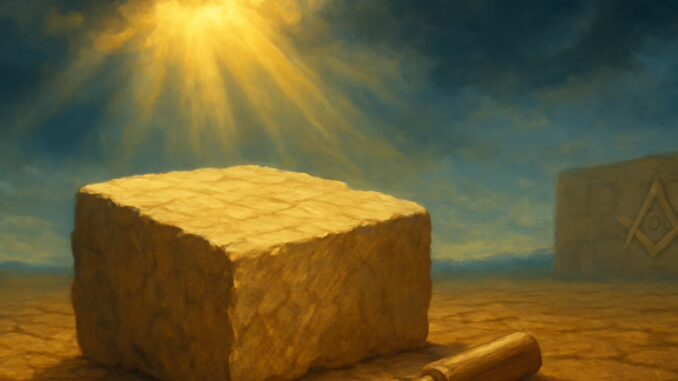
The Symbolism of the Rough Ashlar
In Freemasonry, we work on ourselves as upon a rough ashlar — an unfinished stone that must be shaped and polished. Job’s trials can be understood as the chisel blows needed to reveal our inner form. No one asks for adversity, just as a stone doesn’t ask to be worked upon. Yet it is precisely the friction that brings hidden beauty to light.
When you apply this perspective to your own life, difficult periods take on a different meaning. They are no longer pointless — they become formative. Ask yourself the following question the next time you face hardship: which rough edge of mine is being shaped right now?
This is not an invitation to passivity, but to conscious reflection. Job complains, asks questions, even demands answers. But he does not give up. That combination of protest and perseverance is what makes him such a powerful symbol.
Patience as an Active Force
The patience of Job has become proverbial. But his patience is not passive waiting. It is an active choice not to buckle under pressure. In Masonic terms, you could say that Job refuses to let his inner temple collapse, even as a storm rages around him. This demands discipline — the ability to keep sight of the broader picture when the details are overwhelming.
“Naked I came from my mother’s womb, and naked shall I return there.”
These famous words of Job remind us of the impermanence of all possessions. For the Freemason working on inner growth, they pose a powerful invitation to examine: what am I so attached to that losing it would break me? And then: how can I build a foundation that does not depend on external circumstances?
Concrete Steps for Your Own Path
How can you apply Job’s symbolism in your daily life? Here are three practical actions to consider:
1. Keep an adversity journal. Don’t just record what happens — note the inner reaction it triggers. After a month, you’ll see patterns you would have otherwise missed.
2. Practice asking questions without demanding immediate answers. Job questions, protests, and searches. The answer comes only at the end. Learn to sit with open questions, and allow understanding to arrive in its own time.
3. Find a Brother or Sister with whom you can share your trials. Job’s friends fail in their attempts at comfort, but the conversation itself is valuable. True Brotherhood means being present — even without solutions.
The Light Beyond the Darkness
At the end of the book, the Divine speaks to Job from a whirlwind — not with answers, but with counter-questions that reveal the immensity of existence. Job realizes that his understanding has limits. This is not a defeat. It is a breakthrough. In Masonic terms, Job moves from darkness to light — not by denying the darkness, but by enduring it.
The light that Freemasons seek is not the absence of shadow. It is the ability to see, even when circumstances are dark. Job teaches us that this ability is not given — it is forged. Every hardship is an invitation to dig deeper, build more solidly, and see more clearly.
From Ancient Story to Living Practice
The Book of Job is not a manual for a pain-free life. It is a mirror that confronts us with who we truly are when everything falls away. For the Freemason who is serious about self-knowledge, this ancient story offers a wealth of symbolism. The rough ashlar being shaped. Patience that is not weakness but strength. Light that only becomes visible after you have endured the darkness. These are not abstract ideas — they are invitations to act, here and now, in your own life.
The next time life puts you to the test, remember Job. Not as a tale from long ago, but as a living blueprint for keeping your inner temple standing. Complain if you must, ask your questions, but never surrender your integrity. For it is precisely in the trial that the true material you are built from becomes visible.
Copyright text & image: devrijmetselaar.nl
Texts are based on the ideas and content of the author of devrijmetselaar.nl, reviewed, corrected, and supplemented with the assistance of OpenAI. Images are created based on the ideas of the author of devrijmetselaar.nl using OpenAI/DALL-E.
Frequently Asked Questions
How does the Book of Job relate to Freemasonry?
The Book of Job contains profound spiritual symbolism that directly mirrors the Masonic journey of self-improvement and inner growth. Just as Job's trials shape his character, Freemasons view life's adversities as the chisel blows that refine the rough ashlar—the unpolished stone of the self—revealing hidden inner beauty and strength.
What is the 'rough ashlar' and why is it important in Masonic teaching?
The rough ashlar is an unfinished stone that Masons use as a symbol for the human soul at the beginning of its spiritual journey. It represents the idea that we must be shaped and polished through experience and self-reflection to become our best selves, much like Job's suffering became the means through which his character was refined and deepened.
Does Freemasonry teach that suffering is necessary for growth?
Freemasonry teaches that while we don't seek suffering, the adversities we encounter can become powerful tools for inner development when met with conscious reflection and integrity. The Book of Job exemplifies this by showing that true growth comes not from avoiding hardship, but from maintaining our principles and asking meaningful questions when facing incomprehensible challenges.
How can I apply Job's example to my own spiritual journey?
You can begin by examining your attachments to external circumstances and asking yourself what rough edges are being shaped during difficult periods. Masonic practice encourages keeping an adversity journal, maintaining active patience through challenges, and remembering that your inner temple—your character and integrity—remains unshaken even when external circumstances change.




Be the first to comment