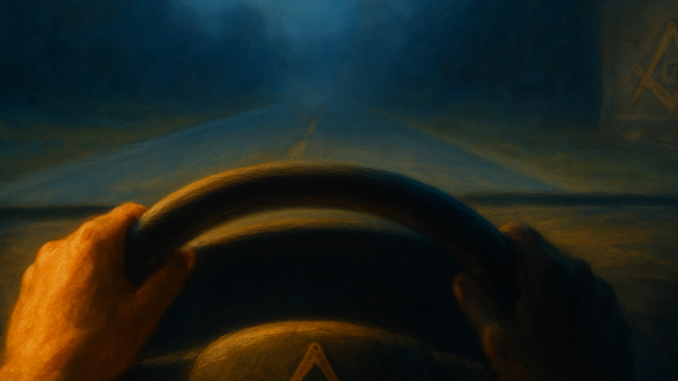
A steering wheel in human hands. A split second. A decision that can never be undone. When the news reports that someone is suspected of causing a fatal accident, it touches the deepest questions about human responsibility. What does it mean to carry guilt? How do our actions relate to our conscience? These questions reach far beyond the courtroom — they strike at the very foundation of what it means to be human.
The Steering Wheel as a Symbol of Choice
Every vehicle has a steering wheel, a rudder, a lever that sets its direction. This seemingly practical instrument carries a deeper meaning. The steering wheel represents the human will — our capacity to chart a course through life. Whoever takes the driver’s seat accepts a responsibility that extends far beyond their own destination.
In Freemasonry, this symbolism finds a parallel in the image of the Master Builder wielding his tools. Just as the square and compasses are instruments for maintaining right angles and proper measure, the steering wheel is an instrument for giving direction. Both demand awareness, attention, and the recognition that every movement carries consequences.
The Inescapable Question of Guilt
When a tragic accident occurs, the question arises inevitably: who bears the guilt? The legal system searches for facts, for negligence, for culpability. But behind these juridical concepts lies a deeper philosophical question. What is guilt, really? Is it merely a legal category, or does it touch something more essential in the human condition?
The ancient Greek philosophers already distinguished between intent and accident, between knowing and not knowing. Yet they also acknowledged that an act carries consequences regardless of intention. The tragedy of a fatal collision lies precisely in this tension: someone meant no harm, and yet harm was done.
The conscience is the voice that speaks when all other voices fall silent.
Conscience as the Inner Court of Justice
Within Freemasonry, conscience plays a central role. It is regarded as the inner voice that guides a person along their path through life. Unlike an external judge, conscience passes judgment not only on actions but also on intentions, on omissions, on what might have been.
This inner court is mercilessly honest. It knows no lawyers, no procedures, no appeals. Whoever has unintentionally caused harm to another knows it best themselves. Conscience registers what no camera captures: the moment of inattention, the thought that wandered, the choice that in hindsight could have been different.
Yet conscience is not only a judge — it is also a guide. It points not only to what went wrong but also to what can be restored. In this dual function lies the hope that can accompany even the heaviest burden of guilt.
Responsibility as a Masonic Ideal
Freemasonry teaches that every person is a builder of their own temple of life. This building does not happen in isolation but in the midst of others. Every stone we lay touches the stones of our fellow human beings. Responsibility, therefore, is not a burden but an acknowledgment of our interconnectedness.
Responsibility demands awareness of our influence on others. It requires the courage to acknowledge mistakes. It invites us toward restoration where restoration is possible. And it accepts the limits of what can never be undone.
In the Lodge, Masons speak of working the rough ashlar — polishing one’s own character through persistent effort. This work also encompasses the confrontation with our own shortcomings, with moments when we were not the best version of ourselves. Guilt, in this sense, is not a dead end but a starting point for inner labor.
Recognizing the Other in Ourselves
When we read about someone suspected of causing a fatal accident, the first impulse is often distance. We think: this could never happen to me. Yet honest self-reflection invites a different response. Who among us has never experienced a moment of inattention? Who has always been fully present behind the wheel, at every moment, without exception?
Freemasonry speaks of brotherhood — of recognizing our fellow human beings as equals. This does not mean excusing actions or diminishing responsibility. It means acknowledging the shared human vulnerability that binds us all. In the other, we see ourselves, with all our limitations and our capacity for failure.
Ethics as a Daily Practice
Ethics is not an abstract system of rules. It becomes real in concrete moments — in the split second when we choose. The steering wheel we grip, the words we speak, the attention we give or withhold. In all these moments, our ethics are tested.
The Freemason strives to practice this daily exercise with full awareness. Not because he pursues perfection, but because he knows that every choice matters. Life does not demand flawlessness — it demands attentiveness, a willingness to learn, and the courage to take responsibility for what comes from our hands.
The steering wheel keeps turning. Life goes on, even after the deepest tragedy. Guilt is not a prison but an invitation to deeper awareness. It reminds us of our interconnectedness, of the vulnerability we share, of the responsibility that life entrusts to us. In the face of what can never be undone, one question remains: how do we continue to build? The answer lies in every next choice, every next moment of attention, every next act of care for another.
Copyright text & image: devrijmetselaar.nl
Texts are based on the ideas and content of the author of devrijmetselaar.nl, reviewed, corrected, and supplemented with the assistance of OpenAI. Images are created based on the ideas of the author of devrijmetselaar.nl using OpenAI/DALL-E.
Frequently Asked Questions
What does Freemasonry teach about personal responsibility?
Freemasonry teaches that every person is a builder of their own temple of life, and this building happens within a community where every action affects others. The craft emphasizes that we each bear responsibility not only for our intentional choices but also for the consequences of our actions, making us accountable members of society. This principle encourages Masons to act with awareness, attention, and consideration for how their decisions impact those around them.
How does Freemasonry view conscience and guilt?
In Freemasonry, conscience is regarded as an inner voice and guide that honestly reflects on both actions and intentions, serving as an inner court of justice. Rather than viewing guilt solely as a legal concept, Freemasonry recognizes it as something deeply human that connects us to our moral responsibility. The craft teaches that conscience, while truthful about our mistakes, also points toward restoration and the opportunity to make amends.
What is the symbolic meaning of the steering wheel in Masonic teaching?
In Masonic symbolism, the steering wheel represents human will and our capacity to chart a course through life with awareness and intention. Just as the square and compasses are tools for maintaining proper measure, the steering wheel symbolizes our responsibility to direct our actions with care, knowing that every choice carries consequences. This symbol reminds us that accepting control over our direction in life means accepting the responsibility that comes with it.
Can Freemasonry help someone understand unintentional harm or accidents?
Freemasonry addresses the profound human experience of causing unintentional harm by acknowledging that consequences exist regardless of intent, while also recognizing the difference between negligence and accident. The craft teaches that our conscience guides us not only to acknowledge what went wrong but also toward meaningful restoration and reconciliation. Through this balanced perspective, Freemasonry offers a framework for processing guilt and moving toward healing.




Be the first to comment