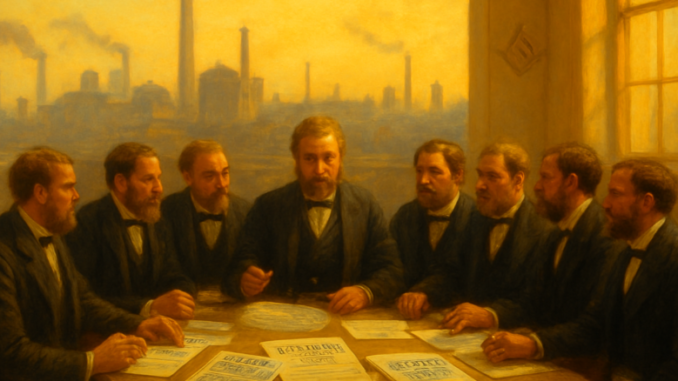
The 19th century was an era of sweeping transformation. The Industrial Revolution, the rise of nation-states, and the march toward democracy reshaped the world as we know it. Throughout this turbulent period, Freemasonry played a significant role as a community of ideas, social reform, and international cooperation.
Freemasonry and the Industrial Revolution
As industrialization took hold across Europe and North America, new social classes emerged and the demand for social justice grew louder. Many Masonic lodges found themselves at the forefront of initiatives that championed social reform. Members leveraged their networks to advocate for improved working conditions, expanded access to education, and the establishment of charitable institutions.
It was also during this period that women first began to gain a foothold in Freemasonry, albeit often through so-called “adoptive lodges” that operated under the supervision of male Grand Lodges. While inclusivity was slowly increasing, most lodges remained closed to women — a tension that would continue well into the following century.
Political Involvement and National Movements
The 19th century also witnessed a growing political influence of Freemasonry. In countries like France and Italy, lodges were closely involved in the struggle for national unification and the promotion of republican ideals. Prominent Freemasons such as Giuseppe Garibaldi in Italy seamlessly combined their Masonic membership with leadership roles in powerful political movements.
In other nations, such as the United Kingdom, lodges served as neutral ground where political and social discussions could take place freely. This highlighted one of Freemasonry‘s enduring strengths — its ability to act as a bridge between different ideologies and bring people of differing viewpoints together in a spirit of fraternity.
International Expansion
The 19th century was a time of colonial expansion, and Freemasonry followed these global movements closely. In colonial territories across India, Africa, and beyond, lodges were established that served as meeting places for European colonists and local elites alike. While this expansion was sometimes intertwined with imperialism, lodges also functioned as spaces of cultural exchange and dialogue, creating connections that transcended national and ethnic boundaries.
Rituals and Symbolism in Transition
Throughout the 19th century, Masonic rituals and symbolism underwent a significant process of standardization. New branches and rites, such as the Scottish Rite, grew rapidly in popularity and offered members the opportunity to explore deeper spiritual and philosophical knowledge beyond the three Craft degrees.
The emphasis on morality and personal growth remained a cornerstone of Freemasonry, while increasing attention was given to the social and civic impact of the fraternity. This dual focus — inner development and outward contribution — became a defining characteristic of 19th-century Masonic practice.
The Lasting Impact of the 19th Century
The 19th century was a period of remarkable growth and adaptation for Freemasonry. The fraternity played an important role in social movements and expanded its presence across every inhabited continent. At the same time, the Order faced mounting pressure from religious institutions and conservative governments that viewed its influence with suspicion and distrust. These external challenges, however, only seemed to strengthen the bonds within the Craft and reinforce its commitment to Enlightenment values.
The 19th century was a defining era for Freemasonry — a time of growth, political engagement, and meaningful social reform. The fraternity proved itself once again as a wellspring of ideas and a force for positive change in an age defined by both progress and profound challenges. Discover how Freemasonry navigated the turbulent waters of the 20th century in our next article.
Copyright text & image: devrijmetselaar.nl
Texts are based on the ideas and content of the author of devrijmetselaar.nl, reviewed, corrected, and supplemented with the assistance of OpenAI. Images are created based on the ideas of the author of devrijmetselaar.nl using OpenAI/DALL-E.
Frequently Asked Questions
What role did Freemasonry play during the Industrial Revolution?
During the 19th century, Masonic lodges were at the forefront of social reform initiatives, with members using their networks to advocate for improved working conditions, expanded education access, and charitable institutions. Freemasons recognized the challenges posed by industrialization and actively worked to address social injustice and support emerging working classes.
How did Freemasonry influence political movements in the 19th century?
Freemasonry had significant political influence, particularly in countries like France and Italy where lodges were deeply involved in national unification and republican ideals. Prominent Freemasons like Giuseppe Garibaldi combined their Masonic membership with leadership in major political movements, while in other nations like the United Kingdom, lodges served as neutral spaces where people of differing political viewpoints could engage in meaningful dialogue.
Did women participate in Freemasonry during the 19th century?
Yes, women began to gain a foothold in Freemasonry during the 19th century through 'adoptive lodges' that operated under male Grand Lodges, marking the beginning of gradual inclusivity in the fraternity. While most traditional lodges remained closed to women, this period represented an important step toward greater openness and diversity within Freemasonry.
How did Freemasonry expand globally during the 19th century?
Freemasonry expanded internationally during this period of colonial expansion, with lodges established across India, Africa, and other territories as centers for cultural exchange and dialogue. These lodges served as meeting places for diverse communities and helped create connections that transcended national and ethnic boundaries.
What changes occurred in Masonic rituals and practices during the 19th century?
The 19th century saw significant standardization of Masonic rituals and symbolism, with new branches and rites like the Scottish Rite gaining popularity and allowing members to explore deeper spiritual knowledge. Freemasonry maintained its emphasis on personal moral growth while increasingly focusing on social and civic contributions, creating a balance between inner development and outward community service.

Be the first to comment