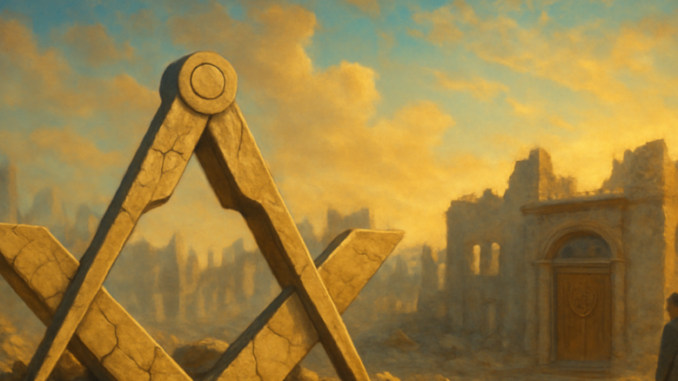
The 20th century was one of the most turbulent periods in human history — shaped by two devastating world wars, the rise and fall of totalitarian regimes, and sweeping social transformations. Throughout it all, Freemasonry endured as a beacon of stability and idealism. Yet the Craft was far from untouched by these upheavals. It faced persecution, adapted to new realities, and ultimately emerged with its core values intact, ready to carry them into a new millennium.
Freemasonry Under Totalitarian Regimes
During the interwar years and the Second World War, Masonic lodges across Europe became targets of systematic oppression. Totalitarian regimes — most notably Nazi Germany and Fascist Italy — viewed Freemasonry as a direct threat. The fraternity’s commitment to liberty, equality, and brotherhood stood in stark opposition to authoritarian ideology. Lodges were forcibly closed, their members persecuted, and countless irreplaceable archives were destroyed or confiscated.
Despite this relentless campaign of suppression, Freemasonry did not disappear. In several countries, lodges continued to operate underground, preserving their traditions and humanitarian ideals in secret. Their quiet resilience served as a powerful testament to the enduring strength of Masonic principles, offering a spark of hope even in the darkest chapters of the century.
Freemasonry During the Cold War
After the war ended in 1945, lodges across Western Europe and beyond began the long process of rebuilding. Freemasonry played a meaningful role in the reconstruction of post-war societies, providing networks of fellowship and shared purpose at a time when communities were fractured.
During the Cold War, Masonic lodges in the West served as valuable meeting places where individuals from different political backgrounds could engage in respectful dialogue. This was very much in keeping with the Masonic tradition of seeking common ground beyond partisan divides. In communist countries, however, Freemasonry was once again banned, viewed with suspicion by regimes that tolerated no independent civic organizations.
This era also saw the growing influence of international Masonic bodies such as the United Grand Lodge of England and the Grand Orient de France. These organizations strengthened ties between lodges in different nations, reinforcing Freemasonry’s identity as a truly global fraternity.
Social Reform and the Push for Inclusivity
The second half of the 20th century brought significant internal changes to Freemasonry. As broader society grappled with questions of civil rights and equality, the Craft began to address its own traditions of exclusivity. In many countries, lodges started opening their doors to women and members of minority groups, reflecting a more inclusive understanding of the fraternity’s founding principles.
This shift led to the establishment and growth of co-Masonic organizations such as Le Droit Humain, which welcomed both men and women as equal members. The role of women within Freemasonry expanded considerably during this period, adding new perspectives and energy to the Craft.
Beyond its internal evolution, Freemasonry continued to make a tangible impact on the wider world through charitable work. Masonic organizations funded schools, hospitals, and relief programs in communities around the globe, underscoring the fraternity’s deep commitment to social responsibility.
Freemasonry in Popular Culture and the Rise of Myths
The 20th century saw a dramatic increase in public fascination with Freemasonry. Books, films, and television series brought Masonic imagery and themes to mainstream audiences. Works like Dan Brown’s The Da Vinci Code and the film National Treasure captivated millions, weaving Masonic symbolism into compelling narratives of mystery and adventure.
While this pop culture attention sometimes fueled misconceptions and conspiracy theories, it also had a positive effect. It sparked genuine curiosity about the history, symbolism, and philosophy of Freemasonry, prompting many people to look beyond the myths and explore what the Craft actually stands for.
Embracing Technological Progress
As the century drew to a close, Freemasonry began to embrace the possibilities offered by new technology. The arrival of the internet and digital communication tools made lodges more accessible than ever before. Information about Masonic history, philosophy, and membership became available to a worldwide audience, breaking down barriers that had long surrounded the fraternity.
This digital shift laid important groundwork for the modernization of Freemasonry in the 21st century, enabling the Craft to reach new generations while preserving its rich traditions.
The Lasting Legacy of the 20th Century
If the 20th century proved anything about Freemasonry, it was the fraternity’s extraordinary resilience. Through persecution, world wars, ideological conflict, and rapid social change, the Craft remained true to its core values of brotherhood, charity, and truth. It adapted without abandoning its identity, and it emerged from the century as a living symbol of humanity’s capacity for fellowship — even in the most challenging of times.
The story of Freemasonry in the 20th century is one of endurance and evolution. The Craft served as a bridge between tradition and modernity, demonstrating that its ideals are not relics of the past but living principles capable of guiding people through even the most turbulent eras. This legacy laid a strong foundation for Freemasonry’s continued relevance in the 21st century and beyond.
Copyright text & image: devrijmetselaar.nl
Texts are based on the ideas and content of the author of devrijmetselaar.nl, reviewed, corrected, and supplemented with the assistance of OpenAI. Images are created based on the ideas of the author of devrijmetselaar.nl using OpenAI/DALL-E.
Frequently Asked Questions
Was Freemasonry affected by World War II and totalitarian regimes?
Yes, Masonic lodges across Europe faced severe persecution from totalitarian regimes like Nazi Germany and Fascist Italy, which viewed Freemasonry's commitment to liberty and equality as a threat to their ideologies. However, despite forced closures and member persecution, Freemasonry demonstrated remarkable resilience by continuing to operate underground in several countries, preserving its humanitarian ideals through the darkest chapters of the century.
What role did Freemasonry play after World War II?
After 1945, Masonic lodges played a meaningful role in rebuilding post-war societies by providing networks of fellowship and shared purpose when communities were fractured. During the Cold War, lodges in the West served as valuable meeting places where people from different political backgrounds could engage in respectful dialogue, embodying Freemasonry's tradition of seeking common ground beyond partisan divides.
How did Freemasonry address inclusivity in the 20th century?
In the second half of the 20th century, Freemasonry began opening its doors to women and members of minority groups, reflecting a more inclusive understanding of its founding principles of equality. This evolution led to the growth of co-Masonic organizations such as Le Droit Humain, which welcomed both men and women as equal members, demonstrating the Craft's commitment to adapting while maintaining its core values.
Is Freemasonry truly a global organization?
Yes, Freemasonry is a truly global fraternity, particularly strengthened during the 20th century through the growing influence of international Masonic bodies such as the United Grand Lodge of England and the Grand Orient de France. These organizations reinforced ties between lodges in different nations, creating a worldwide network united by shared ideals of fellowship and mutual respect.

Be the first to comment