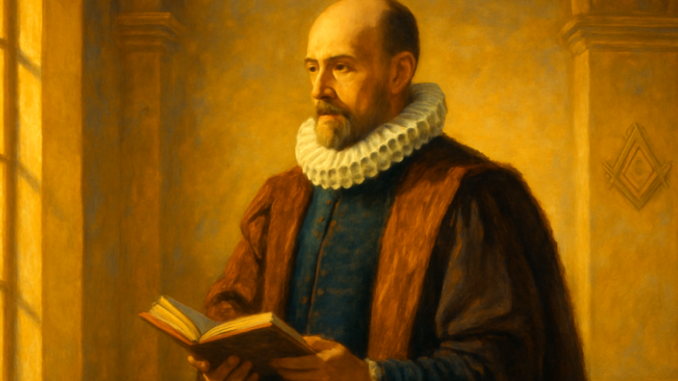
Picture an evening in lodge. A brother delivers a carefully prepared lecture, eloquent and polished. The words flow like water over smooth stone. Yet when he finishes, the silence that follows isn’t one of admiration — it’s a vague sense of emptiness. The words were beautiful, but they touched no one. This is precisely the phenomenon that Michel de Montaigne dissected four centuries ago in his essay “On the Vanity of Words,” and his insight has lost none of its edge.
When Eloquence Becomes a Mask
Montaigne wrote this short but incisive essay in the first book of his famous Essais. Its core message is as simple as it is uncomfortable: words used merely to impress inevitably lose their value. He invoked the Roman rhetorician Marcus Antonius Gnipho and pointed to the Greek tradition in which rhetoric was elevated to an art form in its own right — entirely detached from substance or truth. The orators of his time, he observed, were far more occupied with polishing their sentences than deepening their thoughts.
What Montaigne exposed is a tension recognizable in every era: the difference between speaking to be heard and speaking to connect. In a world awash with rhetoric, advertising, and hollow phrases, his warning is more relevant than ever. But it is within the context of Freemasonry that this message takes on a particularly profound dimension.
The Lodge as a Practice Ground for Honest Speech
Within Freemasonry, the spoken word holds a special place. During rituals, texts are delivered that have been passed down through generations. Beyond ritual, brethren present papers and personal reflections — known in some traditions as “architectural works” — to share with the lodge. It is here that Montaigne’s warning finds immediate resonance. A lecture that exists solely to let the speaker shine misses its purpose entirely. Freemasonry asks for something different: sincerity, vulnerability, and the willingness to share thoughts that genuinely come from the heart.
This distinction between vain eloquence and authentic communication touches one of the brotherhood’s core values. Connection does not arise from the beauty of words but from the honesty behind them. Aristotle, in his Rhetoric, already distinguished between ethos, pathos, and logos — the three pillars of persuasion. Montaigne went a step further, arguing that even the most brilliant rhetoric is worthless when it is not rooted in authentic experience. In the lodge, this principle is tested every time a brother rises to speak.
Working the Rough Stone with Honest Words
Freemasonry employs the symbol of the rough ashlar — the unfinished stone that the Entered Apprentice must work into a perfect cube. This symbol represents inner growth and moral refinement. But how does it relate to Montaigne’s thoughts on language? The connection is surprisingly direct. The rough stone stands for the unpolished self, including our tendency to present ourselves as more refined, more intelligent, or more profound than we truly are. Montaigne identified exactly this tendency as the heart of vain rhetoric: polishing the exterior while the interior remains untouched.
The real work lies in finding words that align with who you truly are. This is no easy task. It demands self-reflection — another core value that both Montaigne and Freemasonry place at the center of the human endeavor. Socrates, whom Montaigne admired and frequently cited, captured it in his famous injunction: know thyself. In Freemasonry, this principle translates into a continuing invitation to look honestly at yourself — especially in how you express yourself.
True connection does not emerge from the beauty of words but from the courage to say what is genuinely true, even when it sounds simpler than you might wish.
Brotherhood Beyond Words
There is yet another layer in Montaigne’s thinking that carries special relevance for Freemasons: the recognition that the deepest connections often lie beyond words altogether. In other essays — most notably his celebrated reflection on his friendship with Étienne de La Boétie — Montaigne described how true bonds transcend language. His famous explanation, “Because it was he, because it was I,” is perhaps the finest example of a statement that says everything precisely through its simplicity.
In the lodge, brethren experience something comparable. The silence after a well-executed ritual, the look of recognition following an honest presentation, the handshake that speaks louder than a thousand words — these are moments where connection arises that no language can fully capture. Montaigne’s critique of empty words is therefore not a condemnation of language itself but an invitation to reach beyond the surface toward that which truly unites us.
The Search for Truth in a Noisy World
Freemasonry describes its path as a search for light and truth. Montaigne would surely have appreciated this formulation — provided it did not devolve into a hollow phrase. For that is precisely the danger he identified: even the most elevated ideals can lose their meaning when they exist only as beautiful words, without the actual practice of honest inquiry and genuine encounter.
Voltaire, himself connected to Freemasonry, later wrote in a similar spirit about the dangers of dogmatic rhetoric. Johann Wolfgang von Goethe, also a Freemason, continually sought in his work the point where language and experience converge. They stood in a tradition that Montaigne had helped to shape: a suspicion of empty words combined with a deep trust in the power of speaking authentically.
What This Means in Practice
Montaigne’s essay invites Freemasons to examine their own speech — not as an exercise in self-criticism, but as an act of brotherly honesty. A few questions worth considering: Do I speak to impress or to connect? Are my words rooted in genuine reflection, or am I simply arranging attractive phrases? Do I have the courage to be simple when simplicity serves truth better than eloquence?
These are not comfortable questions, but they are precisely the kind of questions the Craft encourages us to ask. Montaigne never demanded that we abandon rhetoric or stop striving for articulate expression. His point was subtler and ultimately more challenging: that the value of our words is determined not by how they sound, but by how honestly they reflect who we are and what we have genuinely come to understand.
In a culture that often rewards performance over substance, this remains a radical proposition — and one that every brother can put into practice the next time he rises to speak in lodge.
Montaigne’s centuries-old meditation on the vanity of words carries a timeless message for Freemasons. The lodge is not a stage for rhetorical display but a sacred space for authentic encounter. When we dare to set aside the polished surface and speak from genuine experience, we honor both the Craft and one another. True brotherhood, after all, is not built on beautiful words — it is built on honest ones.
Copyright text & image: devrijmetselaar.nl
Texts are based on the ideas and content of the author of devrijmetselaar.nl, reviewed, corrected, and supplemented with the assistance of OpenAI. Images are created based on the ideas of the author of devrijmetselaar.nl using OpenAI/DALL-E.

Be the first to comment