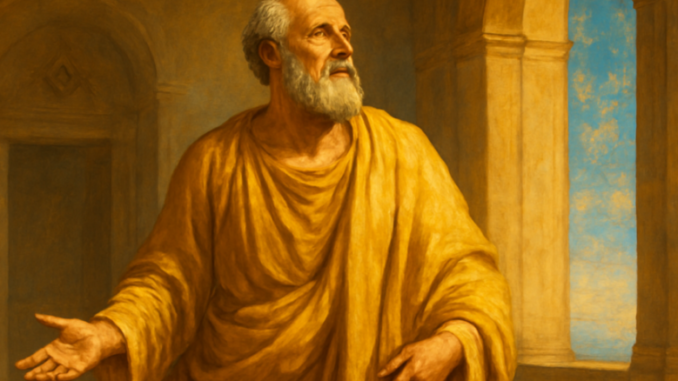
Imagine reading a text written nearly two thousand years ago and recognizing your own inner struggles in every line. How do I live well? What do I owe my fellow human beings? Is it enough to follow rules, or must I understand why I do what is right? These are precisely the questions Lucius Annaeus Seneca poses in his ninety-fifth letter to Lucilius — and they are precisely the same questions that echo through the rituals and ethical foundations of Freemasonry. This article traces the philosophical roots that nourished Seneca when he wrote this remarkable letter and reveals how deeply those roots reach into Masonic thought.
The Heart of Letter XCV: Rules or Understanding?
In Letter XCV, Seneca addresses a debate that had occupied the Stoic school for generations: are moral precepts sufficient to lead a virtuous life, or does one need a deeper philosophical understanding? His correspondent Lucilius seems drawn to the practical and the manageable — give me a list of rules and I will follow them. But Seneca refuses to make it that simple. He argues that rules without an understanding of the principles behind them are hollow and fragile. You can tell someone to be kind to another person, but if they do not understand why, that kindness will evaporate at the first sign of hardship.
This distinction between surface-level guidelines and deeply rooted moral awareness forms the backbone of the letter. And it is exactly this distinction that Freemasonry has made central to its own method: not the teaching of dogma, but the cultivation of personal insight through experience, reflection, and brotherly dialogue.
The Stoic Tradition as Foundation
To understand where Seneca stands, we need to go back to the founders of Stoicism. Zeno of Citium, who established the Stoic school in Athens around 300 BCE, laid the groundwork for an ethics centered on living in accordance with nature and reason. His successor Cleanthes, and later Chrysippus, developed this into a comprehensive system in which logic, natural philosophy, and ethics were inseparably intertwined.
Seneca consciously places himself within this lineage, but he also keeps his distance. He is no system-builder like Chrysippus. He is a practical philosopher who writes for real people facing real problems. Yet he holds fast to the core Stoic idea: virtue is the only true good, and virtue requires understanding. Where Chrysippus emphasized logical consistency, Seneca emphasizes the inner transformation necessary to act with genuine goodness.
Posidonius and the Idea of Cosmic Connection
A thinker who plays a significant role in the background of Letter XCV is Posidonius of Apamea. This brilliant Stoic of the second and first centuries BCE combined philosophy with science, geography, and historiography. What Seneca draws from him above all is the idea of cosmic sympathy — the conviction that all parts of the universe are interconnected, and that human beings, as rational creatures, bear a special responsibility within that greater whole.
This idea of universal connectedness resonates when Seneca writes that a human being “ought to be sacred to another human being.” This is not sentimental idealism but a philosophical position with deep roots. The insight that you cannot harm another without harming yourself — because both of you are part of the same rational whole — is one of the most powerful ideas Stoicism ever produced.
Care for others, in the Stoic tradition, is not an imposed commandment. It is a logical consequence of the insight that all people share in the same universal reason. For Freemasons, this resonates deeply — brotherhood is not merely a social arrangement but a reflection of a fundamental truth about human interconnectedness.
Aristotle, Plato, and the Ethics of Virtue
Although Seneca is a Stoic, he does not write in a vacuum. The broader Greek philosophical tradition continually resonates throughout his work. Aristotle’s concept of virtue as a cultivated disposition — a hexis that becomes second nature through repetition and practice — lies close to what Seneca argues. You do not become virtuous by memorizing a list of rules, but through constant practice and self-reflection. Plato’s idea that true knowledge is inseparably connected with right action also echoes in Seneca’s refusal to separate knowing from doing.
Where the Stoics go further than Aristotle is in their universalism. Aristotle largely limited his ethics to the polis — the city-state — and to free male citizens. Seneca, influenced by the cosmopolitan thinking of later Stoicism, extends his moral concern to all human beings regardless of origin or status. This expansion is precisely what makes Letter XCV so timeless, and it is what Freemasonry centuries later embraced as one of its defining principles: that the dignity of every human being transcends the boundaries of nation, class, and creed.
The Echo in Freemasonry: Philosophy as Living Practice
Perhaps you recognize something in Seneca’s argument from your own experience. You can hear a thousand times that you should be a good person. But the moment you truly understand what that means does not come from a book or a rule. It comes from experience, from confrontation with yourself, from a conversation with someone you trust. Freemasonry has elevated this insight into a method. In the lodge, you do not learn through instruction alone — you learn through ritual, through reflection, and through the shared contemplation of brothers who seek wisdom together.
The distinction Seneca draws between precepts and principles finds a direct parallel in the Masonic approach. The rituals offer structure and direction, but the real growth takes place in the inner processing. Just as Seneca describes the Stoic path as a journey from self-knowledge to compassion for others, Freemasonry describes its path as a journey from the rough ashlar to the perfect ashlar — from unworked potential to consciously shaped character.
What Seneca and Freemasonry Share
At their core, both Seneca’s Stoic philosophy and the Masonic tradition share a powerful conviction: that moral action begins with self-knowledge, not with external commands. Rules and rituals have their place — they provide the scaffolding within which deeper understanding can develop. But without that inner understanding, without the genuine transformation of character, outward compliance remains brittle and unreliable.
Seneca understood that philosophy is not an intellectual exercise confined to the classroom. It is a way of life, a daily practice of examining one’s motives, refining one’s character, and extending genuine care to others. Freemasonry, drawing on centuries of symbolic and philosophical tradition, embodies this same conviction. The lodge is not a school where answers are handed down. It is a workshop where each brother labors on his own inner stone, guided by ancient symbols and supported by the fellowship of like-minded seekers.
The universalism of Seneca’s moral vision — that every human being is sacred, that care for others flows naturally from right understanding — aligns with Freemasonry’s aspiration to unite people of every background under the banner of shared human dignity. In a world that often fragments along lines of ideology, identity, and self-interest, both Seneca and the Masonic tradition remind us that our deepest obligations are to one another, and that fulfilling those obligations begins with the hard and rewarding work of knowing ourselves.
Nearly two millennia separate us from Seneca’s writing desk, yet his insistence that genuine virtue requires understanding rather than mere obedience remains as urgent as ever. Freemasonry, with its emphasis on inner transformation, symbolic learning, and universal brotherhood, carries forward the very impulse that animated Seneca’s ninety-fifth letter. Whether you encounter these ideas in a Stoic text or within the walls of a lodge, the invitation is the same: do not settle for being told what is right — seek to understand why it is right, and let that understanding reshape the way you live and care for others.
Copyright text & image: devrijmetselaar.nl
Texts are based on the ideas and content of the author of devrijmetselaar.nl, reviewed, corrected, and supplemented with the assistance of OpenAI. Images are created based on the ideas of the author of devrijmetselaar.nl using OpenAI/DALL-E.


Be the first to comment