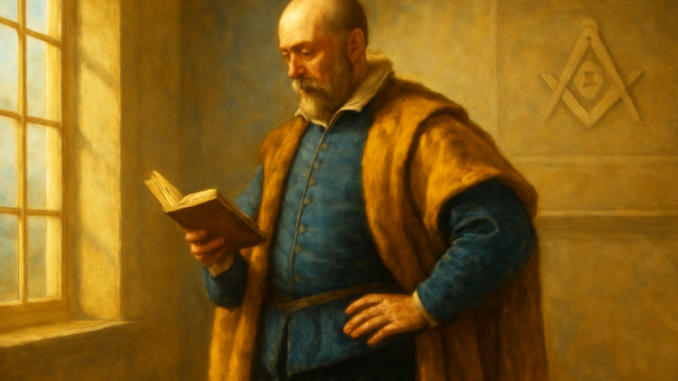
You may recognise this: a day off with no obligations, a chance to finally relax — and yet your thoughts race in every direction. Your mind feels busier than ever. The sixteenth-century philosopher Michel de Montaigne described exactly this phenomenon in his short but powerful essay On Idleness. He discovered that an empty mind does not lead to peace, but to chaos. What begins as a search for rest turns out to be a confrontation with ourselves.
The Core Idea of the Essay
In this eighth essay from his first book, Montaigne examines a paradox that remains strikingly familiar today: when we fail to engage our mind with purposeful activity, it does not settle into calm — it runs wild. Montaigne writes that an unoccupied mind gallops off in every direction, like a horse without a rider. Thoughts multiply, take on bizarre shapes, and produce what he calls “monsters” and “chimeras.”
The essay is deeply personal in tone. Montaigne describes how, after retiring from public life, he settled on his country estate fully expecting his mind to find peace. The opposite happened. Without the discipline of daily obligations, his thoughts began to churn uncontrollably. This unsettling experience became the very catalyst for his writing — an attempt to gain purchase on his own restless thought processes.
Classical Imagery and Metaphors
As is typical of his essays, Montaigne draws freely from classical antiquity to reinforce his argument. He cites Virgil, who in the Aeneid describes how standing water stagnates and grows foul. This vivid image illustrates Montaigne’s central point: movement and activity keep the mind healthy, while stagnation leads to decay. He also references Lucan, who writes about a woman whose thoughts spiralled out of control through inactivity.
Another powerful comparison is that of fallow land. Just as a fertile field left unploughed will be overrun with weeds, so a fertile mind without direction becomes choked with useless or harmful thoughts. This agricultural metaphor was immediately recognisable to Montaigne’s contemporaries, but it remains just as evocative today — perhaps especially for those who have experienced the restlessness of an unfocused mind during periods of enforced stillness.
“I recently retired to my estate, determined to devote myself to nothing other than spending in rest and seclusion the little time I have left. It seemed to me I could do my mind no greater favour than to let it entertain itself in total idleness.”
Writing as a Remedy for Mental Chaos
Montaigne presents his writing as a direct remedy for the turmoil in his head. By committing his thoughts to paper, he hopes to impose order and gain understanding. He wants to catalogue what he calls his own mental excesses — partly out of a sense of embarrassment, partly out of genuine curiosity. The essay thus becomes an instrument of self-knowledge, a mirror the writer holds up to himself.
This makes On Idleness more than just an observation about the human mind. It is a programmatic text — the foundation for Montaigne’s entire essay project: examining himself without judgement but with unflinching honesty. His essays are his method of taming the restless mind, not by suppressing it, but by giving it direction and purpose.
Relevance for Personal Growth
It would be easy to dismiss this essay as a relic of another age, disconnected from modern life. But consider your own moments of idleness. How quickly do you reach for your phone the moment silence descends? Montaigne’s insight explains why: we instinctively fear the chaos that emerges when we stop distracting our minds. Yet within that very confrontation lies a genuine opportunity for growth.
Anyone engaged in personal development will recognise the truth of Montaigne’s message. True rest does not come from passivity — it comes from conscious, directed activity. The point is not to be perpetually busy, but to cultivate an inner discipline. Reflection requires structure; without it, contemplation degenerates into anxious rumination. This is a timeless lesson for anyone committed to the path of self-knowledge — a path that lies at the very heart of Masonic philosophy.
The Value of Directed Contemplation
Montaigne’s essay offers no simple solution, but it does provide an honest diagnosis. He acknowledges that the human mind is restless by nature and that this restlessness does not disappear simply by changing external circumstances. The solution lies in developing a relationship with your own thoughts — facing them squarely and giving them form. Writing was his chosen method, but yours might be something different entirely: a meaningful conversation, a mindful walk, a period of structured meditation, or the focused reflection that a lodge meeting can inspire.
The essay poses a fundamental question: what do you do with your empty moments? Do you fill them with distraction, or do you dare to enter the silence? Montaigne shows us that silence is not necessarily peaceful, but that engaging with it is the first step towards genuine self-understanding. The courage to turn inward without immediately fleeing — that may be the deepest wisdom this small essay has to offer. For Freemasons, who are called to work upon the rough ashlar of their own character, this resonates profoundly. The unexamined mind, like the unworked stone, remains shapeless and unrefined.
In On Idleness, Montaigne delivers a surprisingly modern insight: rest is no guarantee of peace. Anyone who truly wishes to know themselves must be willing to meet the chaos of the unoccupied mind head-on. His decision to write was his answer to that chaos — an attempt to create order from the tangle of thoughts. For us, centuries later, the invitation still stands: dare to examine your own mind, give direction to your reflection, and discover what arises when you truly stand still. It is a challenge worthy of any seeker of light.
Copyright text & image: devrijmetselaar.nl
Texts are based on the ideas and content of the author of devrijmetselaar.nl, reviewed, corrected, and supplemented with the assistance of OpenAI. Images are created based on the ideas of the author of devrijmetselaar.nl using OpenAI/DALL-E.
Frequently Asked Questions
What is the main paradox that Montaigne describes in his essay On Idleness?
Montaigne explores the paradox that an empty mind does not lead to peace and relaxation, but rather to chaos and restlessness. He discovered that without purposeful activity or engagement, our thoughts race uncontrollably in every direction, creating what he calls 'monsters' and 'chimeras.' This insight reminds us, much like Freemasonry teaches through self-reflection, that the mind requires discipline and direction to find true peace.
How does Montaigne use classical imagery to support his argument about idleness?
Montaigne draws from classical sources like Virgil and Lucan, using vivid metaphors such as stagnant water becoming foul and unploughed fields becoming overrun with weeds to illustrate how inactivity harms the mind. These timeless comparisons show that human nature and the need for mental discipline have remained constant throughout history, principles that resonate with Freemasonry's emphasis on self-improvement and enlightenment.
What solution does Montaigne propose for his restless mind?
Montaigne uses writing as a remedy for mental chaos, committing his thoughts to paper to impose order and gain self-knowledge. By examining and cataloguing his own mental excesses, he transforms personal confusion into understanding and wisdom. This practice of self-examination through writing exemplifies the Masonic principle of continuous self-improvement and introspection.
Why is Montaigne's essay still relevant to people today?
Modern readers still experience the same phenomenon Montaigne described—having free time yet feeling mentally restless and overwhelmed by racing thoughts. His insights about the need for purposeful engagement and mental discipline speak to contemporary challenges with focus and mindfulness. The essay's timeless wisdom encourages us to seek meaningful activities and self-reflection, values that align beautifully with Masonic teachings on personal growth.


Be the first to comment