Sometimes you come across a news story that stays with you all day — not because of the shocking details, but because of the questions it raises. A court hands down a nine-year prison sentence, and you find yourself wondering: how does a person end up there? What happens within someone’s personality that leads them down a path ending in a courtroom? These questions go far beyond the legal realm. They touch on something fundamental about who we are and who we have the potential to become.
The Rough Stone Within Each of Us
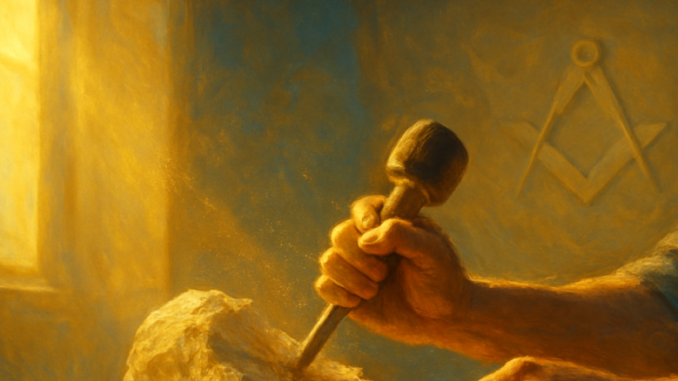
In Freemasonry, we work with the symbol of the rough ashlar — the unfinished stone. This is no arbitrary metaphor. The rough stone represents the human being as they enter the world: full of potential, but also full of imperfections, sharp edges, and hidden cracks. The Freemason’s task is to work that stone — to chisel, smooth, and polish it. Not to achieve perfection, because that is an illusion, but to become more conscious of your own shape and the choices you make.
When you read about a tragic event where lives have been permanently altered by violence, an uncomfortable question surfaces: what happened to the rough stone of the person who committed the act? What fractures were never healed? What chisel never did its work? This is not an excuse for destructive behavior — it is an invitation to reflect on how personality develops, or how it stagnates when left unworked.
Character as a Daily Practice
You might think that character is something you either have or you don’t — something fixed at birth, as unchangeable as your blood type. But that is not how it works. Character is not a possession; it is a practice. Every single day, you face choices both large and small. Do you respond with patience or with anger? Do you reach for the quick gain or commit to the slower path of integrity?
In Freemasonry, we call this “working on yourself.” It sounds simple, almost cliché, but it is one of the most difficult things a person can do. It demands radical honesty with yourself. It requires facing your shadow side — those parts of your personality you would rather keep hidden from the world and even from yourself.
“Know thyself” was inscribed above the Temple of Apollo at Delphi. Thousands of years later, that command is as urgent as ever.
The Mirror of Others
You cannot truly know yourself in isolation. For that, you need others. In Freemasonry, this principle finds expression in the Brotherhood — a community where you can show vulnerability, receive honest feedback, and see yourself reflected in the eyes of your peers. Not to be judged, but to be helped to grow.
What would happen if more people had access to such a community? A place where they are truly seen, where their anger and frustration find an outlet that does not end in violence? This is not a naive question. Research consistently shows that social connectedness is one of the strongest protective factors against destructive behavior. Loneliness and isolation, on the other hand, are breeding grounds for our darkest impulses.
Taking Responsibility
A nine-year prison sentence is society’s response to a deed. It is a boundary that we draw collectively. But behind that boundary lies a deeper question: how do we prevent people from reaching that point in the first place? Freemasonry offers no political answers, no quick fixes. What it does offer is a method — a path of self-reflection and personal responsibility.
Taking responsibility does not simply mean bearing the consequences of your actions. It also means taking the initiative to shape yourself before you find yourself in situations where you are capable of the worst. It means summoning the discipline to choose the better path every single day — even when no one is watching.
Consider these principles as starting points: reflect regularly on your reactions and impulses. Seek out community where you can show your authentic self. Have the courage to face your shadow side. Choose consciously, even in the smallest daily situations.
From Rough Stone to Building Block
The goal of working the rough stone is not to become a perfectly polished masterpiece. The goal is to become a useful building block — a stone that fits into a larger structure, that contributes to something greater than yourself. In the language of Freemasonry, we call this the construction of the Temple of Humanity: a metaphor for a better, more humane society.
Every time you choose understanding over judgment, patience over anger, connection over isolation, you lay another stone in that temple. It is slow work, often invisible, rarely spectacular. But it is the only work that is truly lasting.
A news report about a court verdict reminds us how fragile human personality can be — and how crucial it is to consciously work on who we are. Freemasonry invites you not to ignore the rough stone within yourself, but to embrace it as raw material for growth. Not to be better than others, but to bring out the best in yourself. Every single day. Because character is not a destination — it is a journey you must undertake yourself.
Copyright text & image: devrijmetselaar.nl
Texts are based on the ideas and content of the author of devrijmetselaar.nl, reviewed, corrected, and supplemented with the assistance of OpenAI. Images are created based on the ideas of the author of devrijmetselaar.nl using OpenAI/DALL-E.
Frequently Asked Questions
What does the 'rough ashlar' symbol mean in Freemasonry?
The rough ashlar represents the human being as they enter the world — full of potential but also full of imperfections and hidden cracks. A Freemason's task is to work that stone through self-improvement, becoming more conscious of their own character and the choices they make. This symbolic work helps members understand that personal growth is an ongoing process, not an end goal.
Is character something you're born with, or can it be developed?
According to Masonic teaching, character is not fixed at birth but rather a daily practice developed through the choices we make. Every day presents opportunities to respond with patience instead of anger, or to choose integrity over quick gains. Freemasonry emphasizes that working on yourself is difficult but essential, requiring radical honesty and continuous self-reflection throughout your life.
Why does Freemasonry emphasize community and Brotherhood?
Freemasonry recognizes that you cannot truly know yourself in isolation — you need others to help you grow and see yourself clearly. The Brotherhood provides a community where members can show vulnerability, receive honest feedback, and be truly seen by their peers without judgment. Research supports this principle, showing that social connectedness is one of the strongest protective factors against destructive behavior.
How does Freemasonry help prevent destructive behavior?
Freemasonry addresses destructive behavior by fostering self-awareness, personal responsibility, and strong community bonds. Through the practice of working on oneself and engaging in honest reflection within a supportive Brotherhood, members develop healthier ways to process anger and frustration. The emphasis on character development and knowing oneself helps individuals make better choices before they reach crisis points.
What does 'Know thyself' mean in the context of Freemasonry?
This ancient command, inscribed at the Temple of Apollo, remains central to Masonic teaching as an urgent call to self-awareness. It means understanding your strengths, weaknesses, and especially your shadow side — those parts of personality you'd rather hide. Through this knowledge and the support of your Masonic community, you can make conscious choices that lead to personal growth and positive character development.

Be the first to comment