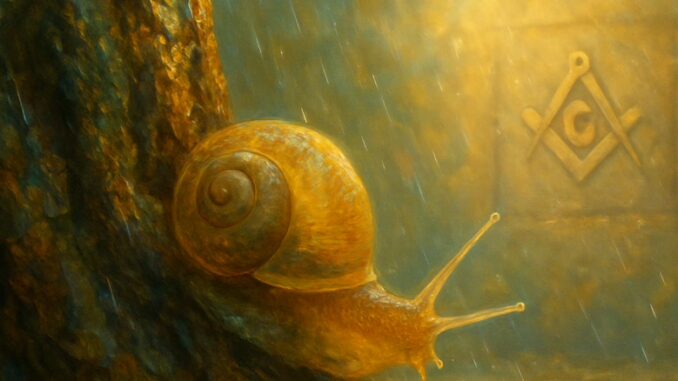
Imagine walking through a tropical rainforest as the first drops of rain begin to fall. Everything around you shifts and transforms. And there, on a tree trunk barely an arm’s length away, a snail disappears right before your eyes — not by crawling away, but by changing color until it blends perfectly into the wet bark. Biologists recently announced the discovery of a new species of tree snail with exactly this ability. It sounds like magic, but it’s evolution. And it raises a question that sits at the very heart of Freemasonry: when is it ethically right to make yourself invisible?
The Art of Disappearing
The newly discovered species, found in the rainforests of Southeast Asia, possesses a remarkable adaptive ability. The moment raindrops touch its skin, specialized pigment cells activate, rendering the snail nearly invisible against the backdrop of wet bark. This isn’t a conscious decision on the snail’s part — it’s a finely tuned survival mechanism that has evolved over millions of years. Predators searching for an easy meal simply look right through it.
What makes this discovery truly fascinating isn’t just its biological complexity. It’s the deeper question it raises about visibility and vulnerability. When do you choose to be seen, and when is it wiser to withdraw? This isn’t a question that only snails answer through instinct. It’s one that you and I face every single day.
Ethics and the Choice of Restraint
In Freemasonry, ethics plays a central role — not as a rigid set of rules, but as a living practice of self-reflection. One of the fundamental questions a Freemason asks himself is: how do I conduct myself toward others and toward myself? Part of that inquiry involves knowing when to step forward and when to consciously step back. Not out of cowardice, but out of wisdom.
The tree snail doesn’t hide because it has done something wrong. It hides because the circumstances demand it. The rain makes it vulnerable to predators, so it adapts. In human terms, you might say it chooses self-preservation without causing harm to others. That is ethical action in its most fundamental form — recognizing the right moment.
Wisdom is not always about speaking. Sometimes wisdom lies in knowing when to remain silent.
The Difference Between Hiding and Deceiving
Here we touch on an important distinction. Hiding can be ethical, but deception rarely is. The tree snail doesn’t actively mislead its predators. It doesn’t lure them into a trap. It doesn’t pretend to be something it’s not. It simply makes itself less visible. In Freemasonry, we recognize a similar principle: discretion is not secrecy. A Freemason doesn’t conceal his membership out of shame — he simply chooses not to flaunt what he holds sacred.
This distinction is crucial in an age when total transparency is often held up as the highest virtue. Of course openness matters. But complete transparency can also leave you exposed at moments when protection is needed. The ethical question isn’t whether you’re allowed to hide, but why you do it and whom it serves.
Vulnerability as a Teacher
Perhaps you recognize the feeling of vulnerability in certain situations — a difficult conversation at work, a family conflict, a moment when you’re not quite sure what to say or do. In those moments, it’s tempting to lay yourself completely bare, hoping that honesty alone will resolve everything. But sometimes it’s wiser to wait, to let the situation settle before you act.
Freemasonry teaches that self-reflection precedes action. Before you speak, you think. Before you judge, you listen. This is not passivity — it is active restraint. Just as the tree snail doesn’t flee but adapts, you too can choose a response that fits the moment.
Know your own vulnerabilities before others discover them. Choose consciously when to step forward and when to wait. Don’t hide out of fear — hide out of wisdom. And always ask yourself who you serve with your visibility or your invisibility.
Nature as an Ethical Mirror
It’s tempting to romanticize nature, but reality is more sober than that. The tree snail doesn’t act from moral considerations — it follows instinct. Yet we as humans can learn from this behavior, precisely because we do make moral choices. We can ask the question the snail cannot: is what I’m doing good?
In Freemasonry, nature is often seen as a source of symbolism and wisdom. Not because animals or plants act morally, but because their behavior invites us to reflect. The tree snail dissolving into the rain reminds us that adaptation is not weakness, that restraint is not cowardice, and that ethical action sometimes means stepping out of the spotlight so you can return later with greater clarity and strength.
Next time it rains, spare a thought for that little tree snail somewhere in a distant rainforest — not visible, not invisible, but present in exactly the measure the situation requires. And ask yourself: in which situations do I choose to be seen? And when is it time to disappear for a while — not to flee, but to grow? The discovery of these remarkable creatures is more than a biological curiosity. It’s an invitation to reflect on ethics, on the art of timing, and on the wisdom of restraint. In Freemasonry, we know that true strength is not always visible. Sometimes the greatest courage lies in the ability to blend into the background, and from there, with a clear eye, determine what the next step should be. Just like the snail in the rain: invisible, but very much alive.
Copyright text & image: devrijmetselaar.nl
Texts are based on the ideas and content of the author of devrijmetselaar.nl, reviewed, corrected, and supplemented with the assistance of OpenAI. Images are created based on the ideas of the author of devrijmetselaar.nl using OpenAI/DALL-E.
Frequently Asked Questions
What does Freemasonry teach about when it's appropriate to be discreet or private?
Freemasonry teaches that discretion is a virtue distinct from deception. A Freemason may choose privacy about sacred matters not out of shame, but out of respect and wisdom, much like the tree snail that becomes less visible when circumstances demand protection. This ethical principle recognizes that true transparency doesn't mean exposing everything at all times, but rather acting with integrity in knowing when to speak and when to remain silent.
Is Freemasonry about hiding secrets or teaching ethical behavior?
Freemasonry emphasizes ethical behavior and self-reflection rather than deceptive secrecy. The organization teaches members to recognize the difference between hiding (protecting what is sacred) and deceiving (misleading others for personal gain). A Freemason's discretion about his membership and beliefs is a conscious choice rooted in wisdom and respect, not in wrongdoing or shame.
How does Freemasonry help members understand ethical decision-making?
Freemasonry encourages members to practice living ethics through constant self-inquiry about how they conduct themselves toward others and themselves. This includes developing the wisdom to recognize when to step forward and when to step back—not from cowardice, but from genuine understanding of what circumstances require. The organization teaches that ethical action means preserving yourself and others without causing harm.
Why do Freemasons value discretion in a world that demands transparency?
Freemasonry recognizes that while openness matters greatly, complete transparency can leave people vulnerable when protection is needed. Discretion allows members to honor what they hold sacred while remaining ethically sound, demonstrating that ethical conduct isn't about exposing everything, but about acting with integrity and wisdom in all circumstances.

Be the first to comment