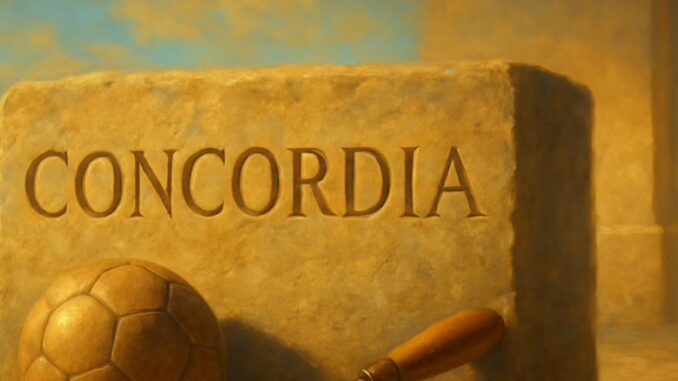
In the heart of the Dutch province of Friesland, the name Concordia Sneek carries a meaning that reaches far beyond sports. The Latin word concordia — meaning unity or harmony — reflects a deeply rooted human aspiration: the desire for connection in a fragmented world. This desire takes many forms, from local sports clubs to centuries-old brotherhoods. When we examine these seemingly different worlds through the lens of community and civic engagement, surprising parallels emerge.
The World of Concordia Sneek: Local Bonds in Action
For anyone who grew up in or around the Frisian town of Sneek, the name Concordia is inseparable from community life. For generations, it has stood for togetherness on the sports field, for the thrill of competition and the warmth of the clubhouse afterward. It is a world where people know each other by name, where volunteers tirelessly mark the pitch lines, and where children learn their first lessons in teamwork.
This local community functions as a micro-society. There are written and unwritten rules, traditions passed down from generation to generation, and a shared purpose that binds individuals together. The player who dedicates his best years to the club, the parent who stands on the sideline every Saturday morning, the treasurer who keeps the books — all contribute to something greater than themselves. It is a form of civic participation that is visible and tangible.
The World of Freemasonry: Symbolic Concordia
Where a sports club experiences its unity on the field, the Freemason finds his concordia in a very different kind of space. The Lodge is not a stadium but a workshop — not an arena for competition but a place for inner construction. Yet the pursuit of harmony is every bit as central. The term concordia would fit seamlessly into the Masonic vocabulary, which is rich with Latin concepts expressing moral and spiritual ideals.
In Freemasonry, unity is not achieved by winning a match but through the collective search for truth and wisdom. Brethren from different backgrounds, professions, and worldviews come together in a space where those differences are temporarily set aside. What remains is a shared humanity — the understanding that every individual is a rough stone that can be refined through labor and reflection.
Concordia as a Shared Foundation
When we place these two worlds side by side, surprising parallels reveal themselves. Both the sports club and the Lodge have a form of initiation — a moment when the newcomer is welcomed into the community. Both have rituals that mark transitions: the first match jersey, the first handshake in the circle. Both traditions recognize that community does not arise on its own but must be actively cultivated.
Unity is strength is more than a motto; it is a living practice that must be renewed with every generation.
This shared foundation goes beyond surface-level similarities. At its core lies the recognition that people flourish when they are part of something greater than themselves. Whether that something is a football team in Friesland or a brotherhood with roots in the eighteenth century, the need for connection is universal.
What Sports Clubs and the Lodge Can Teach Us
The comparison between these two worlds reveals something essential about society. In an era where individualism is often seen as the dominant trend, both traditions prove that people actively seek out community. The enduring popularity of local sports clubs and the continuing relevance of organizations like Freemasonry speak to a deep hunger for meaningful human contact.
Both traditions share striking qualities: a dedication that goes beyond self-interest; a space where the hierarchies of the outside world fade away; a demand for active participation rather than passive spectatorship; and values that cannot be captured in rulebooks alone. It would be tempting to regard one of these worlds as superior to the other, but that would miss the point entirely. The footballer who takes to the pitch every Sunday and the Freemason who visits the Temple each month share more than they might suspect. Both understand that unity is not a given — it is a daily choice.
Harmony in Diversity: A Modern Challenge
In today’s society, where divisions sometimes seem sharper than ever, both the local sports club and the Masonic Lodge offer a counterbalance. They remind us that people from different walks of life can work together toward a common goal. It matters little whether that goal is a championship or the completion of one’s inner temple — the process of collaboration itself is transformative.
The name Concordia Sneek may primarily evoke associations with sport and local Frisian life, but its deeper meaning resonates with traditions far older. Unity is a craft that must be practiced, a fire that must be tended. Whether you are kicking a ball or working with symbols, the longing for harmony connects us all.
When we place the world of a Frisian sports club alongside that of a centuries-old brotherhood, we see not a contradiction but a reflection. Both traditions embody the principle that human beings are communal creatures, that unity must be created and maintained, and that the most meaningful achievements arise when individuals join forces. Whether you stand on the sideline in Sneek or participate in a Masonic ritual, the desire for concordia is what binds us — across all boundaries.
Copyright text & image: devrijmetselaar.nl
Texts are based on the ideas and content of the author of devrijmetselaar.nl, reviewed, corrected, and supplemented with the assistance of OpenAI. Images are created based on the ideas of the author of devrijmetselaar.nl using OpenAI/DALL-E.
Frequently Asked Questions
What does 'concordia' mean and why is it important to Freemasonry?
Concordia is a Latin word meaning unity or harmony, reflecting the fundamental human desire for connection and belonging. In Freemasonry, concordia represents the collective search for truth and wisdom among brethren from different backgrounds, making it a cornerstone principle of the fraternity's mission to bring people together in pursuit of self-improvement and understanding.
How does Freemasonry create unity among its members?
Freemasonry creates unity through shared rituals, symbolic teachings, and a common purpose that transcends individual differences. Members from diverse professions and worldviews come together in the Lodge as equals, focusing on their shared humanity and the collective goal of personal and moral refinement through labor and reflection.
What is the role of initiation in Freemasonry?
Initiation in Freemasonry is a significant moment when newcomers are formally welcomed into the brotherhood and introduced to its principles and traditions. Like other communities, initiation marks an important transition and serves to integrate the individual into the larger fraternal body, establishing their connection to centuries of accumulated wisdom and fellowship.
How does the Lodge function as a 'workshop' for personal development?
The Masonic Lodge serves as a workshop where members engage in symbolic work aimed at refining themselves morally and spiritually, similar to how a craftsman perfects his skills. Through ritual, study, and brotherhood, each member—viewed as a rough stone—is gradually polished and refined through dedicated labor and thoughtful reflection toward becoming a better version of himself.


Be the first to comment