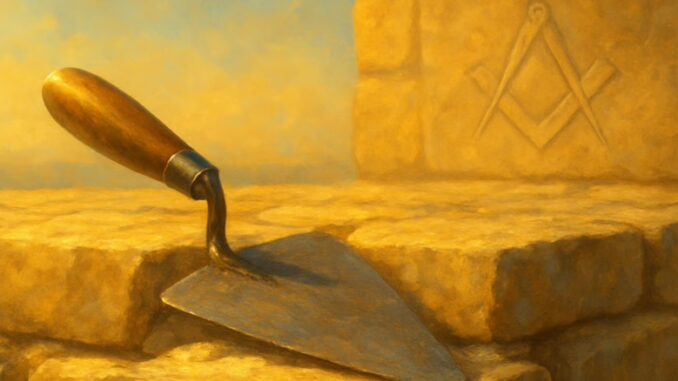
You may have come across the name “Lodge The Trowel” — one of the well-known Masonic lodges in the Netherlands. But what does that name actually mean? And more importantly, what can you learn from the philosophy behind this symbol, whether you’re a Freemason or not? The trowel is far more than a builder’s tool. It’s an invitation to work daily on connection — with yourself, with others, and with the world around you.
Why Name a Lodge After the Trowel?
The name of a Masonic lodge is never chosen at random. Every lodge carries a name that points to an ideal, a symbol, or an aspiration. A lodge named after the trowel refers to the tool that masons use to spread mortar between stones. Without the trowel, a wall is nothing more than a loose pile of bricks. With the trowel, those individual pieces become a unified structure — one that endures.
In Freemasonry, the trowel symbolizes the act of binding people together. Where the hammer and chisel shape and refine individual stones, the trowel is what creates cohesion. It is the tool of community, of brotherhood, of smoothing out the rough edges between people. A lodge that bears this name makes a deliberate choice to place connection at the heart of its work.
The Philosophy of the Trowel in Practice
Philosophy can sound abstract, but the symbolism of the trowel is remarkably practical. Think of a recent situation where you had a conflict with someone — a family member, a colleague, a friend. You were right, they were wrong. Or perhaps the other way around. Either way, the gap remained. This is exactly where the trowel comes in: not as a tool to prove your point, but as an instrument to fill the space between you with something that binds.
That binding agent might be a conversation. A gesture. A moment of listening without immediately judging. The trowel doesn’t ask you to abandon your position. It asks you to be willing to work on the connection. This is the essence of Masonic philosophy: the individual ego is not the priority — the greater structure you’re building together is what matters.
Four Practical Steps to Apply the Trowel in Your Life
How do you bring this philosophy into your everyday life? Here are four actions you can try today, inspired by the symbolism of the trowel:
First, choose one relationship where tension exists and take the initiative to reach out — without an agenda and without blame. Second, in your next conversation, listen fully before responding. Let the other person finish and ask a question before sharing your own perspective. Third, when you find yourself in a conflict, look for the shared interest instead of focusing on the difference. What do you both actually want? Fourth, end your day with a simple question: where did I build connections today, and where did I leave walls standing?
These steps sound simple, but they require practice. The trowel is not a magic wand. It demands craftsmanship, patience, and the willingness to start over when the mortar doesn’t hold right away.
The Trowel as a Mirror for Self-Examination
The philosophy behind the trowel isn’t only about relationships with others. It’s also an invitation to look inward. How well do you connect the different parts of yourself? Many people experience inner contradictions: ambition that clashes with the need for rest, the desire to be liked that rubs against the need for authenticity.
A strong building needs more than solid stones — it needs carefully applied mortar to hold everything together.
The trowel invites you to work on inner cohesion as well. Not by denying your contradictions, but by acknowledging them and searching for a way they can coexist. This requires honesty with yourself and the courage to examine the joints in your own foundation.
Why the Trowel Remains Relevant Today
In an era where polarization often dominates public discourse, the symbolism of the trowel is more relevant than ever. It’s easy to build walls, to shut out people who think or live differently. It takes courage and effort to build bridges instead. Lodges like Lodge The Trowel serve as a reminder that building a better society starts with small gestures — with the willingness to bridge the gap rather than widen it.
Freemasonry doesn’t offer ready-made answers, but it does provide a rich collection of symbols that invite reflection and action. The trowel is one of the most accessible and practical among them. It doesn’t require grand gestures — only the willingness to choose connection over division, every single day.
The philosophy of the trowel isn’t an abstract concept confined to the lodge room. It’s a practical invitation you can pick up right now. Look at your relationships, your inner life, the world around you. Where can you apply the mortar? Where can you choose cohesion over separation? The trowel is already in your hands. All that remains is the decision to use it.
Copyright text & image: devrijmetselaar.nl
Texts are based on the ideas and content of the author of devrijmetselaar.nl, reviewed, corrected, and supplemented with the assistance of OpenAI. Images are created based on the ideas of the author of devrijmetselaar.nl using OpenAI/DALL-E.
Frequently Asked Questions
What does the trowel symbolize in Freemasonry?
The trowel symbolizes the act of binding people together and creating cohesion within a community. While other tools like the hammer and chisel shape individual stones, the trowel spreads the mortar that unifies separate pieces into a strong, enduring structure. In Masonic philosophy, it represents brotherhood, connection, and the smoothing of rough edges between people.
Why did Lodge The Trowel choose this particular name?
Lodge names are never chosen randomly—they reflect an ideal, symbol, or aspiration that the lodge wishes to embody. By naming itself after the trowel, Lodge The Trowel deliberately places connection and community at the heart of its work, emphasizing the importance of binding members together rather than focusing solely on individual achievement.
How can I apply the trowel philosophy to my daily life?
You can practice the trowel philosophy by reaching out to resolve tensions without blame, listening fully before responding in conversations, seeking shared interests during conflicts, and reflecting daily on where you built connections. These practical steps require patience and craftsmanship, but they help transform how you relate to others and build stronger relationships.
Is the trowel philosophy only for Freemasons?
No, the trowel philosophy is universal and valuable for anyone seeking to improve their relationships and connections with others. Whether you're a Freemason or not, the symbolism offers practical wisdom for building stronger communities and bridging gaps between people in your everyday life.


Be the first to comment