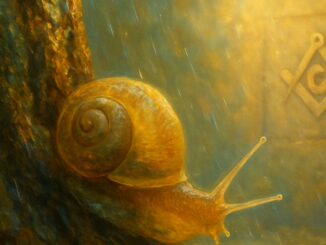
A camouflaged tree snail blending into wet bark in a tropical rainforest
Philosophy & Ethics

Invisible Tree Snails and Ethics: When Hiding Is Wisdom

Imagine walking through a tropical rainforest as the first drops of rain begin to fall. Everything around you shifts and transforms. And there, on a tree trunk barely an arm’s length away, a snail disappears right before your eyes — not by crawling away, but by changing color until it blends perfectly into the wet bark. Biologists recently announced the discovery of a new species of tree snail with exactly this ability. It sounds like magic, but it’s evolution. And it raises a question that sits at the very heart of Freemasonry: when is it ethically right to make yourself invisible? The Art of Disappearing The newly discovered species, found in the rainforests of Southeast Asia, possesses a remarkable adaptive ability. The moment raindrops touch its skin, specialized pigment cells activate, rendering the snail nearly invisible against the backdrop of wet bark. This isn’t a conscious decision on the snail’s part — it’s a finely tuned survival mechanism that has evolved over millions of years. Predators searching for an easy meal simply look right through it. What makes this discovery truly fascinating isn’t just its biological complexity. It’s the deeper question it raises about visibility and vulnerability. When do you […]

Symbolic representation of the 33rd degree in Scottish Rite Freemasonry
Philosophy & Ethics

The 33rd Degree: Wisdom or Mystery?

Few numbers capture the imagination of those curious about Freemasonry quite like the number 33. It surfaces in conversations about the Craft, often shrouded in speculation and fascination. But what truly lies behind this thirty-third step on the ladder of Masonic knowledge? Let’s explore the philosophy behind the degrees, their meaning, and the deeper question of whether wisdom can ever be contained in a number. What Is the 33rd Degree, Really? Let’s start with the basics. Within the Scottish Rite — one of several appendant bodies in Freemasonry — there are thirty-three degrees. The first three are the so-called Blue Lodge degrees: Entered Apprentice, Fellow Craft, and Master Mason. Beyond these lie thirty additional degrees, with the thirty-third serving as the capstone. But does holding this degree automatically mean someone is wiser or more knowledgeable? The answer is more nuanced than you might expect. The 33rd degree is not an academic credential, nor is it proof of superiority. It is, above all, a recognition of years of dedication to the principles of brotherhood, self-improvement, and service to the community. The number itself carries symbolic weight, but the true value lies in the journey that leads to it. Why Thirty-Three? This […]

Ancient open book with symbolic garden imagery representing Masonic wisdom
Christianity

Song of Solomon & Symbolism: Love, Wisdom, and Freemasonry

Why would a Freemason spend time studying an ancient love poem from the Bible? The Song of Solomon contains no moral law, no historical narrative, no prophecy. It is pure poetry — brimming with longing, beauty, and mysterious imagery. And yet, hidden within that imagery are symbols that touch the very heart of Freemasonry. Let’s explore this remarkable book and the surprising connections it holds for the Craft. What Is the Song of Solomon? The Song of Solomon — sometimes called the Song of Songs or Canticles — is the twenty-second book of the Old Testament. It consists of lyrical dialogues between a bridegroom and a bride, interspersed with choruses and interludes. On the surface, it reads as a collection of love poems filled with sensory descriptions: the fragrance of myrrh, the taste of wine, the sight of blossoming vineyards. But is that really all there is? For centuries, scholars and theologians have searched for deeper layers beneath the poetic language. In the Jewish tradition, it was read as an allegory for the relationship between the Eternal and His people. In Christian circles, the bride was seen as the Church, the soul, or humanity itself seeking union with the Divine. […]

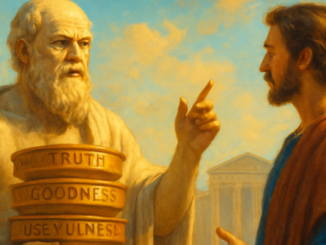
The Three Sieves of Socrates illustrated as a Masonic moral lesson
Philosophy & Ethics

The Three Sieves of Socrates: A Masonic Lesson in Speech

In Freemasonry, our meetings are a blend of serious reflection and warm fellowship. Brothers chat over coffee before the lodge opens, share a drink during the interval, and linger after the closing to enjoy each other’s company. During the formal proceedings — the lodge work itself — the tone is generally more earnest, with lectures and presentations that challenge us to think deeply. Yet even then, there is always room for a well-timed anecdote. Recently, a brother shared the parable of the Three Sieves of Socrates, and it struck a chord with everyone present. It is a short story, but one well worth reflecting upon — because its lesson is as relevant today as it was in ancient Athens. The Story of the Three Sieves Socrates, the great Greek philosopher, was walking through the streets of Athens one day when a man rushed toward him in a state of excitement. “Socrates! I must tell you something about your friend who—” “Hold on a moment,” Socrates interrupted. “Before you go any further, have you passed the story you want to tell me through the Three Sieves?” “The Three Sieves? What three sieves?” the man asked, bewildered. “Let us try,” Socrates suggested […]