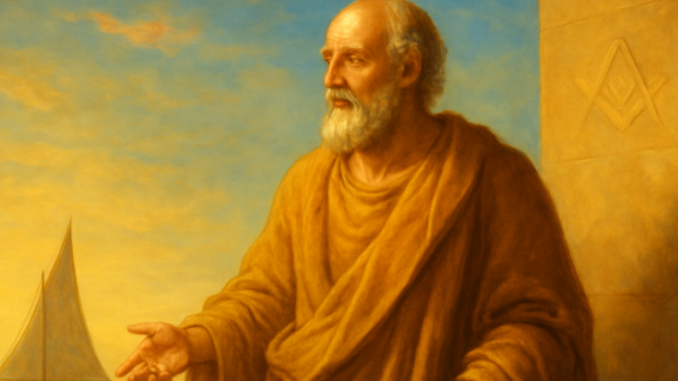
Picture the scene: you’re in a grocery store and you notice an elderly woman struggling with her bags. You hesitate for a moment, then walk past. Later that day, it gnaws at you. Why didn’t you help? Nearly two thousand years ago, Lucius Annaeus Seneca asked himself the very same question. In his ninety-fifth letter to his student Lucilius, he explored why broad moral principles are not enough — and why we need concrete guidelines to actually act with care. This is not abstract philosophy. It is a practical manual that still works today.
The Debate That Drove Seneca: Rules or Principles?
At the heart of Letter XCV lies a philosophical debate that had been raging within the Stoic school long before Seneca picked up his pen. Ariston of Chios, a student of Zeno of Citium, argued that a philosopher only needs to teach grand principles. Once someone truly understands what virtue is, Ariston reasoned, they need no specific instructions for every individual situation. Seneca fundamentally disagrees. He acknowledges the value of principles, but insists that most people become lost in daily life without concrete guidance. You may know that you should do good — but if no one shows you how, you end up standing in that grocery store and walking right past.
This disagreement was no minor academic squabble. Cleanthes, Zeno’s successor as head of the Stoic school, had already advocated for the usefulness of specific precepts. Chrysippus refined this position further. Seneca consciously places himself within this tradition and brings the debate to a personal level: it’s not about winning a philosophical argument, but about the question of how you can truly help another human being.
Stoic Ethics as the Foundation
To understand why Seneca argues so passionately for caring about others, we need to return to the core of Stoic ethics. The Stoa teaches that all human beings are part of a single cosmic community, connected by the logos — universal reason. Marcus Aurelius would later express this beautifully in his Meditations: what is harmful to the hive is harmful to the bee. For the Stoics, caring for a fellow human being is therefore not an optional act of kindness, but a logical consequence of our nature as rational, social creatures.
Seneca enriches this foundation with a remarkably warm view of humanity. Where some Stoics leaned toward a cool rationalism, he repeatedly emphasizes human vulnerability in Letter XCV. He compares humanity to a body in which all limbs work together. When one limb suffers, the whole body suffers. This image was not chosen at random — it had been used earlier by the Roman orator Menenius Agrippa to illustrate the importance of social unity. Seneca gives it a deeper ethical weight.
Caring for others is not a virtue you profess — it is a skill you practice, day after day, in the small choices that no one else sees.
Influences Beyond the Stoa: Plato, Aristotle, and Epicurus
Seneca was no dogmatist. He read widely and borrowed freely from other traditions. In Letter XCV, echoes of Plato’s Republic can be heard — a work in which the ideal society is built on justice and every citizen bears responsibility toward the whole. Aristotle’s concept of phronesis, or practical wisdom, also resonates in Seneca’s argument: it is not enough to know what is good; you must also know how and when to act.
Even Epicurus, typically the Stoics’ philosophical rival, is treated with respect by Seneca. Epicurus taught that friendship and mutual care are essential to a happy life. Seneca quotes him regularly throughout his letters — not out of weakness, but out of intellectual honesty. In Letter XCV, he uses this broad philosophical base to demonstrate that caring for others is not an exclusively Stoic idea, but a universal human insight shared by all the great intellectual traditions.
Practical Application: Four Steps from Seneca’s Teaching
The power of Letter XCV lies in its practical translation. Seneca does not merely offer philosophical arguments — he provides actionable tools you can use today. Based on his reasoning, four concrete steps can be distilled:
1. Begin each day with an intention. Choose one person to whom you will give conscious attention, whether that is a colleague, a neighbor, or a stranger.
2. Ask yourself the evening question Seneca practiced. What fault did I correct today? What habit did I resist? In what way have I become a better person?
3. Translate principles into precepts. Don’t just say “I want to be a good person.” Formulate something concrete: “When I see someone who needs help, I will offer it before I have time to talk myself out of it.”
4. Find a conversation partner. Seneca had Lucilius. In the Masonic tradition, the brotherly dialogue within the Lodge serves exactly this function — a space where you don’t just share ideas, but hold your own actions up against those of others for honest examination.
The Lodge as a Training Ground for Seneca’s Ideal
Freemasonry offers a remarkable framework for putting Seneca’s lessons into practice. The ritual of the Lodge is, at its core, a structured exercise in attentiveness toward the other. The fraternal meal, listening to a Brother’s presentation, the silence in which you reflect on your own conduct — these are all concrete moments in which the abstract virtue of care becomes tangible. Seneca would recognize it instantly. His plea for precepts alongside principles finds a direct echo in the ritual, which does not merely tell the Freemason what is good, but teaches him through repetition and experience how to embody that good.
Johann Wolfgang von Goethe, himself a Freemason and deeply influenced by the Stoic tradition, wrote that the deed is the beginning of all things. That is precisely what Seneca argues in Letter XCV. Philosophy that does not lead to action is hollow. A brotherhood that does not lead to concrete care is an empty shell. The challenge is not to admire these insights from a comfortable distance — it is to live them.
Seneca’s ninety-fifth letter remains astonishingly relevant, not because it offers easy answers, but because it refuses to let us hide behind grand principles without acting on them. The Stoic call to care for others — grounded in the idea that we are all limbs of one body — finds a natural home within the Masonic Lodge, where ritual, reflection, and fraternal dialogue transform philosophy into practice. The next time you find yourself hesitating to help, remember that Seneca already diagnosed the problem two millennia ago. The cure is not more knowledge. It is a concrete precept, a daily intention, and a community that holds you accountable. Start today.
Copyright text & image: devrijmetselaar.nl
Texts are based on the ideas and content of the author of devrijmetselaar.nl, reviewed, corrected, and supplemented with the assistance of OpenAI. Images are created based on the ideas of the author of devrijmetselaar.nl using OpenAI/DALL-E.



Be the first to comment