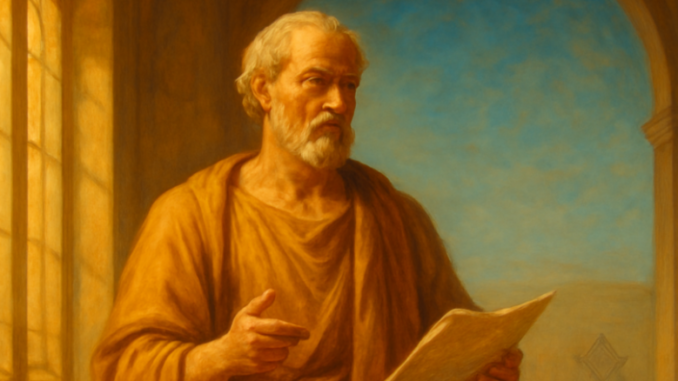
There are moments when silence wraps around us like a cloak, and other moments when we long for the sound of familiar voices. Lucius Annaeus Seneca, the great Stoic philosopher, understood this tension like few others. In his fifty-fifth letter to his student Lucilius, he examines the delicate relationship between withdrawal from the world and participation in it — a question that still resonates centuries later, especially within traditions that deliberately navigate between inner reflection and brotherly community.
The Villa of Vatia: A Symbol of Misguided Retreat
Seneca opens his letter by describing a coastal walk near Cumae, where he passes the abandoned villa of Vatia. This former praetor had withdrawn from public life decades earlier, living in complete seclusion. Roman society admired him for it: “Vatia knows how to live,” people said. But Seneca fundamentally questions this admiration. Is this truly living, or is it merely hiding?
The villa becomes a powerful symbol within the letter. It represents not wise withdrawal, but flight. Vatia did not retreat to find himself or to cultivate wisdom. He hid from the dangers of the imperial court, from the intrigues of his era. His solitude was not a choice for something — it was an escape from something. Seneca draws a sharp distinction: there is a difference between living in peace and being buried alive.
True Withdrawal: The Freedom of the Inner Life
The central theme of Letter 55 revolves around what genuine solitude actually means. For Seneca, physical isolation is worthless in itself if the mind is not free. A person may retreat to the most remote villa, but if his thoughts remain filled with fear, craving, or restlessness, he is never truly alone with himself. Conversely, someone standing in the middle of a crowd can experience complete inner tranquility.
True solitude, Seneca argues, is not a matter of location but of inner disposition. The person who is at peace with himself carries his sanctuary wherever he goes. This insight reaches far deeper than practical life advice. Seneca suggests that the real journey goes inward, not outward. The walls of a house may offer shelter, but it is the walls of the mind that determine whether we are truly safe. This understanding has echoed through the centuries in the writings of Marcus Aurelius, Epictetus, and numerous contemplative traditions that followed.
The Necessity of Fellowship
While Seneca acknowledges the value of retreat, he warns just as firmly against the opposite extreme. The human being is a social creature, he emphasizes. Complete isolation leads to a kind of wildness of the mind. Without the mirror of another person, we lose sight of ourselves. Fellowship sharpens, corrects, and enriches. The wise person therefore seeks a balance: periods of contemplation alternate with engagement in the lives of others.
Seneca counsels Lucilius to use his solitude for study and self-reflection, but never to forget that he is part of a greater whole. The community needs him, and he needs the community. This is not weakness — it is an honest recognition of the human condition. Even the most enlightened mind benefits from companionship, from the sharing of insights, and from the warmth of genuine connection.
The Rhythm of Retreat and Return
What Seneca describes is, in essence, a rhythm of life. Just as day passes into night and returns again to light, the wise person moves between silence and conversation, between turning inward and stepping outward. This rhythm is not a sign of inconsistency but of maturity. It requires self-knowledge: when do I need distance, and when do I need closeness?
The door plays a fascinating symbolic role in this context. A door can be closed to keep the world out, but the same door can be opened to let others in. It is not the door itself that matters, but the intention with which we use it. The doors of Vatia’s villa remained permanently shut — not out of wisdom, but out of fear. The wise person uses his door with purpose: sometimes closed for concentration, sometimes open for community.
Resonance with Masonic Tradition
The question Seneca raises finds remarkable resonance within Freemasonry — a tradition that deliberately combines personal development with community building. The balance between working on oneself and working with others is a theme that has run through the Craft for centuries. Lodge meetings provide a space for collective reflection, while the time between them calls for individual contemplation and the practical application of lessons learned.
The Temple itself, as a symbol, represents precisely this dual movement. A Brother enters to set aside the outside world, to listen in stillness, and to learn. But ultimately, he steps back out into the world, enriched by fellowship with like-minded seekers. The solitude experienced within the Temple walls is not an end in itself — it is preparation for a richer, more purposeful life beyond them. Every Mason who has sat in quiet reflection before the opening of a Lodge, only to emerge afterward in warm conversation with his Brethren, has lived out the very rhythm Seneca describes.
The Core Message for Today
Seneca’s Letter 55 remains surprisingly relevant in an age when we constantly toggle between digital connectivity and a deep longing for silence. The lesson is clear: fleeing is not wisdom, and isolation is not a virtue. What matters is the quality of our inner peace and the awareness with which we choose to be alone or to be together. Vatia’s villa still stands as a warning: the one who withdraws out of fear does not truly live — he merely waits for death.
Neither total withdrawal nor constant busyness holds the key to a good life. What matters is the freedom of the mind — the ability to consciously choose when to close the door and when to open it. In that deliberate choice lies a wisdom that the ancient Stoics and the Masonic tradition share across the centuries.
Letter 55 invites each of us to examine our own relationship with solitude and fellowship. Seneca’s Stoic counsel reminds us that the path to a meaningful life runs through both the quiet chamber of self-reflection and the warm embrace of brotherhood. The wise person — and the thoughtful Mason — learns to move gracefully between the two, carrying an inner sanctuary that no external circumstance can disturb, while remaining open to the transformative power of genuine human connection.
Copyright text & image: devrijmetselaar.nl
Texts are based on the ideas and content of the author of devrijmetselaar.nl, reviewed, corrected, and supplemented with the assistance of OpenAI. Images are created based on the ideas of the author of devrijmetselaar.nl using OpenAI/DALL-E.

Be the first to comment