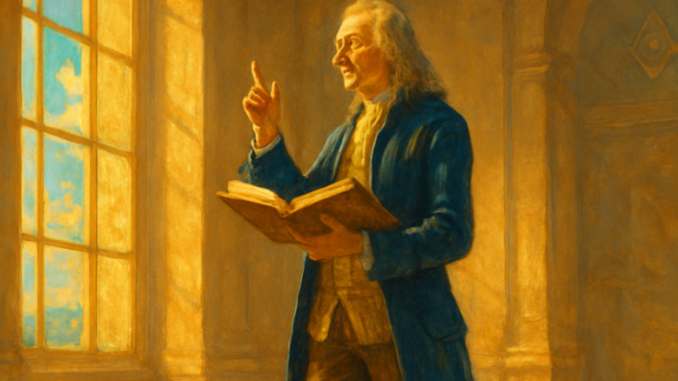
An enormous figure, eight hundred feet tall, descends upon our tiny planet. He leans forward, raises a magnifying glass to his eye, and only after a long search discovers the minuscule creatures who call themselves the crown of creation. This vivid image, which Voltaire crafted in his 1752 tale Micromégas, draws on a philosophical tradition stretching back millennia — one that reminds humanity of its modest place in the universe, and one that carries powerful resonance for Freemasons to this day.
The Legacy of Stoicism
When Voltaire’s giant travels from the star Sirius to Earth, we immediately recognize the cosmic perspective that the Stoics cultivated two thousand years earlier. In his Meditations, Marcus Aurelius urged the wise person to observe themselves from the vantage point of the stars, a mental exercise through which earthly worries lose their apparent weight. Seneca encouraged his readers to regard the Earth as a dot in the infinite — a practice in intellectual humility that echoes directly through Voltaire’s satirical masterpiece.
The Stoic tradition taught that true greatness lies not in physical size or social standing, but in the virtue of the soul. Voltaire translates this principle with playful wit: his colossal visitors from outer space do not automatically possess more wisdom than the microscopic inhabitants of Earth. The philosopher from Geneva inverts expectations, demonstrating that genuine greatness cannot be measured by outward scale.
Skepticism as a Philosophical Compass
Voltaire was deeply influenced by Skepticism, the philosophical tradition that systematically questions the possibility of absolute knowledge. Michel de Montaigne, whose essays Voltaire had studied extensively, posed a deceptively simple question in the sixteenth century: what does a human being actually know for certain? In his famous Apology for Raymond Sebond, Montaigne dismantled human self-glorification by pointing to the limited reach of our senses and our reason.
Voltaire’s Micromégas teaches us that true wisdom begins precisely where the pretense of omniscience ends.
In Micromégas, this skeptical tradition reaches a playful climax. When the giants finally engage in conversation with a group of philosophers aboard a ship, it turns out these learned men can agree on virtually nothing. The Cartesian, the Leibnizian, and the Aristotelian each proclaim their own truth with unshakable conviction. Voltaire shows just how absurd this certainty becomes when viewed from a cosmic perspective.
The Enlightenment and Relativism
Micromégas appeared at the heart of the European Enlightenment, a period when thinkers like Locke, Hume, and Voltaire himself critically examined the foundations of knowledge and morality. The story breathes the spirit of scientific curiosity that characterized the era. The giants measure, calculate, and observe — exactly as the natural philosophers of the eighteenth century did with their newly invented telescopes and microscopes.
Yet Voltaire simultaneously warns against scientific arrogance. The discovery that intelligent life exists on other worlds should compel humanity toward humility, not toward new forms of self-congratulation. This relativism, rooted in the encounter with the unknown, runs like a thread through the entire fabric of Enlightenment thinking.
Pascal and Humanity Between Two Infinities
Although Voltaire and Blaise Pascal stood on opposite sides of many issues — especially regarding religion — they shared a fascination with humanity’s position in the universe. Pascal described the human being as suspended between two infinities: the infinitely large cosmos and the infinitely small world of atoms. This idea, which drove Pascal toward religious surrender, Voltaire transforms into an indictment of human vanity and dogmatism.
Where Pascal trembled before the eternal silence of infinite spaces, Voltaire’s giants traverse them with a sense of wonder rather than dread. The contrast is telling: for Voltaire, the cosmos is not a source of existential terror but a mirror in which humanity can learn to recognize and accept its own limitations.
Freemasonry and Cosmic Humility
The philosophical traditions that nourish Micromégas resonate deeply with the symbols and rituals of Freemasonry. The lodge is traditionally conceived as a reflection of the universe, complete with its celestial vault and canopy of stars. The Freemason is invited to see himself as a small but meaningful stone within an immeasurably greater edifice.
The square and compasses, central symbols of the Craft, remind the Brother that he is part of a larger order that transcends his individual understanding. Just as Voltaire’s earthly philosophers must acknowledge that their systems contain only fragments of truth, the Freemason learns that wisdom grows through openness to what he does not yet know. The initiation ritual itself is an exercise in humility: the candidate is led into darkness, unaware of what lies ahead, and must place his trust in the Brotherhood that guides him.
Lucian and the Satirical Tradition
Voltaire also drew from the satirical tradition of the Greek writer Lucian of Samosata, who in the second century composed fantastical travel tales in which Earth was observed from the Moon. This tradition of the philosophical voyage — in which distance, both literal and figurative, provides perspective — found its way through the Renaissance into the Enlightenment. Cyrano de Bergerac and Jonathan Swift built upon it, and Voltaire brought it to a pinnacle with his cosmic satire.
Within this literary lineage, the outsider’s gaze always serves as an instrument of self-reflection. Whether the observer is a traveler from a distant land or a being from another planet, they hold up a mirror to society. Voltaire deliberately chose extraterrestrial giants because no earthly distance was vast enough to fully put human pretension into perspective.
Voltaire’s Micromégas stands as more than an eighteenth-century thought experiment — it is a philosophical allegory whose lessons remain as vital as ever. Its roots stretch from ancient Stoicism through Renaissance skepticism to the bold questioning of the Enlightenment. For Freemasons, the tale carries a particular charge: it mirrors the Craft’s own insistence that true wisdom begins with the recognition of how little we know. In a world still prone to dogmatic certainty, Voltaire’s cosmic travelers remind us that the greatest step toward understanding is — and always will be — a humble one.
Copyright text & image: devrijmetselaar.nl
Texts are based on the ideas and content of the author of devrijmetselaar.nl, reviewed, corrected, and supplemented with the assistance of OpenAI. Images are created based on the ideas of the author of devrijmetselaar.nl using OpenAI/DALL-E.


Be the first to comment