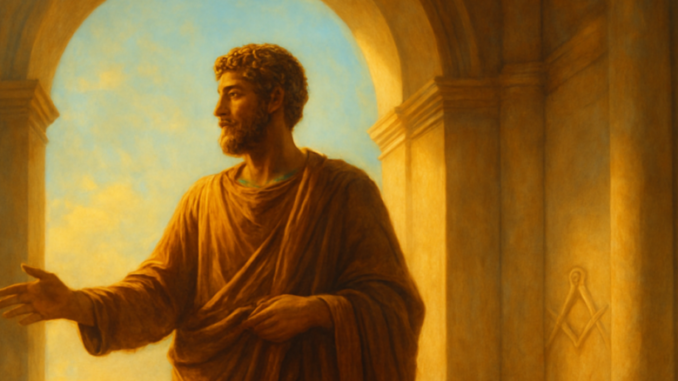
A stone dropped into water sinks to the bottom. That is its nature. But what is the nature of human judgment? Marcus Aurelius, Roman emperor and Stoic philosopher, devoted a significant portion of his eighth book to this very question. In his private writings — now known to us as the Meditations — he examines how our prejudices and snap judgments can hold us captive. This article explores the heart of Book VIII and reveals why mastering our judgment is the key to genuine freedom.
The Central Insight of Book VIII
Throughout Book VIII, Marcus Aurelius returns again and again to one fundamental truth: it is not events themselves, but our judgments about those events, that determine our suffering or our peace. He writes to himself as a reminder — a kind of inner compass meant to steer him away from the pitfalls of thoughtless reaction. The emperor understood that even the most powerful man in the world can be enslaved by his own prejudices if he fails to question his first impressions.
The central theme is best described as the art of suspension — not the suspension of action, but the suspension of judgment. Marcus Aurelius invites us to widen the space between stimulus and response, so that we are not automatically swept along by what he calls the “untamed impressions” of the senses. He regards this discipline as the true meaning of freedom.
Lessons From Everyday Life
Marcus Aurelius uses concrete examples to ground his philosophical insights in the fabric of daily experience. He speaks of people who insult us, of setbacks at work, of the death of those we love. In every case, he points out that our pain does not arise from the events themselves but from the meaning we attach to them. An insult is merely a series of sounds until we decide it is an attack on our dignity. A setback is merely a change in circumstances until we label it a catastrophe.
The judgment we suspend is the prejudice we overcome.
One particularly powerful example is his reflection on anger toward others. Marcus Aurelius reminds himself that the person who wrongs him is acting from his own understanding of what is good — however distorted that understanding may be. By adopting this perspective, he transforms his anger into compassion. The prejudice that the other person is evil gives way to the insight that the other person is simply ignorant. This is not weakness; it is the highest form of strength.
The Stone as a Symbol of Transformation
Within the symbolic tradition, as it is practiced in Freemasonry, the rough ashlar carries a profound meaning. It represents the human being in an unworked state — full of sharp edges and irregularities. Marcus Aurelius would have understood this symbolism, even though he wrote centuries before modern Freemasonry came into being. His Book VIII is, in essence, a manual for working on one’s own stone — for smoothing our jagged judgments into something that fits within a greater whole.
A stone sinks to the bottom because that is its nature. But a human being can transform his nature. By consciously choosing how we judge, we are no longer driven by automatic reactions but by considered wisdom. This is the difference between the rough and the polished stone. The Freemason who works upon himself will recognize in Marcus Aurelius a kindred spirit who fought the same inner battle.
Prejudice as a Veil Over Reality
Marcus Aurelius describes prejudices as veils that cloud our view of reality. We do not see the world as it is, but as we have been conditioned to see it. This conditioning arises from upbringing, culture, personal experience, and emotional patterns. The work of the philosopher — and by extension, of anyone who aspires to wisdom — is to remove these veils one by one.
In symbolic terms, one might compare this to entering a dark room where light is gradually kindled. Every veil that falls is a candle that is lit. The process of self-knowledge and mastery over judgment is not a one-time event but an ongoing practice. Marcus Aurelius did not write his meditations as a finished product; he wrote them as a daily exercise — a ritual of self-reflection not unlike the inner work encouraged in every Masonic lodge.
The Freedom That Emerges
What Marcus Aurelius ultimately pursues is inner freedom. Not freedom from external circumstances — for those we can rarely fully control — but freedom from our own limiting thoughts. He who masters his judgments is free even in chains. He who overcomes his prejudices finds peace in the midst of chaos. This is the paradox of the Stoic art of living: true power lies not in controlling the outer world, but in governing the inner one.
For today’s reader, Book VIII offers a timeless invitation. In a world saturated with instant opinions and shallow judgments, Marcus Aurelius reminds us that wisdom begins with silence — the silence between the stimulus and the response, the silence in which we can choose who we want to be.
Book VIII of the Meditations is not abstract philosophy; it is a practical guide for daily life. Marcus Aurelius shows us that our judgments are the architects of our inner world. By becoming aware of our prejudices and learning to suspend them, we build a stronger foundation — a polished stone that fits within the greater edifice of a meaningful life. His words, written in the solitude of military encampments nearly two thousand years ago, still resonate with everyone who seeks inner freedom — and especially with those who, as Freemasons, have committed themselves to the lifelong work of shaping the self.
Copyright text & image: devrijmetselaar.nl
Texts are based on the ideas and content of the author of devrijmetselaar.nl, reviewed, corrected, and supplemented with the assistance of OpenAI. Images are created based on the ideas of the author of devrijmetselaar.nl using OpenAI/DALL-E.


Be the first to comment